
Spray foam is a local service. Your customers are homeowners, builders and property owners within a few hours' drive, and most of them start with Google. When someone searches "spray foam insulation near me" or "insulation contractor in [city]," they are often close to getting quotes. Local SEO is how you earn a place in those results.
Local SEO means making it easy for Google and for customers to see what you do, where you do it and why you can be trusted. Unlike paid ads, which stop when the budget stops, the work you put into your profile, reviews and website keeps working. It is not instant, and no one can promise a ranking or a timeline, but it is one of the most practical ways for a local contractor to build steady inbound leads.
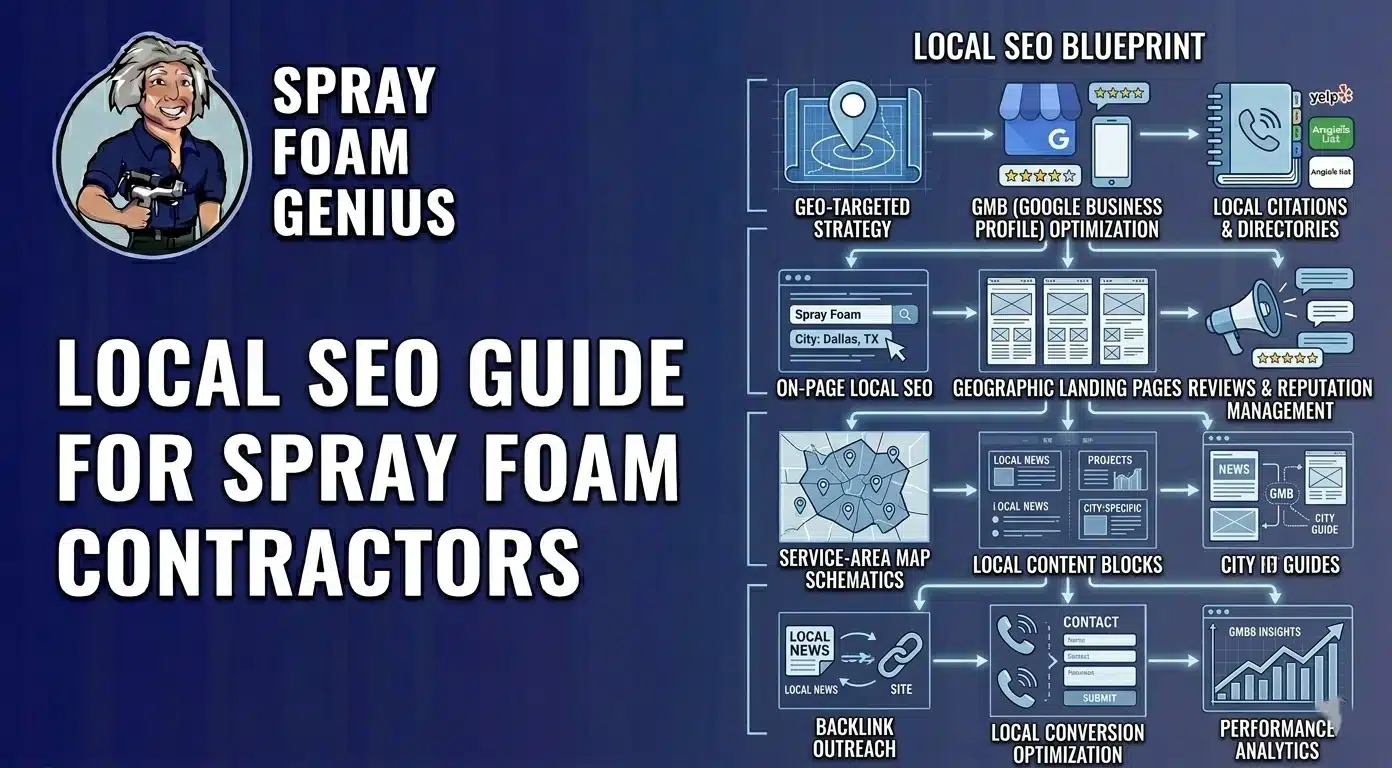
This guide covers the full picture: how Google decides, what to do on your profile, your website, your listings and your reputation, and how to measure whether it is working. Where a topic has its own deeper guide, we link to it.
How Google Decides Who Shows Up Locally
Google says local results are mainly based on relevance, distance and prominence. Relevance is how well your profile matches the search. Distance is how far you are from the searcher. Prominence is how well known you are, which can include links to your site and the number and quality of your reviews. Google also says you cannot pay for a better local ranking. The details are in Google's tips to improve your local ranking.
You cannot move closer to every customer, so most of your effort goes into relevance and prominence: an accurate, complete profile, a believable service area, helpful pages on your website, consistent listings, genuine reviews and real links from local sources.
Related reading: How to Target Multiple Service Areas with Local SEO
Step 1: Set Up and Complete Your Google Business Profile

Your Google Business Profile (GBP) powers your listing in the map results, on Google Maps and in the panel that appears when someone searches for your company by name. It is the most important local SEO asset you control.
- Claim and verify the profile, and clean up duplicates. Verification can be by postcard, phone, email or video, depending on the business.
- Use your real business name. Google does not allow keywords or city names added to the name.
- Pick Insulation Contractor, or whichever primary category best matches your core business, and add secondary categories only when they genuinely fit.
- Use an eligible address. If you travel to customers, you can hide the address and list a realistic service area instead.
- List your services in customers' words, such as open-cell spray foam, closed-cell spray foam, attic insulation and crawl space encapsulation, and write an honest description.
- Keep hours, phone and website current, and add real photos of your crew, rig and finished jobs.
We walk through each setting in our Google Business Profile guide for insulation contractors, and explain how the map listings work in how to rank your spray foam business on Google Maps. Our Google Business Profile service covers setup and ongoing management.
Step 2: Build a Steady Flow of Reviews
Google says more reviews and positive ratings can help your local ranking, and homeowners use them to choose who to call. Most happy customers will not leave a review unless they are asked, given an easy link and reminded once.
- Ask at the right moment, right after the job when the customer is happy.
- Send a direct link to your Google review page by text or email.
- Follow up once, politely, if they do not respond.
- Reply to every review. Thank people and mention the job. Answer negative reviews calmly and offer to resolve things offline.
Do not offer discounts, gifts or prizes for reviews, and do not ask only the customers you expect to be happy. Google's review policy treats incentives and selective solicitation as manipulation. You may ask open, specific questions, such as "What difference have you noticed in the comfort of your home?", but do not script what people write. For more, see our guide on Google reviews for spray foam businesses.
Step 3: Build a Website That Supports Local Search

Your profile gets you seen on the map. Your website is where customers decide whether to trust you, and it gives Google more evidence about what you do and where. A single generic "Services" page rarely does either job well.
Research the Searches Your Customers Use
Start with how customers actually search. Type your main services into Google and note the autocomplete suggestions and the "People also ask" questions. Google Search Console shows the searches that already bring people to your site. The searches usually fall into four groups:
- Service plus place: spray foam insulation contractor in [city], attic spray foam [city]
- Problem-aware: how to stop drafts in an old house, why are energy bills so high
- Comparisons: spray foam versus fiberglass, open-cell versus closed-cell spray foam
- Specific jobs and places: crawl space insulation in [city], garage or pole barn insulation in [suburb]
Create a Page for Each Core Service and Each Important Area
Make one page per core service, such as residential spray foam, attic insulation, crawl space encapsulation and commercial insulation. If you serve several cities, add a page for each important one, written to help someone who lives there. Include the services you offer, the local problems you see, real photos of jobs nearby, reviews from customers in that area (with permission), a map or service area details, and a clear call to action with your phone number.
Do not copy one page and change the city name. Pages that repeat the same text with only the place swapped add little value and read as spam. Aim to be useful to a person in that town, such as noting its climate, common building styles or moisture problems that affect the advice you give.
Get the Page Basics Right
- A clear title and main heading that say what the page is about and where
- A short, readable description that makes someone want to click
- Fast loading and easy use on a phone, with a click-to-call button
- Internal links between your service pages, location pages and relevant blog posts
These line up with the fundamentals in Google's SEO Starter Guide. LocalBusiness structured data is optional. It can help describe your business to search engines, but it does not guarantee a ranking.
What About AI Search?
Google says the best practices for SEO remain relevant for its AI features, such as AI Overviews and AI Mode, and that no special files, markup or optimizations are required to appear in them. That means the same basics apply: clear, useful pages that answer customers' questions, accurate business information and a good reputation. Nobody can promise a mention in an AI answer.
Step 4: Keep Your Listings and Citations Consistent
A citation is any mention of your business name, address and phone number (NAP) on another site. Your details should be the same everywhere: your profile, website, social pages and directories. A mismatch such as "ABC Spray Foam LLC" on one site and "ABC Spray Foam Co." on another can create duplicate or confused listings.
Audit what exists, fix inaccuracies and remove duplicates. Then claim the listings that matter for a contractor: the major general directories, Bing Places and Apple Maps, the Better Business Bureau, any lead marketplaces you actually use, your local chamber of commerce and trade association directories such as the Spray Polyurethane Foam Alliance. Accuracy matters more than the number of listings. Check them at least once a year, and again if you move or change your phone number.
Step 5: Earn Local Links and Mentions

Google lists links to your site among the things that can contribute to prominence. For a local contractor, that usually means real relationships, not tricks:
- Sponsoring a local team, charity event or community group that lists its sponsors
- Being listed on your local chamber, home builders association or trade association site
- Manufacturer or supplier pages that list certified or recommended installers, if you qualify
- Partnerships with builders, HVAC companies, home inspectors and real estate agents who recommend you
- Local news or community blogs that run a helpful quote or project story from you
Do not buy links or trade them in bulk. A few relevant, real links beat a pile of poor ones.
Step 6: Publish Helpful Local Content
A blog or resource section lets you answer questions homeowners ask before they ever call, and shows your experience. Good topics come straight from your own sales conversations:
- Open-cell versus closed-cell spray foam, and which fits which part of a house
- What affects the cost of spray foam insulation, explained in plain terms
- Signs a home needs new insulation, and what to expect on installation day
- Spray foam for new construction: what builders need to know
- Moisture, crawl spaces and attic problems common in your area
Write for the customer, not for search engines. Link each article to the relevant service page, and link back. Stay accurate on safety, product and cost questions, and use real project photos and examples from your own jobs.
Step 7: Track What Matters
You cannot improve what you do not measure. Review these monthly:
- Calls, direction requests, messages and website clicks from your Google profile's performance data
- Rankings for your main services across a grid of locations around your base, using a local rank tracking tool
- Organic visits and leads by service or location page, using Google Search Console and Google Analytics
- New reviews per month, your rating and how quickly you reply
- Quote requests and booked jobs that started from search, not only calls
Look at trends over months, not single days. Local search can move slowly, and booked jobs matter more than positions on a map.
Common Local SEO Mistakes
- Inconsistent business name, address or phone across the web
- Keywords or city names added to the Google profile name
- A virtual office, mailbox or fake address on the profile
- Duplicate listings from old owners, employees or former marketers
- Thin location pages copied with only the city name changed
- No system for asking for reviews, or offering perks in exchange for them
- A slow site that is hard to use on a phone
- Never checking rankings, calls or booked jobs
Local SEO and Paid Ads
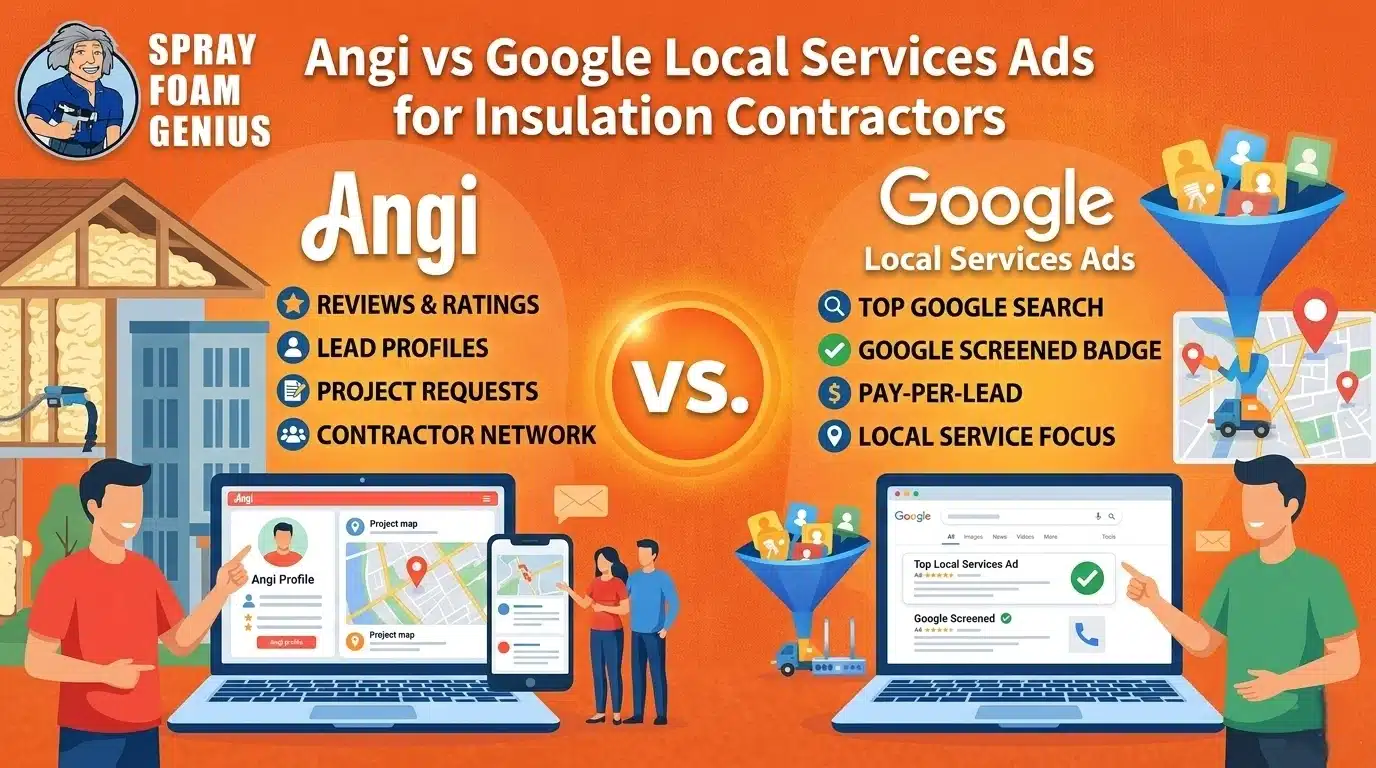
Local SEO takes time to build, while Google Ads and Local Services Ads can start producing calls sooner but stop when you stop paying. Many contractors use both: ads for near-term calls and SEO for steady visibility that builds over time. Which mix suits you depends on your budget, your market and how quickly you need leads.
Get a Free Marketing Audit
Not sure where you stand in your market? We offer a free marketing audit for spray foam and insulation contractors that looks at your profile, reviews, website and local visibility. Call 877-840-3626 or email info@sprayfoamgeniusmarketing.com.
Frequently Asked Questions
How long does local SEO take to work?
It depends on your competition, how complete your profile and website already are and how consistently you keep up the work. Nobody can promise a timeline or a position. Expect gradual change rather than overnight results, and measure calls and booked jobs along the way.
Do you need a website to appear in the map results?
You can have a Google Business Profile without a website, but a helpful website gives customers and Google more information about your services and service areas, and gives people somewhere to learn more and contact you.
How many reviews do you need?
There is no fixed number. Compare yourself with the local competitors your customers are also considering, and aim to match or beat them on rating, number and recency, with every review genuine.
What is the biggest local SEO mistake contractors make?
Inconsistent or inaccurate business information is one of the most common problems, along with an incomplete profile and no system for reviews. Fix your name, address, phone, categories and duplicates before investing in anything advanced.
Can you do local SEO yourself, or do you need an expert?
You can handle the basics yourself, including claiming the profile, asking for reviews, posting photos and fixing listings. Many contractors bring in help for the ongoing work such as location pages, content, link building and tracking, because it takes consistent time.
Should you run Google Ads alongside local SEO?
Many contractors do, because ads can bring calls sooner while organic visibility builds. The right mix depends on your budget and market, and you should track which source produces booked jobs.
Can you rank in a city where you have no office?
It is harder, because distance is a core factor and Google only permits a separate profile where you have a real, staffed location. You can list the areas you serve on your existing profile and build useful pages and local reviews, but results are not guaranteed.
Further Reading
Official guidance from Google on the topics in this article: