
Drive through any mid-sized metro area and you’ll spot three or four spray foam trucks within ten miles, all chasing the same jobs. Homeowners searching “spray foam near me” see a wall of nearly identical listings. Standing out isn’t about being the loudest. It’s about giving people a specific reason to pick you over the crew parked two doors down.
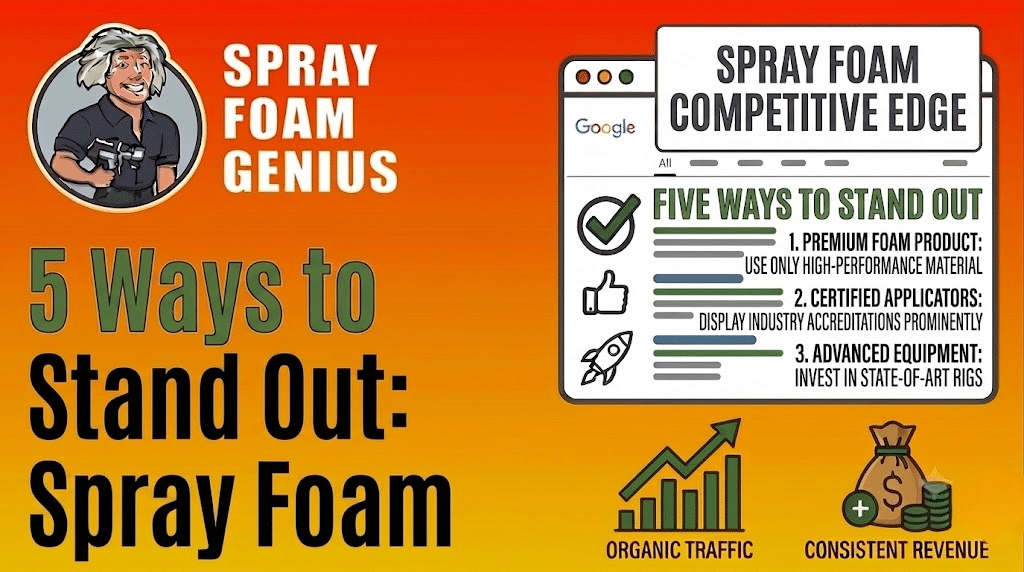
Here are five practical spray foam contractor marketing moves you can act on this quarter.
Why Differentiation Matters More Than Ever
The barrier to entry for spray foam installation has dropped. Financing is easier, and training now moves crews from “new” to “operating” fast. That’s good for the trade, but price alone is a losing strategy. If your only pitch is “we’re cheaper,” someone will always undercut you.
Contractors who win the better jobs share one trait: a clear answer to “why you, specifically.” That shows up in the website, the reviews, and how the phone gets answered.
1. Niche Down Instead of Trying to Serve Everyone
Most spray foam websites read the same way: residential, commercial, agricultural, and roofing listed as equally important. That dilutes your message and makes it harder for Google, and homeowners, to know what you’re known for.
I typically recommend picking one or two service lines to lead with, based on where the best margins already are. If crawlspace encapsulation and attic retrofits are your bread and butter, those deserve dedicated pages, not a paragraph under “services.” Pull your last 20 jobs and sort by margin, not revenue. That pattern is usually your niche.
A generic homepage rarely ranks for “crawlspace spray foam contractor.” A dedicated page can. If your site lacks that structure, website development built for spray foam and insulation contractors is usually the fastest fix.
2. Build Location Pages That Actually Say Something
Listing five or six cities in a footer and calling it local SEO satisfies almost nothing. Google, and the homeowner reading the page, wants proof you know the area: the housing stock, the climate quirks, the permitting process.
Take a city with a lot of 1960s-70s ranch homes with vented crawlspaces. A page that mentions the moisture and mold issues common to that housing stock, and how closed-cell foam addresses them, reads as expertise. A page that just swaps in the city name reads as a template.
A strong location page names the climate or code factor for that area, the housing types affecting the job, and a clear next step like a phone number or quote form. This is covered in more depth in our marketing guide for spray foam contractors.
3. Turn Your Google Business Profile Into a Sales Asset
Your Google Business Profile is often the first thing a homeowner sees, before they click through to your site. Most contractors treat it as set-it-and-forget-it: a logo, an address, a few old photos.
A profile that’s actively managed, with recent photos and prompt review responses, tells Google the business is active, which affects map pack rankings, and tells the homeowner scrolling through options that you’re real and responsive.
I usually check three things first: how recently photos were added, whether every review has a response, and whether the listed categories match what the contractor wants to be found for. Getting those right often moves the needle fastest. If your profile hasn’t been touched since setup, Google Business Profile management for spray foam companies is a reasonable place to start.
4. Make Reviews Part of the Sales Process
Two contractors can have nearly identical websites and pricing. What separates them is almost always social proof. A contractor with 140 recent, detailed reviews looks safer than one with 12 reviews from three years ago, even with equally good work.
The mistake I see most often isn’t a lack of good work, it’s a lack of a system for asking. A follow-up text sent within 48 hours, while the experience is fresh, closes that gap. Other mistakes: ignoring negative reviews instead of responding, and never mentioning reviews during sales calls even though prospects almost always check them first.
Reputation management services for contractors build a repeatable process around this.
5. Show Proof of Work, Not Just Claims of Quality
“Quality workmanship” and “trusted professionals” appear on nearly every spray foam site in the country. Those phrases have stopped meaning anything. What still works is proof: before-and-after attic photos, a short video from a real job site, a specific number like R-value achieved.
A weekly social post showing a completed job, even a simple photo with a two-line caption, does more for credibility over six months than a static “About Us” page. Social media marketing for spray foam and insulation contractors can handle that cadence so the crew stays focused on installs.
Putting It Together
These five strategies work best together. A niche-focused site still needs a Google Business Profile that reinforces it, reviews that back it up, and proof of work to close the loop. Contractors who pull ahead usually aren’t doing one thing brilliantly, they’re doing all five consistently.
Not sure where your gaps are? Our SEO services for spray foam contractors start with an audit of site structure, local pages, profile health, and review velocity before recommending any new spending.
A Practical Next Step
Standing out doesn’t require a total rebrand. Pick one or two areas above where you’re weakest, starting with whichever is costing you the most leads right now.
We offer a free marketing audit for spray foam and insulation contractors. Request one through our contact page, call the USA at 877-840-FOAM or Canada at 844-741-FOAM, or email info@sprayfoamgeniusmarketing.com. For a broader benchmark, Google’s own guidance on local business ranking factors is worth checking too.
Frequently Asked Questions
What’s the fastest way for a spray foam contractor to stand out from local competitors?
Start with your Google Business Profile and one or two niche service pages. These usually move fastest because they directly affect what homeowners see first in local search, often within a few weeks.
Does spray foam contractor marketing really need niche-specific pages, or is one general services page enough?
A single general page rarely ranks for specific searches like “crawlspace encapsulation contractor.” Dedicated pages for each core service give search engines and homeowners a clearer answer.
How many Google reviews does a spray foam contractor need to look credible?
There’s no fixed number. Recency and detail matter more than raw count. A steady stream of new, detailed reviews signals an active business better than a large but stagnant total from years ago.
Should spray foam contractors run paid ads if they’re already doing SEO?
They can work together, but ads without a strong site and profile foundation often waste spend on clicks that don’t convert. Most contractors get better results fixing organic visibility first, then layering in ads.
How often should a spray foam company update its Google Business Profile?
Weekly activity, even one new project photo or a short update post, keeps the profile signaling as active to Google and to homeowners browsing local listings.