

If your insulation company is doing good work but the phone is not ringing consistently, the problem almost always lives somewhere in your online presence. Most insulation contractors who struggle with slow seasons and unpredictable lead flow are not failing because of their service quality or their pricing. They are failing because potential customers cannot find them, do not trust what they see when they do, or land on a website that does nothing to convert them into a call.
This article breaks down the six most common reasons insulation companies fail to generate leads online, gives you a self-audit checklist to score your own situation, and shows you the specific fixes that change the result.
| TL;DR What This Article Covers • The 6 reasons most insulation companies do not generate leads online: Google Business Profile problems, poor Google rankings, low or missing reviews, a slow or broken website, no content targeting buyer searches, and wrong keywords • 97% of consumers look up local businesses online before contacting them and 88% read Google reviews before making a decision • A complete, verified Google Business Profile gets 7x more clicks than an incomplete one and businesses in the Google 3-Pack get 126% more traffic than those ranked 4 through 10 • Page load time directly kills leads: conversion rates drop threefold between a 1-second and a 5-second load time • Feast-and-famine cycles are almost always a symptom of one lead source, not a lack of jobs in the market • The self-audit checklist in this article covers 24 checkpoints across 6 categories with a scoring guide to tell you exactly where to focus • Most problems on this list can be fixed in 30 to 90 days with the right approach and do not require rebuilding everything from scratch • Contractors who fix these issues consistently report moving from inconsistent referral-dependent revenue to steady inbound lead flow within 3 to 6 months Read time: 5 to 7 minutes. |
The Real Reason Slow Seasons Keep Happening
Most insulation contractors who experience slow seasons blame the time of year. And seasonality is real. But the contractors in the same markets who stay busy year-round are not doing different work. They have built a consistent online presence that generates inbound leads even when demand softens.
The feast-and-famine cycle is almost always a symptom of dependence on one lead source: referrals. When referrals are flowing, business is good. When they slow down, there is nothing else filling the pipeline. The fix is not more networking. It is building the kind of online visibility that generates calls from homeowners and builders who have never heard of you but are actively searching for exactly what you do.
The six problems below are why most insulation contractors are invisible online or visible but not converting. Work through each one and use the self-audit checklist at the end to score your situation.
Problem 1: Your Google Business Profile Is Incomplete or Unoptimized
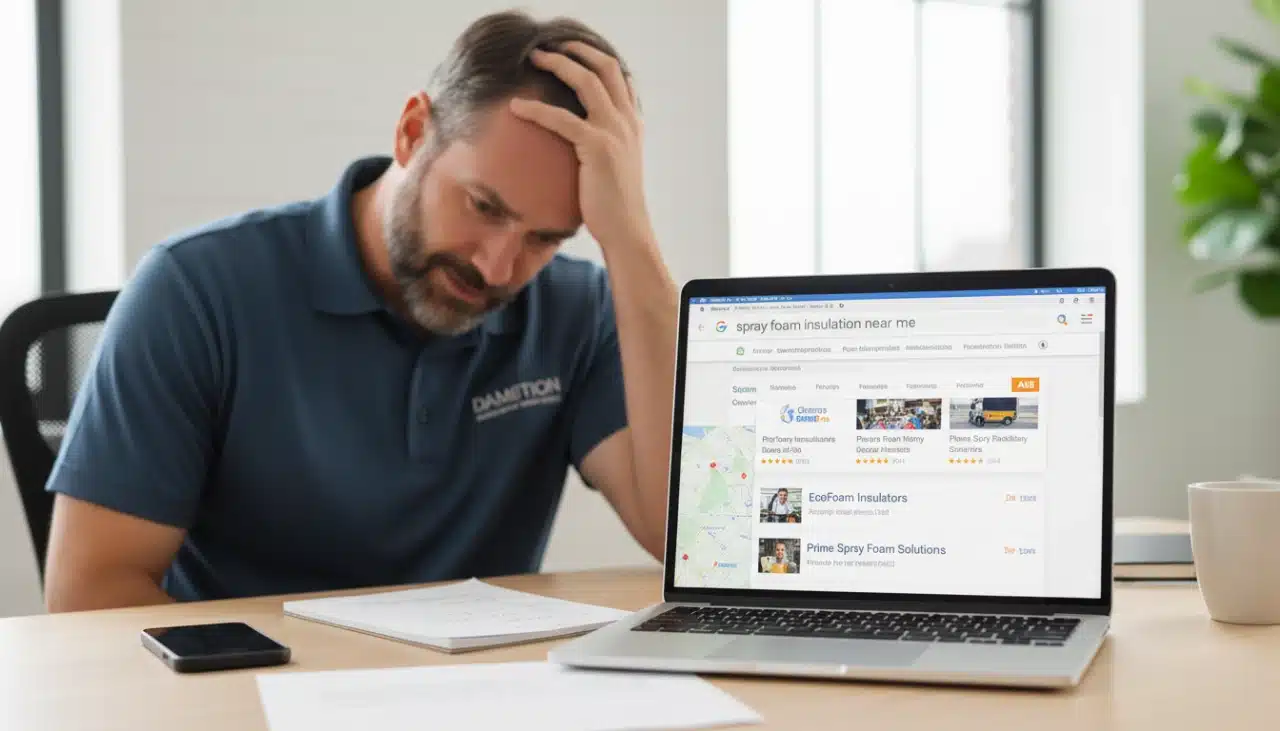
When a homeowner searches ‘spray foam insulation contractor near me’ or ‘blown-in insulation [city]’, the first thing they see is the Google Maps 3-Pack: three local businesses with star ratings, photos, and a click-to-call button. If your business is not in that 3-Pack, or if it shows up but looks incomplete, you are losing those calls to whoever is there.
The data on this is stark. A complete, verified Google Business Profile gets 7 times more clicks than an incomplete listing. Businesses in the Google 3-Pack receive 126% more traffic and 93% more actions, including calls and website visits, compared to those ranked 4 through 10. Businesses with complete profiles are 2.7 times more likely to be seen as trustworthy.
The most common Google Business Profile failures insulation contractors make:
| GBP Problem | Why It Matters | How to Fix It |
|---|---|---|
| Profile not claimed or verified | You have no control; Google may show wrong info | Claim at business.google.com and complete verification |
| Missing or wrong service categories | Google does not know what searches to show you for | Add primary category + all relevant insulation service categories |
| No photos or photos more than 1 year old | Profiles with 15+ photos see stronger engagement across all actions | Add 15 to 20 job photos: attic work, spray foam, crawl spaces, equipment |
| No Google Posts in the last 30 days | Signals to Google the profile is inactive | Post a project photo or a tip weekly to maintain freshness signals |
| Business description not written for search | Misses keyword signals that help Google match you to searches | Write a 750-character description that includes your services and service cities |
| No Q&A section populated | Missed opportunity to answer pre-sales questions and add keywords | Add 5 to 10 common questions and answer them yourself |
| Missing service area setup | Google does not know which cities you serve | Add every city and zip code you actively service |
| The 3-Pack Changes Everything 42% of people who conduct a local search click on one of the three results in the Google Maps Pack. The businesses outside that top 3 split the remaining clicks among dozens of results. Getting into the 3-Pack is not optional for insulation contractors who want consistent inbound lead flow. It is the single most important local SEO goal. |

Problem 2: Your Website Is Not Showing Up on Google
A common situation: a contractor has a website, pays for hosting, and considers their online presence covered. Then they search ‘spray foam insulation [their city]’ on Google and their site does not appear anywhere on the first page. Or the second page. Or third.
Not ranking on Google is not a minor inconvenience.97% of consumers look up local businesses online before contacting them. When your site does not rank, you do not exist in the buyer’s mind. The customers who would have called you are calling whoever does rank.
The most common reasons an insulation contractor’s website does not rank:
| Ranking Problem | What It Looks Like | Fix |
|---|---|---|
| No dedicated service pages | One page mentions all services briefly | Create individual pages for spray foam, blown-in, crawl space, batt, commercial insulation |
| No location pages | Website says ‘serving the tri-state area’ | Create a dedicated page for each city you serve with city-specific content |
| No backlinks or citations | Website has authority score near zero | Build citations in contractor directories, local business directories, BBB |
| Thin or duplicate content | Pages have fewer than 300 words or copy each other | Write 600 to 1,000+ words of original content per service and location page |
| Technical errors blocking Google | Pages say ‘noindex’ or have crawl errors | Run a free Google Search Console audit and fix all flagged issues |
| New domain with no history | Website launched within the last 6 to 12 months | Consistent monthly SEO investment; expect 3 to 6 months to build authority |
| What ‘Service Area Pages’ Actually Means If you serve 8 cities, you need 8 separate pages, one for each city, each with original content describing your services in that location. A single page that says ‘we serve Atlanta, Marietta, Roswell, and Alpharetta’ does not rank for any of them. Google ranks pages, not sentences. Each city you want to appear in needs its own dedicated page. |
Problem 3: You Have No Reviews or Too Few to Be Trusted
Reviews are no longer just a trust signal. They are a ranking factor. Google’s local algorithm weighs the quantity, recency, and quality of your reviews when deciding which insulation contractors to show in the 3-Pack. A contractor with 8 reviews from 2021 will consistently rank below a competitor with 45 recent reviews, even if the older contractor has been in business longer.
The consumer data is equally clear:88% of consumers read Google reviews before making a hiring decision, and 73% only trust reviews written in the last month. Insulation is a high-trust purchase. Homeowners are spending several thousand dollars and letting strangers into their home. A thin or stale review profile creates doubt that costs you jobs even when you show up in search.
| Review Situation | What Customers Think | Business Impact |
|---|---|---|
| 0 to 5 reviews | Not enough to trust; might be new or unreliable | High abandonment rate even if you rank |
| 6 to 15 reviews, all 2+ years old | Possibly still in business but not actively working | Low click-through rate from Google |
| 16 to 40 reviews, mostly recent | Looks active but not yet dominant | Moderate trust; will lose to competitors with more |
| 40+ reviews, 4.7 stars or higher, recent activity | Established, trusted, highly rated | Strong conversion rate; Google favors in rankings |
The fix is a systematic review generation process, not hoping satisfied customers remember to leave one. Ask every customer at job completion. Text them a direct link to your Google review page. A contractor in Boise who added 22 new 5-star reviews in a single month saw a 60% increase in local calls. The volume of asks determines the volume of reviews.
| The Review Decay Problem Reviews have a shelf life. A review from 2021 carries almost no weight with a homeowner searching in 2025. Google also weighs recency when ranking locally. A contractor who actively generates 3 to 5 new reviews per month will consistently outrank a competitor with the same number of total reviews but none in the last 6 months. Review generation is not a one-time project. It is an ongoing operation. |
Problem 4: Your Website Is Slow, Broken, or Hard to Use on Mobile
Getting someone to your website is only half the job. If they land on a site that loads slowly, looks outdated, or does not work properly on a phone, they leave and call your competitor. This is not a small problem. Mobile devices now drive the majority of local service searches, and most contractor websites perform significantly worse on mobile than on desktop.
The conversion rate data is direct: conversion rates drop threefold between a 1-second and a 5-second load time. A one-second delay in mobile load time reduces conversions by up to 20%. When a page takes 5 seconds or longer to load, the probability of the visitor bouncing increases by 90% compared to a 1-second load.
For insulation contractors, a ‘conversion’ is a phone call or a form submission. Every visitor who bounces because of a slow site is a lead that evaporated before you had a chance to answer.
| Website Problem | How to Test It | What a Fix Looks Like |
|---|---|---|
| Loads in more than 3 seconds | Run your URL through Google PageSpeed Insights (free) | Compress images, remove unused plugins, upgrade hosting if needed |
| Fails Core Web Vitals | Google Search Console > Core Web Vitals report | Address Largest Contentful Paint and Interaction to Next Paint issues |
| Not mobile-friendly | Google Mobile-Friendly Test (search.google.com/test/mobile-friendly) | Responsive design that adjusts to screen size; tap targets must be large enough |
| No clear call to action above the fold | View your homepage on your phone; what is the first thing you see? | Phone number and a ‘Get a Free Quote’ button visible before any scrolling |
| No trust signals on the page | Do you show licenses, insurance, reviews, and photos prominently? | Add a Google review badge, license number, and 3 to 5 project photos to the homepage |
| Contact form does not work | Submit a test lead and check if it arrives | Test all forms monthly; use call tracking to confirm calls are routing correctly |
| Test Your Website Right Now Open your website on your phone. Time how long it takes to load. Then ask: is a phone number visible without scrolling? Is there a clear button to request a quote? Does the site look professional? If any answer is no, you are losing leads today. Contractors achieving good Core Web Vitals scores see 8 to 15% visibility boosts in competitive local searches. Your website is not just a brochure. It is a conversion tool. |
Problem 5: You Have No Content Targeting How Buyers Actually Search
Insulation buyers do not start their search with your company name. They search for solutions to a problem they have right now. They search for ‘why is my attic so hot in summer’, ‘spray foam vs blown-in insulation’, ‘crawl space encapsulation cost’, and ‘how long does spray foam insulation last’. If your website has no content targeting these searches, you are invisible to buyers in the research phase.
This is the stage where buyers form preferences and develop trust before they ever call anyone. The insulation companies that show up with helpful answers during the research phase win the call when the buyer is ready to move forward. The companies that only have a ‘Contact Us’ page and a service list are not part of that conversation.
Content that attracts insulation buyers at different stages of the decision:
| Buyer Stage | What They Search | Content That Captures Them |
|---|---|---|
| Awareness (problem stage) | ‘Why is my energy bill so high?’ / ‘Signs of poor insulation’ | Educational blog posts, energy efficiency guides, symptom articles |
| Research (comparison stage) | ‘Spray foam vs blown-in insulation’ / ‘Open cell vs closed cell’ | Comparison pages, how-it-works explainers, R-value guides |
| Decision (cost stage) | ‘Spray foam insulation cost [city]’ / ‘How much does crawl space encapsulation cost’ | Transparent cost guide pages, FAQ pages, service-specific pricing content |
| Intent (ready to hire) | ‘Spray foam contractor [city]’ / ‘Insulation company near me’ | Service area pages, Google Business Profile, homepage SEO |
Most insulation contractor websites only have content targeting the intent stage. That means they are competing for the same ‘insulation contractor near me’ searches as every other local company, with nothing to differentiate them during the research phase when brand preference forms.

Problem 6: Your Website Is Targeting the Wrong Keywords
There is a significant difference between keywords that get traffic and keywords that get calls. Many insulation contractor websites are optimized for broad terms that attract the wrong audience, or for terms so generic that they cannot realistically rank for them, or for industry jargon that homeowners never actually type.
Common keyword mistakes insulation contractors make:
| Wrong Keyword Approach | The Problem | Better Alternative |
|---|---|---|
| Targeting ‘insulation’ (single word) | Impossible to rank; hundreds of millions of results; no buying intent | ‘Spray foam insulation contractor [city]’, ‘attic insulation [city]’ |
| Targeting only the biggest city in the region | Extremely competitive; may be outside your actual service radius | Target every city and town you realistically serve with individual pages |
| Using trade terminology homeowners do not search | ‘Open cell ocSPF installation’ vs how people actually search | ‘Spray foam insulation for homes’, ‘foam insulation for attic’ |
| Ignoring question-based searches | Missing the research phase entirely | ‘How much does spray foam insulation cost’, ‘is spray foam worth it’ |
| Not targeting service-specific keywords | Generic ‘insulation company’ pages compete with everyone | Separate pages for spray foam, blown-in, crawl space, batt, commercial |
| Forgetting seasonal and problem-based searches | Leaving energy-trigger traffic on the table | ‘Hot upstairs rooms’, ‘high energy bills’, ‘cold floors over crawl space’ |
| How to Find the Right Keywords for Free Type your main service into Google and look at the ‘People also ask’ and ‘Related searches’ sections at the bottom of the page. These are real searches from your potential customers. Every question in ‘People also ask’ is a potential content page. Every ‘Related search’ is a keyword variation worth targeting. You do not need paid tools to start building a better keyword strategy. |
The Insulation Company Online Presence Self-Audit
Use this checklist to score your current online presence. Be honest. The goal is to identify exactly where the problems are so you can fix them in the right order.
| Area | What to Check | Priority | Quick Fix |
|---|---|---|---|
| Google Business Profile | Profile is claimed and verified | Critical | Claim at business.google.com immediately |
| Google Business Profile | All service categories are filled in | Critical | Add primary + secondary insulation service categories |
| Google Business Profile | 15+ photos posted, at least 5 from the last 6 months | High | Add job site photos weekly going forward |
| Google Business Profile | Business description is written and includes service keywords | High | Write a 750-character description with services and cities |
| Google Business Profile | Service area cities are all listed | High | Add every city and zip code you serve |
| Google Rankings | Company appears in top 3 for ‘[service] [your city]’ | Critical | Ongoing local SEO investment; GBP optimization; citations |
| Google Rankings | Website has a dedicated page for each core service | Critical | Create individual pages for spray foam, blown-in, crawl space, batt, commercial |
| Google Rankings | Website has a dedicated page for each primary city served | High | Create city-specific landing pages with original local content |
| Google Rankings | Google Search Console is set up and shows no critical errors | High | Set up Search Console; fix crawl errors and indexing issues |
| Reviews | 30 or more Google reviews total | Critical | Start a systematic ask process at job completion |
| Reviews | At least 3 new reviews in the last 30 days | High | Text every customer a direct review link after job sign-off |
| Reviews | Average star rating is 4.5 or higher | High | Address service issues; respond professionally to all negative reviews |
| Reviews | Business responds to reviews (positive and negative) | Medium | Respond to every review within 48 hours |
| Website | Homepage loads in under 3 seconds on mobile | Critical | Run PageSpeed Insights; compress images; upgrade hosting |
| Website | Phone number is visible above the fold on mobile | Critical | Move phone number to top of page; make it click-to-call |
| Website | Clear ‘Get a Free Quote’ button is above the fold | High | Add a prominent CTA button on homepage and all service pages |
| Website | Site passes Google Mobile-Friendly Test | High | Use a responsive theme; test at search.google.com/test/mobile-friendly |
| Website | Contact form works and leads arrive correctly | High | Submit a test form monthly; set up email notifications and backup |
| Content | At least one blog post or guide published in the last 60 days | High | Publish one piece of buyer-focused content per month minimum |
| Content | Website has a cost or pricing guide for at least one service | High | Write a transparent cost guide for spray foam or your primary service |
| Content | Website answers common buyer questions (FAQ page or blog) | Medium | Add FAQ sections to service pages; pull from ‘People also ask’ on Google |
| Keywords | Each service page targets a specific city plus service keyword | Critical | Optimize page titles, H1s, and content for ‘[service] [city]’ format |
| Keywords | Website targets question-based searches in content | Medium | Add cost guides, comparison pages, and how-it-works content |
| Keywords | Keywords match how homeowners search, not trade jargon | Medium | Review page titles; use plain language terms homeowners type into Google |
How to Score Your Audit
Count how many checkpoints you marked as failing or incomplete:
| Failing Checkpoints | What It Means | Priority Action |
|---|---|---|
| 0 to 3 | Strong online presence; fine-tune and maintain | Focus on review generation and content to stay ahead |
| 4 to 8 | Visible gaps that are costing you leads right now | Fix Critical items first; 60 to 90 days of focused work will produce results |
| 9 to 15 | Significant problems across multiple areas | Need a structured plan; DIY is possible but an agency will move faster |
| 16 or more | Online presence is not functioning as a lead source | Treat this as a business priority; every month without fixing it costs jobs |
What to Fix First: The Priority Order
If your audit reveals problems across multiple areas, the order in which you fix them matters. Some problems block others from working. For example, ranking in Google Maps with no reviews means the traffic you earn will not convert. Getting a fast website with no rankings means no one visits it. The right sequence:
| Step 1: Google Business Profile (Week 1 to 2) Claim, verify, and fully optimize your GBP. This is the fastest path to appearing in local search and it is free. Add photos, complete all fields, set up your service areas, and write a keyword-rich description. Step 2: Review Generation (Ongoing from Day 1) Start asking every customer for a review immediately. Do not wait until your website is perfect. Reviews improve your GBP ranking and your conversion rate simultaneously. Step 3: Website Technical Fixes (Week 2 to 4) Fix mobile speed, ensure the phone number is visible, and confirm the contact form works. These are conversion fixes that make everything else more effective. Step 4: Service and Location Pages (Month 1 to 2) Create or improve dedicated pages for each service and each city. This is the foundation of organic rankings. Without it, nothing else produces sustained results. Step 5: Content Strategy (Month 2 and Ongoing) Begin publishing buyer-focused content monthly. Cost guides, comparison articles, and FAQ content capture research-phase buyers and build long-term authority. |
Realistic Timeline for Results
One of the most common mistakes contractors make is expecting immediate results from SEO work and giving up before the compounding phase begins. Here is an honest timeline of what to expect when all six problems are addressed properly:
| Timeframe | What Typically Happens | What You Will See |
|---|---|---|
| Weeks 1 to 4 | GBP optimized, reviews requested, technical fixes made | GBP impressions start increasing; faster website; review count growing |
| Months 2 to 3 | Service and location pages published, citations built, content started | First organic keyword rankings appear; more GBP calls; early leads from Maps |
| Months 4 to 6 | Content builds topical authority; backlinks accumulate; reviews compound | Consistent Maps calls; website rankings moving up; inbound leads from organic search |
| Months 6 to 12 | Full system is compounding; each new content piece adds to authority | Steady inbound lead flow; reduced dependence on referrals; predictable pipeline |
| Month 12 and beyond | SEO becomes your lowest-cost lead source | Cost per lead drops month over month as traffic and authority grow |
| The Contractors Who Stay Stuck The contractors who never escape the feast-and-famine cycle are the ones who start the process, do not see a flood of calls in the first 30 days, and conclude that online marketing does not work for insulation companies. The problem is almost never the strategy. It is the timeline expectation. The companies doing consistent $1M to $3M+ in revenue from inbound leads built that pipeline over 6 to 18 months of consistent investment. There is no shortcut to a compounding asset. |
Frequently Asked Questions
Can I fix all of this myself without hiring an agency?
Some of it, yes. Claiming and optimizing your Google Business Profile, asking for reviews, testing your website speed, and submitting your site to Google Search Console are all things you can do without any outside help. Writing service and location pages requires more time but not advanced technical skill. Where most contractors run out of capacity is consistent content production, link building, and tracking what is actually working. If you have the time, you can do this yourself. Most owners of growing insulation companies find that their time is more valuable on the job than on marketing tasks.
How quickly will fixing these problems produce more leads?
Google Business Profile improvements and review generation can produce results in 2 to 4 weeks. Those are the fastest-moving levers. Website fixes improve conversion rates immediately for existing traffic. Service and location pages typically produce ranking movement within 60 to 90 days. Full organic lead flow from SEO usually develops between months 4 and 9. The order you fix things in matters because some improvements are immediate while others compound over time.
My competitor has a terrible website but ranks higher than me. Why?
Domain authority and review count are usually the reason. Google cares less about how attractive a website looks and more about how trustworthy and relevant it appears to be. A site that has been earning backlinks and reviews for 5 years will rank above a beautifully designed site that launched last year. The good news is that this gap closes with consistent investment. Review generation, citation building, and content production all build the kind of authority that determines rankings over time.
Is paying for Google Ads a faster solution?
Google Ads can generate leads within days, which makes them useful for filling a slow pipeline while SEO builds. The tradeoff is that paid leads stop the moment you stop spending, and costs in the insulation market can be significant per click. The combination of running ads while building organic presence is more effective than either alone. Contractors who run ads only never build the compounding asset that lowers their cost per lead over time. Contractors who only do SEO wait 4 to 6 months for consistent leads.
How do I know if my current SEO agency is actually doing something?
Ask them to show you three things: your Google Business Profile call volume trend over the past 90 days, your keyword rankings for your primary service plus city terms, and the new content published on your site in the last 60 days. If they cannot show you all three clearly, they are not doing real work. Rankings, GBP calls, and content output are the three leading indicators of whether an SEO program is functioning. Vanity metrics like ‘impressions’ and ‘domain authority scores’ without call volume and ranking data are not enough.
The Bottom Line
Most insulation companies are not failing to get leads because the market is slow or because homeowners are not looking for insulation services. They are failing because they are invisible when those homeowners search, or because something in their online presence is losing the lead before it ever becomes a call.
The six problems in this article: an incomplete Google Business Profile, poor Google rankings, too few or outdated reviews, a slow or broken website, no content targeting buyer searches, and wrong keywords, are fixable. None of them require starting over. Most can be addressed within 30 to 90 days with the right focus.
The contractors who build consistent inbound lead flow from their online presence are the ones who treat it as an asset worth investing in systematically rather than a box to check. Use the audit checklist above to find your highest-priority gaps, fix them in order, and give the compounding effects time to develop.
| Ready to Start Getting Leads Online? Book a free strategy session with Spray Foam Genius Marketing. We work exclusively with insulation contractors nationwide and will show you exactly what is holding your business back online and how to fix it. 877-840-FOAM sprayfoamgeniusmarketing.com |
Spray Foam Genius Marketing | Serving Insulation Contractors Nationwide | sprayfoamgeniusmarketing.com
Spencer is a Google ranking expert and SEO consultant who has helped businesses in the spray foam marketing industry achieve their online marketing goals. Spray Foam Genius Marketing has a proven track record of success, having achieved some impressive results for his clients.
- Best Marketing Channels for Spray Foam Contractors in 2026 - June 5, 2026
- Step-by-Step Google Ads Framework for Spray Foam Contractors - May 15, 2026
- Spray Foam Lead Generation System That Grows Your Business - May 15, 2026