
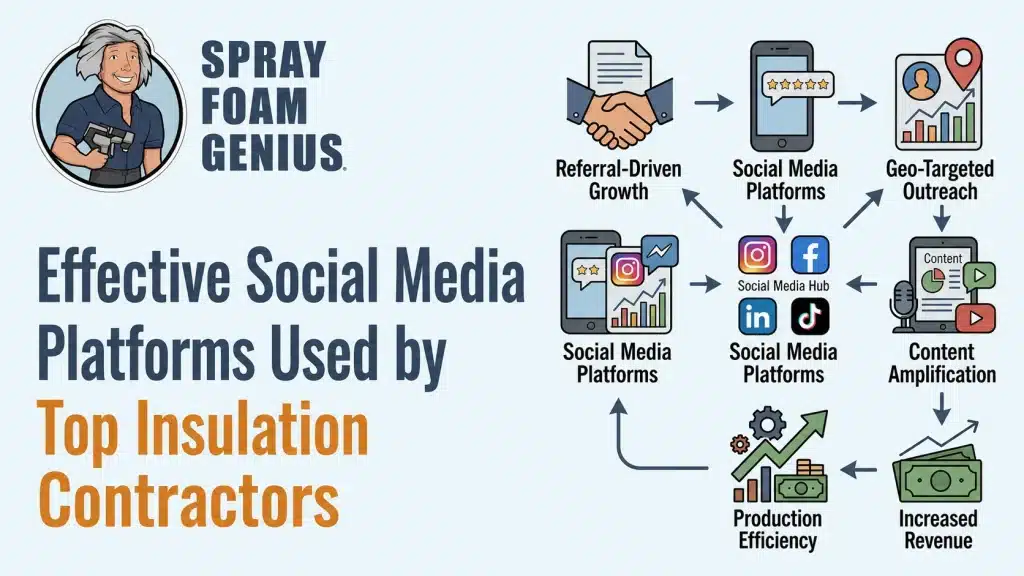
Facebook and Instagram are the top social media platforms for spray foam contractors in 2026, with Facebook driving local leads through groups and ads, and Instagram showcasing before-and-after project visuals. YouTube and LinkedIn round out a strong supporting strategy for educational content and B2B networking. Success depends on consistent posting, local targeting, and visual proof of work, not follower count.
If you run a spray foam insulation business, you already know that word of mouth only takes you so far. Homeowners and commercial property managers are searching online before they ever pick up the phone, and social media has become one of the most important touchpoints in that decision-making journey. Social media for spray foam contractors isn’t about going viral. It’s about showing up consistently where your future customers are scrolling, and giving them a reason to trust you with their attic, crawl space, or warehouse.
In this guide, we’ll break down which platforms actually move the needle for insulation businesses, how to use Facebook marketing for spray foam business growth, why Instagram for spray foam contractors works so well for visual proof, and how to build a content rhythm that doesn’t eat up your entire week. Whether you’re a one-truck operation or managing multiple crews, this guide will give you a clear, practical roadmap for 2026.
Why Social Media Matters for Spray Foam Contractors
Spray foam insulation is a high-trust, high-ticket service. Customers want to see real results, real reviews, and real people behind the brand before they invite a crew into their home or business. Social media marketing for insulation companies bridges that gap by putting your work, your team, and your reputation directly in front of local prospects. This aligns with the energy efficiency upgrades many homeowners are pursuing, as outlined in ENERGY STAR’s home insulation guidance.
Quick answer: Social media helps spray foam contractors build local trust, showcase project results, generate inbound leads, and stay visible to homeowners who are researching insulation upgrades, energy efficiency rebates, or moisture problems.
Unlike traditional advertising, social platforms allow for two-way engagement. A homeowner can comment on a job photo, ask a question, and get a response within minutes, often turning into a booked estimate. This kind of immediate, personal interaction is something print ads and billboards simply cannot replicate.
Related reading: 5 Social Media Strategies Every Spray Foam Contractor Needs
Platform Comparison: Where Should Spray Foam Contractors Focus?
Not all platforms deliver equal value for insulation businesses. Here’s how the major players stack up.
Facebook Marketing for Spray Foam Business
Facebook remains the backbone of local service marketing, and for good reason. The platform’s demographic skews toward homeowners aged 35 to 65, which lines up almost perfectly with the typical spray foam insulation customer.
Here’s what works on Facebook for insulation companies:
- Local Facebook Groups: Joining community groups (neighborhood pages, homeowner associations, local buy/sell groups) and offering helpful advice positions you as the go-to expert without being salesy.
- Before-and-after photo posts: These consistently outperform text-only posts. People want to see the transformation, especially in crawl spaces, attics, and garage conversions.
- Facebook Reviews: A steady stream of recent reviews builds credibility. Encourage every satisfied customer to leave one.
- Facebook Ads with geo-targeting: Even a modest budget ($300 to $500 per month) targeting a 15 to 25-mile radius around your service area can generate consistent estimate requests.
- Facebook Business Page optimization: Make sure your hours, service area, phone number, and booking link are all current. Setting this up correctly through the Meta Business Suite ensures your page stays synced across Facebook and Instagram, with many homeowners clicking straight to “Call Now” from a mobile search.
Quick answer: Facebook marketing for spray foam businesses works best when contractors combine organic content (project photos, customer stories) with targeted local ads and active engagement in community groups.
Instagram for Spray Foam Contractors
Instagram is where visual storytelling does the heavy lifting. Spray foam application is inherently visual: the foam expansion, the clean finish, the dramatic difference between an uninsulated and insulated space. This makes Instagram a natural fit.
Effective Instagram content ideas include:
- Reels showing the spraying process: Time-lapse or sped-up clips of foam application are highly shareable and tend to perform well in the algorithm.
- Carousel posts: Multi-image posts showing a project from start to finish (prep, application, finished result) keep viewers swiping and increase engagement time.
- Stories with polls and Q&A stickers: Use these to answer common questions like “How long does spray foam last?” or “Is spray foam safe for attics?”
- Hashtag strategy: Mix broad tags (#sprayfoaminsulation, #homeenergyefficiency) with local tags (#yourcityname contractor, #yourstate insulation) to capture both reach and local relevance.
- Instagram Business Profile with a clear bio link: Direct traffic to a quote request form or your main website. The Instagram for Business guide walks through setting up a professional profile, including converting a personal account to a business account and accessing audience insights.
Social media marketing for insulation companies on Instagram should feel less like advertising and more like a social media strategy for insulation companies focused on authenticity and education. Homeowners appreciate seeing the actual people who will be working on their property, which builds trust and makes the brand feel more approachable.
Content Calendar Framework: A Practical Weekly Structure

One of the biggest challenges contractors face isn’t knowing what to post; it’s finding time to post consistently. Here’s a simple framework that works well for small teams.
This rhythm requires roughly 3 to 4 pieces of content per week, all of which can be batched from a single job site visit using a smartphone.
Mini-conclusion: You don’t need a professional video crew or a marketing department to succeed on social media. You need consistency, real photos from real jobs, and a willingness to show your work.
YouTube and LinkedIn: The Supporting Players
While Facebook and Instagram should be your primary focus, YouTube and LinkedIn each have a role to play.
YouTube works as a long-term SEO asset. A well-titled video like “How Spray Foam Insulation Is Installed in an Attic” can rank on Google search results for years, continuously bringing in views from homeowners researching the process. According to Google’s own guidance on video SEO, unique titles and descriptions plus structured data help your videos get discovered.
LinkedIn is underutilized by most spray foam contractors but offers real value for commercial work. Property managers, general contractors, and developers who need insulation for warehouses, commercial buildings, or new construction projects are active on LinkedIn. The LinkedIn Marketing Solutions guide for small businesses outlines how to build a company page and use organic posts to reach decision-makers. Sharing case studies of commercial jobs, energy savings data, and partnerships with builders can open doors to higher-value contracts.
Common Mistakes Spray Foam Contractors Make on Social Media
Even well-intentioned contractors fall into patterns that limit their results:
- Posting inconsistently: A burst of activity followed by weeks of silence signals to the algorithm (and to followers) that the page isn’t active.
- Ignoring comments and messages: Response time matters. A homeowner asking “Do you service my area?” who doesn’t get a reply within a day will likely move on to a competitor.
- Overly promotional content: Constant “Call us now!” posts without educational or visual content tend to get less engagement.
- Not using video: Static photos still work, but video content (especially Reels and Shorts) currently receives significantly more algorithmic reach across Facebook, Instagram, and YouTube.
- Skipping local hashtags and geotags: This is a missed opportunity for local discovery, particularly on Instagram and TikTok.
Freshness Note: What’s Changed Going Into 2026
Platform algorithms continue to favor short-form video and authentic, unpolished content over highly produced advertisements. Short-form video often delivers strong returns compared with other content formats across platforms. Facebook’s algorithm, in particular, has shifted toward rewarding content that generates genuine comments and shares within local communities, which benefits service businesses with strong neighborhood ties. Instagram has also expanded its local discovery features, making geotagged content more valuable than in previous years. Contractors who adapt their content strategy to favor short videos and local tagging will see the strongest organic reach as of 2026.
Turn Social Media Into a Consistent Lead Machine
Social media for spray foam contractors doesn’t require a massive budget or a dedicated marketing team to be effective. Focus on Facebook marketing for spray foam business growth through local groups, reviews, and targeted ads, while using Instagram for spray foam contractors to showcase the visual transformation that only spray foam insulation can deliver. Add YouTube and LinkedIn as supporting channels for long-term authority and commercial opportunities.
The contractors who win on social media in 2026 are the ones who show up consistently, post real work from real jobs, and respond to their community. Start with one platform, build a simple weekly rhythm, and expand from there.
Ready to build a social media strategy that actually generates leads?
Contact Spray Foam Genius Marketing today at 877-840-FOAM (USA) or 844-741-FOAM (Canada), or email info@sprayfoamgeniusmarketing.com to get started.
FAQs
1. What is the best social media platform for spray foam contractors?
Facebook is generally the best starting point due to its strong local targeting, community groups, and review system, followed closely by Instagram for visual project showcases.
2. How often should a spray foam company post on social media?
A realistic and effective minimum is 3 to 4 posts per week across primary platforms, with consistency mattering more than volume.
3. Do spray foam contractors need to run paid ads on social media?
Paid ads aren’t required, but significantly accelerate lead generation. A modest, geo-targeted Facebook ad budget often produces a strong return for local service businesses.
4. What type of content performs best for insulation companies?
Before-and-after photos and short video clips of the application process consistently outperform text-only posts or generic stock imagery.
5. Is TikTok worth it for a spray foam business?
TikTok can be valuable for brand awareness, particularly with short transformation videos, but it typically generates more visibility than direct leads compared to Facebook or Instagram.