
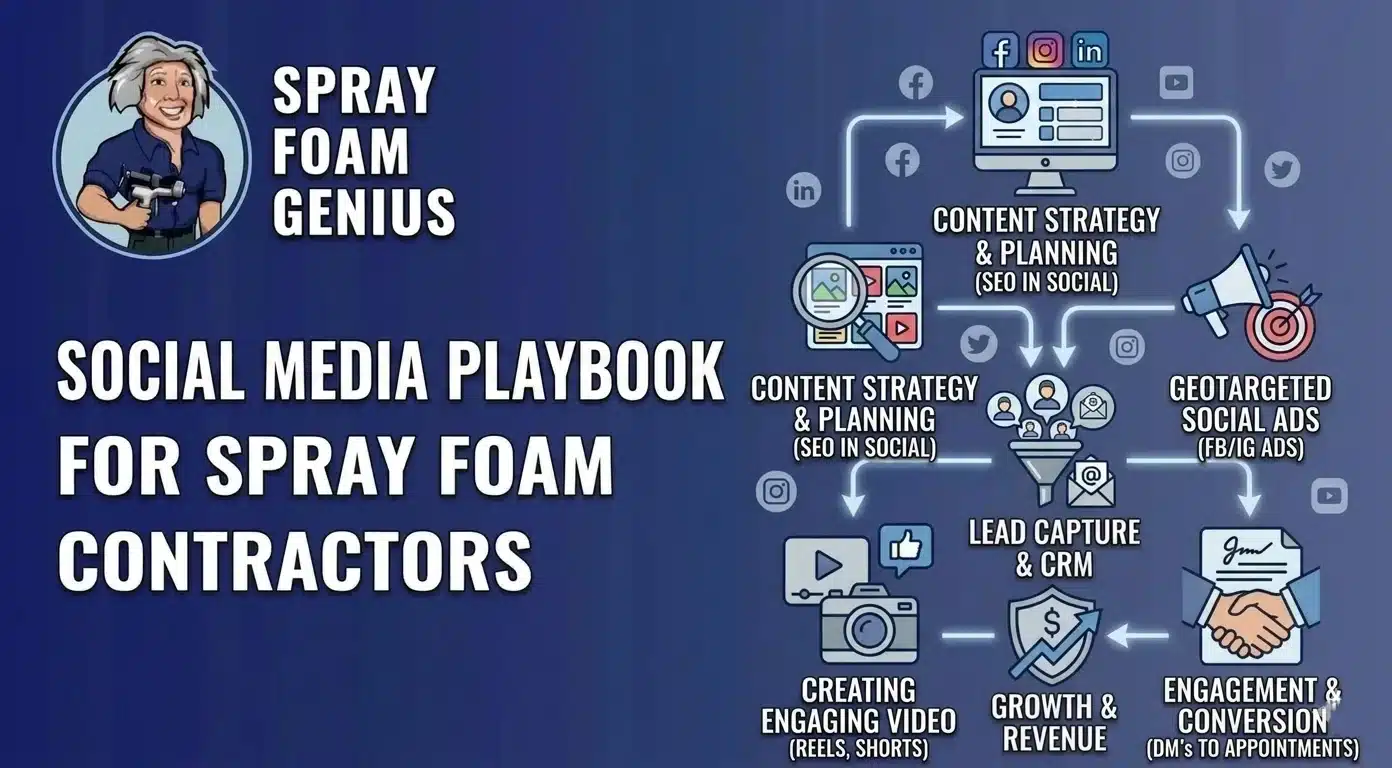
If you are a spray foam contractor who has been posting randomly on Facebook and hoping for leads, you are not alone. Most insulation contractors treat social media as an afterthought. The ones who get value from it have a simple system. This playbook lays that system out.
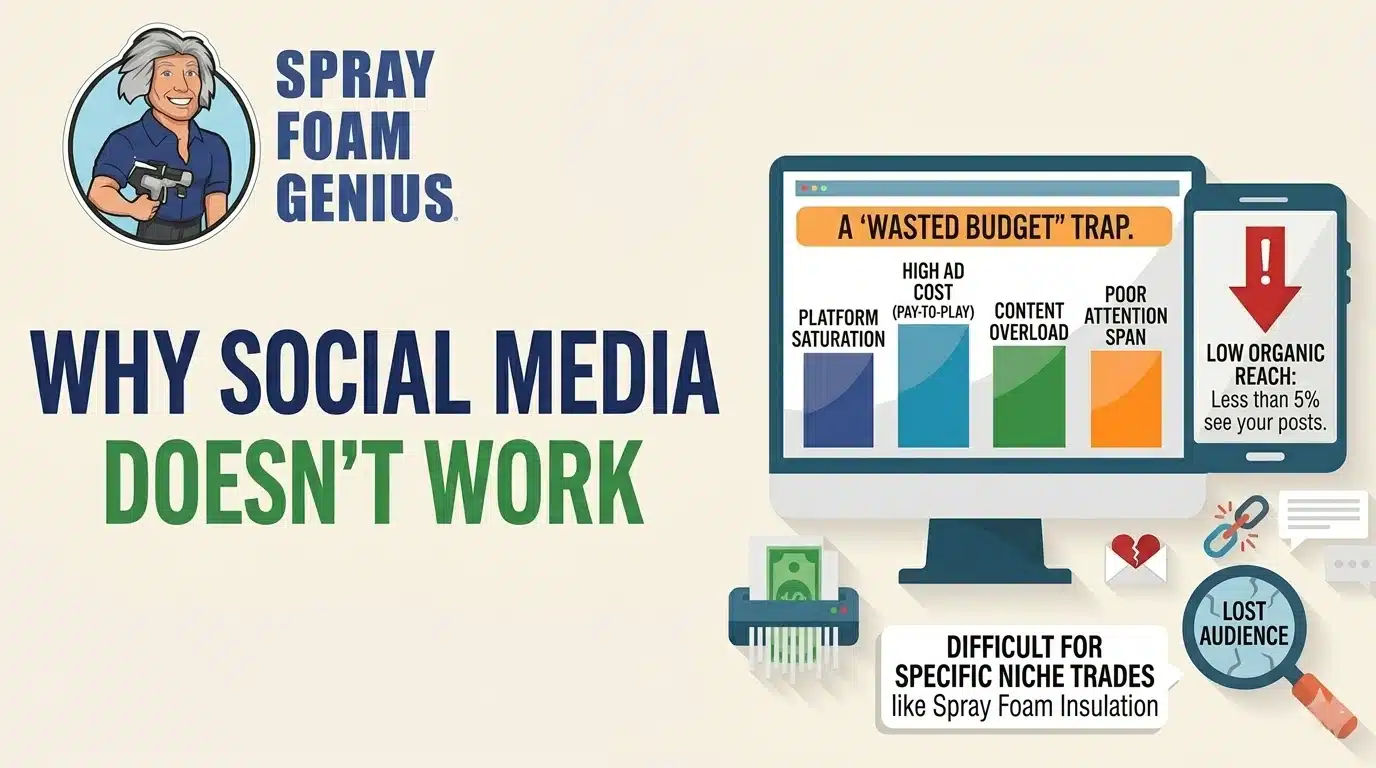
Social media for spray foam contractors is not about going viral. It is about showing up where homeowners and builders already spend time, building credibility before they call, and making it easy to reach you when they are ready. Be realistic about its role: for most contractors it supports trust and follow-up more than it replaces search. Our post on why social media rarely works as a lead source for insulation companies explains where it falls short and what to pair it with.
Why Social Media Matters for Spray Foam Contractors
Spray foam is a high-consideration purchase. Many customers have never hired a spray foam contractor, do not know the difference between open-cell and closed-cell foam, and do not know how to compare bids. What they do know is whether they trust you, and that trust is often formed online before any conversation happens.
Homeowners commonly check a company's Google profile, website, reviews, and social pages before calling. If your Facebook page has not been updated in months or your Instagram shows a few blurry job site photos, that can cost you bids you never knew you were in.
Done well, social media lets you:
- Show expertise through educational posts before the sales call.
- Prove the quality of your work with photos and video.
- Build name recognition in your service area through steady presence.
- Share reviews and testimonials as social proof.
- Run paid ads to homeowners and builders near your shop.
Choose Your Platforms
Do not try to be everywhere. Pick the one or two platforms where your customers are, do them consistently, then expand.
Facebook is the usual starting point for residential work. It offers local groups, reviews, a business page with your service area, and the most developed ad tools for reaching homeowners near you.
Instagram is your visual portfolio. Spray foam is a transformation business: foam rising in a cavity, a bright sealed attic, a clean rim joist. Facebook and Instagram are both run through Meta Business Suite, so you can schedule posts, answer messages, and review results in one place.
YouTube
YouTube suits longer educational videos such as how an attic is insulated. Videos can keep getting found in search long after they are posted. Google publishes guidance on video best practices if you want your videos to be easier to find.
LinkedIn is worth the time if you pursue commercial work. Builders, developers, property managers, and general contractors are active there. Share commercial case studies, partnerships, and company news, and treat it as networking rather than advertising.
TikTok
TikTok can add awareness through short transformation and time-lapse clips, but for most contractors it adds visibility more than direct leads. Try it only after Facebook and Instagram are running steadily.
For most residential contractors, start with Facebook and Instagram. Add LinkedIn if commercial work is a goal. Add video platforms once you can produce video on a regular rhythm.
Build a Simple Strategy
Strategy does not need to be complicated, but it needs to be written down.
1. Pick one goal per quarter
Do you want homeowner leads, commercial contracts, recognition in a new city, or to recruit crew? The goal shapes your content, your platform, and any ads.
2. Know who you are talking to
A homeowner worried about an energy bill is a different person from a developer planning a build. Write for one of them at a time.
3. Complete your profiles
Add your business name exactly as it appears elsewhere, your location and service area, services, phone number, website link, and a logo or clear profile photo. An incomplete profile hurts credibility immediately. Keep your name, address, and phone number consistent with your Google Business Profile.
4. Set a posting rhythm you can keep
Consistency matters more than volume. A rhythm you can maintain, such as a few posts a week, beats a burst of activity followed by silence. Decide what you can sustain and plan it in advance.
5. Review monthly and adjust
Look at which posts earned the most reach, comments, saves, link clicks, and messages. Repeat what works and drop what does not.
A Simple Weekly Content Plan
A calendar removes the daily question of what to post. Use a spreadsheet or the scheduler in Meta Business Suite, and batch the work: shoot photos and short clips on the job, then write and schedule captions once a week.
A balanced week can include:
- One educational post, such as a common homeowner question answered in plain language.
- One trust-builder, such as a review, testimonial, or before-and-after.
- One personality post, such as a crew member, a truck, or a day on site.
- One offer or call to action, such as a free estimate request or seasonal booking reminder.
Every post should have a purpose: educate, build trust, start a conversation, or ask for the call. Add a column in your calendar for the call to action and the link so nothing goes out without a next step.
Content Ideas That Earn Trust and Inquiries
Job completion photos are the floor, not the ceiling. These formats tend to start conversations.
Before-and-after projects
Before-and-after posts are concrete proof. They answer the buyer's question, can this contractor deliver? To make them work:
- Shoot the before and after from the same angle and in similar lighting, so the pair is easy to compare.
- Write a real caption: the problem, what you did, which foam you used (open-cell or closed-cell), and where. Avoid claiming specific savings you cannot back up.
- Add the homeowner's own words about what changed, such as comfort or fewer drafts, with their permission.
- Tag the location and post one or two project posts a week to build a scrollable portfolio.
- Ask the homeowner before posting photos of their home.
Bright work lights make attics and crawl spaces look crisp rather than yellow or gray. Step back to show scale, not only a close-up of the foam.
Educational posts and short Q&A
Answer questions homeowners already ask: the difference between open-cell and closed-cell spray foam, how long the job takes, whether there is an odor after installation, why spray foam can cost more upfront. Keep answers plain and honest. For technical credibility, you can reference the Spray Polyurethane Foam Alliance for industry information.
Process and job site video
Many people fear what they do not understand. Showing the crew arriving, prepping, spraying, and cleaning up lowers that fear. A time-lapse of an application is easy to watch and easy to film.
Testimonials and reviews
A short customer video is often more persuasive than another promotional post. Ask right after the job, while the customer is happy. You can also turn a strong Google review into a branded graphic. Our guide to Google reviews for spray foam businesses covers how to ask for them.
Team and local content
People buy from people. Introduce crew members by name, show your trucks and equipment, and post about local jobs and community events. Tag neighborhoods and nearby landmarks to build local recognition.
Seasonal and timely posts
Tie your service to the time of year: getting an attic ready before winter, keeping a house cooler in summer, or planning a crawl space project before wet weather. If you mention rebates or tax incentives, check that they are current and link to the official program page, because rules change.
Safety and prep tips
Tell homeowners what to expect: how to prepare the space, where pets and family should stay during installation, and when the area can be used again. This sets expectations and shows professionalism.
Make Facebook and Instagram Work Locally
On Facebook:
- Fill out the business page completely, including service area, hours, phone, and booking or quote link.
- Join local homeowner and community groups and take part genuinely. Answer questions and offer advice rather than only dropping links, and follow each group's rules about business posts.
- Use Facebook reviews or recommendations and reply to every one.
- Post stories as well as feed posts to stay visible with little effort.
On Instagram:
- Post before-and-after images with captions that explain the problem and the result.
- Use location tags and a few local hashtags, such as your city plus contractor, mixed with a few service tags. Hashtags help discovery but do not replace good content, and a handful of relevant ones is enough.
- Use Reels for short process clips, which often reach more people than static posts.
- Point your bio link at a landing page or quote form rather than only your homepage.
Video Tips for Contractors
You do not need a production crew. A smartphone, decent light, and a clear message are enough. Authentic and knowledgeable usually beats slick and scripted in a trade business.
- Film vertically for Reels and TikTok, horizontally for YouTube.
- Speak to the camera in the first few seconds so people stop scrolling.
- Add captions, since many people watch without sound.
- End with one clear action, such as call for a free estimate.
- Keep clips short and film one idea per video.
Paid Social: Reach People Who Do Not Know You Yet
Organic posts reach people who already follow you. Paid ads can put your offer in front of homeowners who do not know you yet. Most contractors should have the organic basics in place first, then promote their best posts or run a focused campaign.
Lead ads and offers
Facebook and Instagram lead forms let someone request contact without leaving the app, which keeps friction low. Pair the form with a clear offer, such as a free attic or crawl space assessment, and tell people what happens next.
Targeting
Keep it local: a service radius around your shop, homeowners where available, and interests related to home improvement and energy efficiency. Meta's ad targeting options change over time, so check what is currently offered in your account.
Retargeting
Install the Meta Pixel on your website so you can show a reminder to people who visited but did not contact you. These audiences already know your name, so they tend to be easier to win than cold audiences. Meta's Business Help Center explains setup.
Budget
Social ad spend depends on your market size, competition, and goals, and it is paid to the platform separately from any management fee. We do not publish prices here. Start with an amount you are willing to test for a few months and judge it by cost per lead and cost per job, not by clicks. For the wider picture, see our digital advertising strategy for insulation contractors and our Facebook ads for spray foam contractors page.
Turn Followers Into Leads
Followers are not leads. The gap between a like and a booked job is closed by clear calls to action, easy contact options, and fast follow-up.
- Give every post a next step: call, send a message, or visit the link.
- Answer messages and comments quickly. Many people message before they call. Set an auto-reply that acknowledges them and gives your phone number and website.
- Offer something useful in exchange for contact details, such as a short insulation checklist, if you can follow up with the people who sign up.
- Send ad and bio traffic to a purpose-built landing page with one message and one form. Our guide to designing a high-converting spray foam landing page shows how.
- Follow up fast. A lead who hears from you the same day is more likely to book than one who waits.
Handle Comments and Criticism
Reply to every comment and review, positive or negative. For criticism, acknowledge the concern, stay calm, and move the details to a phone call or private message. Delete only spam and abusive comments, not honest complaints. See our reputation management guide for more.
Common Mistakes to Avoid
- Posting with no strategy, audience, or goal.
- Ignoring comments and messages, which signals that you are too busy or do not care.
- Posting only promotions. If every post says call us for a quote, people tune out. Mix value, proof, and offers.
- Using blurry, dark, or stock images instead of real job photos.
- Leaving profiles incomplete or inconsistent with your website and Google profile.
- Posting in bursts and then going quiet for weeks.
Track What Matters
You do not need a marketing degree to see whether it is working. In the first month, record your numbers as a baseline without judging them. Then review monthly:
- Which posts earned the most reach and engagement?
- How many calls, messages, or form fills came from social media?
- If you run ads, what was the cost per lead, and how many became jobs?
- Which content type performs best again and again?
Ask every new customer how they found you and keep a simple spreadsheet. After a few months you will see which channels produce revenue. Tracking calls and form fills also helps, and our guide to using Google Analytics shows how to see social traffic on your site.
Get a Free Marketing Audit
We work only with spray foam and insulation contractors. If you want a second set of eyes on your social profiles, website, and local search presence, we offer a free marketing audit. Call 877-840-3626 (USA) or email info@sprayfoamgeniusmarketing.com.
Frequently Asked Questions
How often should a spray foam contractor post?
Pick a rhythm you can keep up, such as a few posts a week. Consistency matters more than volume, and two good posts a week beat ten rushed ones followed by silence.
Is Facebook or Instagram better for spray foam leads?
Facebook is often stronger for local lead generation because of its local groups, reviews, and ad tools. Instagram is a strong visual portfolio. Using both through Meta Business Suite is the most efficient setup.
Do spray foam contractors need to run social ads?
No. Organic content can build trust, but ads reach people who do not follow you yet and can bring inquiries faster. Many contractors start organic and add ads once they can answer leads quickly.
What content works best for insulation companies?
Before-and-after projects, short process videos, customer testimonials, and plain-language answers to homeowner questions tend to earn the most engagement and trust.
Is LinkedIn worth it for an insulation contractor?
It can be if you pursue commercial work. Builders, developers, and property managers are active there. For residential-only companies, Facebook and Instagram usually come first.
How long does it take to see results?
No one can promise a timeline. Social media works through repetition and trust, so expect to measure over several months rather than days, and judge it by calls and booked jobs, not likes.
Do you need a social media manager?
Not at the start. Many contractors run a simple weekly plan themselves. As time gets tight, a specialist who understands insulation can keep it consistent, which is something we help contractors with.