
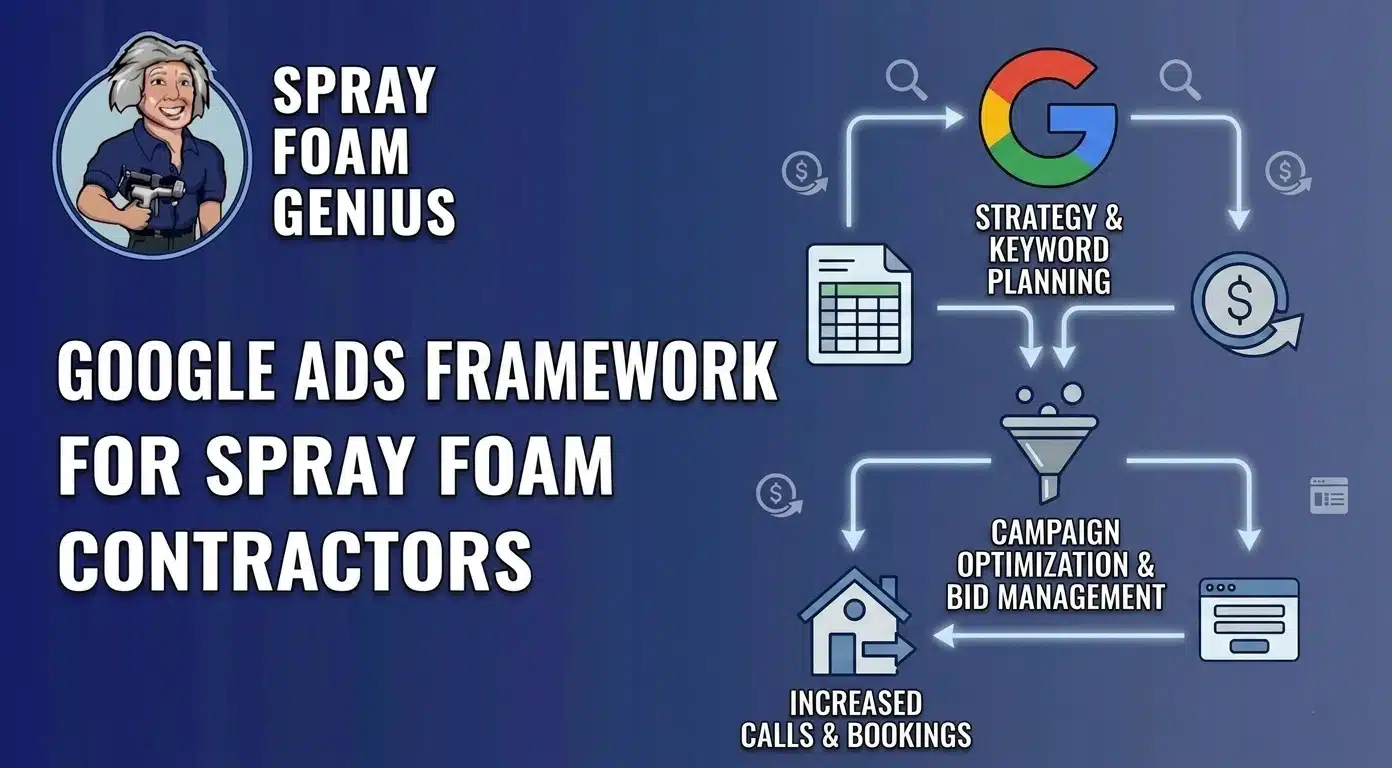
This guide walks spray foam and insulation contractors through a complete Google Ads framework: market basics, account setup, keywords, campaigns, ad copy, landing pages, budgeting, tracking and scaling. Whether you are starting from scratch or trying to fix a campaign that burns budget, the steps below give you a structure you can follow and measure. No one can guarantee results from ads, so the framework is built around tracking what actually produces booked jobs.
Why Google Ads Can Work for Spray Foam
Homeowners, builders and facility managers search Google when they need insulation work. Google Ads can put your business in front of those searches within days, and you choose the keywords, locations, hours and budget. Unlike SEO, which usually takes months to build, a well-structured Search campaign can start producing calls quickly. See our comparison of SEO vs Google Ads for insulation contractors for how the two fit together.
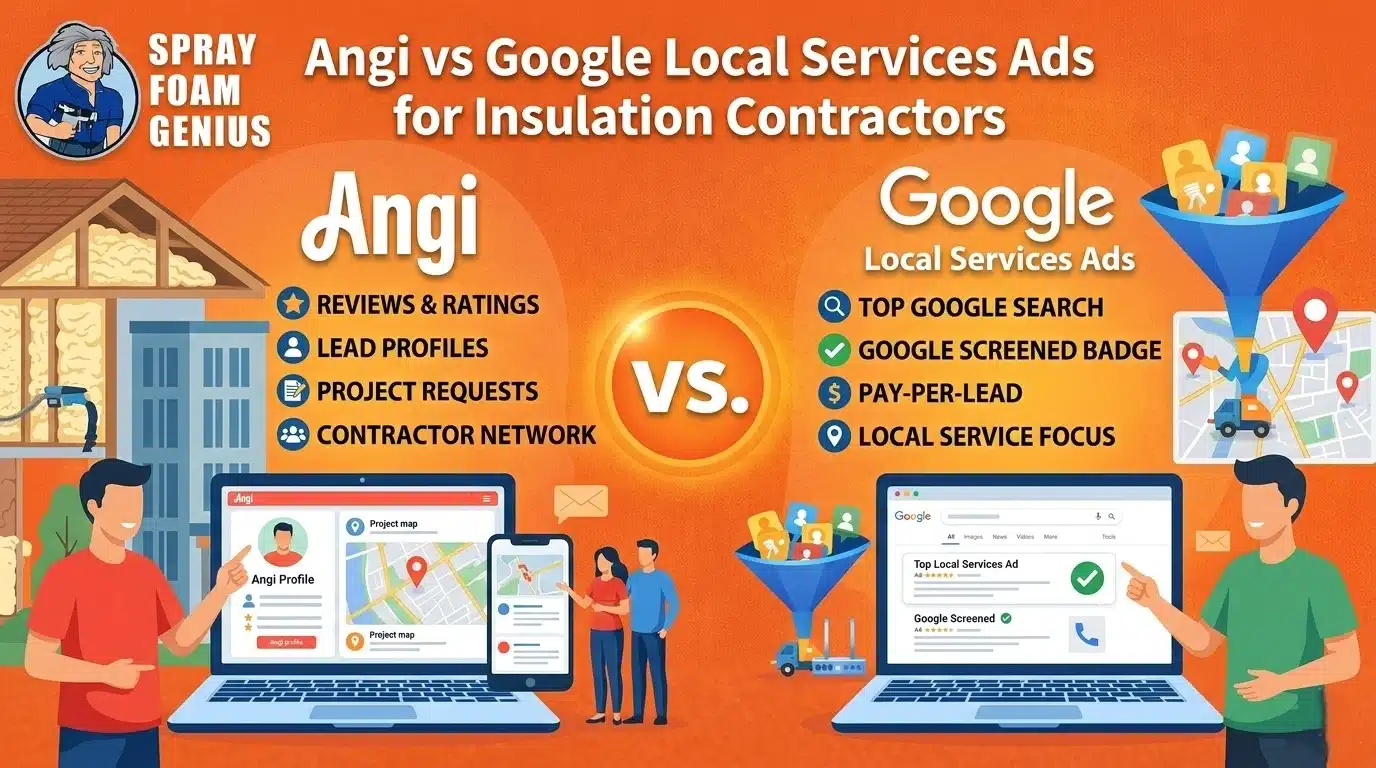
The catch is that most contractors either avoid ads because they seem complicated, or run loosely structured campaigns that spend money on the wrong searches. Ads can also give you more control than shared lead products, since you control the message and keep the data, though you still pay for clicks that do not convert. Compare that with the trade-offs in our guide to Angi, HomeAdvisor and Local Services Ads.
Related reading: Angi, HomeAdvisor and Google Local Services Ads for Insulation Contractors: What Is Worth It?
Step 1: Know Your Market Before You Advertise
Spray foam serves several customer groups, and each searches differently and has different job values:
- Residential homeowners insulating attics, crawl spaces, basements and walls.
- Builders and general contractors who need a spray foam subcontractor.
- Commercial and industrial facility managers with larger projects.
- Agricultural customers insulating barns, storage buildings and metal structures.
Demand also changes through the year and by region, so look at your own seasonal pattern when you plan budgets. Before you write a single ad, answer these questions, because they shape your keywords, messages and landing pages:
- What is your average job value for each service, and what is your margin?
- Which services are most profitable for you?
- How far can your crews realistically travel?
- What makes you different from other local contractors, such as certifications, warranties, response time or materials?
Step 2: Set Up the Account the Right Way
A disorganized account is a common reason contractors waste money. Use a clear structure:
- Account: billing, business information and conversion tracking.
- Campaign: separate by service type or geography, for example residential and commercial.
- Ad group: a tight cluster of closely related keywords, not dozens of unrelated ones.
- Ads: write several responsive search ad variations so you can learn which messages work.
Link your Google Ads account to Google Analytics 4 and Google Search Console from the start so you can see what happens after the click. Google’s guide to Google Ads is worth bookmarking as you go. Set up conversion tracking before you launch, not after, so your first dollars generate usable data.
Step 3: Build a Focused Keyword Strategy

Keywords are where many campaigns succeed or fail. The goal is to capture high-intent searches and filter out irrelevant clicks. Use Google Keyword Planner to find ideas and check what people actually search.
Keyword groups to cover
- High intent: spray foam insulation contractor near me, spray foam insulation cost, hire a spray foam insulation company, spray foam insulation quotes.
- Service specific: attic spray foam insulation, crawl space spray foam, open-cell vs closed-cell spray foam, commercial spray foam insulation.
- Location based: spray foam insulation [city], insulation contractor [city], spray foam company near me.
Match types
Phrase and exact match give you the most control, so many contractors start there. Broad match can find extra searches, but it needs a strong negative keyword list and close monitoring, or it can spend your budget on irrelevant terms.
Negative keywords from day one
Negative keywords tell Google what not to show your ads for. Common ones for spray foam contractors include:
- DIY, how to, tutorial, video, kit.
- Jobs, careers, employment, salary.
- Gun, machine, equipment, rental, parts, buy, repair, wholesale.
- Fiberglass or cellulose, if you do not offer them.
- Free and cheap, unless you intentionally target price-sensitive buyers.
Review your search terms report weekly and keep adding negatives. It is one of the highest-value habits in managing spray foam campaigns.
Step 4: Structure Campaigns Around Intent
A segmented structure gives you control over budget, messaging and testing:
- Residential spray foam: homeowners searching for attic, crawl space, basement and wall insulation.
- Commercial spray foam: facility managers, general contractors and builders.
- Brand: your own company name, to protect your position. Bidding on competitor names is optional and should be handled with care.
- Remarketing: people who visited your site but did not call.
Inside each campaign, build ad groups by service or location, such as attic spray foam, new construction spray foam and near me searches. More relevant ads tend to perform better in the auction.
Campaign settings that matter
- Networks: start with the Search Network only, and do not mix Search and Display in one campaign.
- Location: Google’s default is Presence or interest, which can show your ads to people who only show interest in your area. If you see clicks from outside your service area, consider switching to Presence, knowing it usually reduces impressions.
- Schedule: show ads when someone can answer the phone, and review call data by hour.
- Bidding: begin with Manual CPC or Maximize Clicks with a maximum CPC cap. Move to a conversion-based strategy such as Target CPA once you have a steady record of tracked conversions. Switching too early, without enough data, can make costs unpredictable.
Step 5: Write Ad Copy That Converts
Generic headlines such as “Spray Foam Insulation Services” and “Call Us Today” do not stand out. Good ad copy speaks to what the homeowner wants, addresses the biggest concern (often cost or quality), and gives a clear next step.
A simple headline framework
- What and where: “Spray Foam Insulation in [City]”.
- A differentiator you can prove: “Licensed and Insured” or “[Number] Years in Business”, using only facts that are true for you.
- A call to action: “Get a Free Estimate”.
Example description with placeholders: “We install open-cell and closed-cell spray foam for homes and commercial buildings. Serving [Region]. Call for a free estimate.” Avoid promising specific energy savings you cannot back up.
Assets (formerly called extensions)
Add as many relevant assets as you can, since they make ads more useful and give people more ways to contact you:
- Call assets, so mobile users can dial from the ad.
- Location assets, which show your address and a map link.
- Sitelinks to service pages such as attic, crawl space and commercial.
- Callouts such as “Licensed and Insured” or “Free Estimates”, if true.
- Structured snippets listing your services.
Test one change at a time, such as headlines, descriptions or calls to action, so you can tell what made the difference.
Step 6: Send Clicks to Landing Pages That Convert
Sending ad traffic to your homepage wastes money. Every ad group needs a dedicated landing page that matches the ad’s message and has one job: to get a call or a form submission.
Above the fold
- A headline that matches the ad, such as “Spray Foam Insulation in [City]: Free Estimates”.
- A large, tappable phone number.
- A short form: name, phone, service needed and zip code.
- A trust signal that is true for you, such as license number, years in business or a review rating.
Below the fold
- Short service descriptions with photos of your own work.
- Customer reviews with names and locations, where you have permission.
- A service area list or map.
- Answers to common questions: cost, timeline, open-cell vs closed-cell foam.
- A second call to action.
Pages should load quickly and work well on phones. Google explains how page experience factors are measured in its Core Web Vitals documentation, and PageSpeed Insights lets you test yours. Keep the message consistent: if the ad says “Attic Spray Foam Insulation”, the page headline should say something almost identical. Mismatch causes visitors to leave, and Google also considers landing page experience when it assesses ad quality.
Step 7: Budget and Bid with the Math in Mind

The honest answer to “how much should you spend?” depends on your market, your job value, your margin and your close rate. Start by working out what a lead is worth to you:
- Revenue per lead = average job value x the share of leads you close.
- Allowable cost per lead = revenue per lead x your margin, less anything else you need to cover.
As an example with made-up numbers, if your average job is $3,000 and you close 1 in 4 leads, each lead is worth about $750 in revenue. If your margin on a job is 30 percent, a lead is worth about $225 in gross profit, so a $100 lead may be affordable while a $300 lead is not.
For a rough outside reference, LocaliQ’s 2026 search advertising benchmarks show an average $8.33 cost per click and $90.92 per lead for the broad Home & Home Improvement category. That is a cross-industry average, not a spray foam figure, and your market could be very different.
Choose a budget large enough to gather several weeks of click and call data, because tiny budgets in competitive metro areas rarely produce enough information to optimize. Scale only when campaigns are profitable.
Step 8: Win Local Searches
Many of your best leads search with local intent, such as “spray foam contractor near me” or “insulation company in [city]”. To make the most of them:
- Mention your service cities in headlines and descriptions.
- Set location bid adjustments if some areas produce better jobs.
- Use location assets so your address and map appear in the ad.
- Run ads when your team can answer calls.
- Local Services Ads are currently open to insulation installation contractors only in California and Florida. If you are there, consider them alongside Search campaigns: Google says you are charged for each valid lead.
- Keep your Google Business Profile complete, since it supports both your map visibility and your ad assets.
Step 9: Track Calls, Forms and Booked Jobs
If you are not tracking conversions accurately, you cannot optimize. Without it you may know how much you spent, but not which keywords, ads or campaigns produced jobs.
What to track
- Calls from the ad itself.
- Calls from your website or landing page.
- Form submissions.
- Chat starts, if you use chat.
- Booked appointments and closed jobs, entered in your CRM.
Call tracking and analytics
Use Google’s built-in call reporting or a call tracking tool so each campaign has its own number and you can see which ads produce calls that become jobs. Import conversions into Google Ads so bidding can optimize toward leads, not just clicks. Connect Google Analytics 4 and import key events to see what visitors do after the click, and use that data to build remarketing audiences.
Protect against bad clicks and fake leads
Google says it automatically filters invalid clicks and issues credits when appropriate, and it describes a request process if you suspect problems. For spam form leads, Google suggests tools such as reCAPTCHA and server-side validation.
Step 10: Optimize Weekly, Then Scale
Optimization is ongoing, not a one-time setup. A simple weekly routine:
- Review the search terms report and add negatives.
- Pause keywords with high spend and no conversions or booked jobs.
- Test new ad variations against current ones.
- Review performance by location, device and hour, and adjust bids.
- Check landing page speed and conversion rate.
- Look at Quality Score as a diagnostic only. Google says it is not an input in the auction, but its parts (expected click-through rate, ad relevance and landing page experience) show where to improve.
Once a campaign hits your target cost per lead, expand to nearby cities or zip codes with their own campaigns and pages, promote more services, and test remarketing and audience targeting for people who have already visited your site. Do not scale campaigns that are not yet profitable. Fix the fundamentals first.
Common Mistakes Spray Foam Contractors Make
- Sending traffic to the homepage instead of a matching landing page.
- Ignoring negative keywords, so ads show for “DIY spray foam kits” and similar searches.
- Starting with too small a budget to learn anything in a competitive market.
- Using broad match with no negative keywords or monitoring.
- Tracking only form fills when many leads call by phone.
- Quitting after a few weeks, before there is enough data to optimize.
- Running one generic campaign for residential and commercial work.
Frequently Asked Questions
How much does Google Ads cost for a spray foam contractor?
It depends on your market, competition and goals. Plan for a budget large enough to collect several weeks of data, then judge it by cost per booked job and profit, not clicks. Smaller or rural markets can often start lower than large metro areas. Ad management fees, if you use an agency, are separate from ad spend.
How long does it take to see results from Google Ads?
Campaigns can start sending clicks and calls within days. Reliable performance takes longer, because you need data to refine keywords, ads and landing pages, so judge results over weeks, not days.
What is the best bidding strategy for spray foam campaigns?
A common path is to start with Manual CPC or Maximize Clicks with a CPC cap, then move to a conversion-based strategy such as Target CPA once you have steady tracked conversions. Switching too early can hurt performance.
Should spray foam contractors use Local Services Ads or Search Ads?
Many use both. Local Services Ads charge per valid lead according to Google, while Search Ads give you more control over keywords and messaging. For insulation installation, LSAs are currently limited to California and Florida, so most contractors will rely on Search Ads.
Why do your ads get clicks but no leads?
Usually it is a landing page problem, a keyword problem, or both. Check that the page matches the ad, loads quickly, shows the phone number, has a clear call to action and builds trust. Then review the search terms report for irrelevant searches.
What is a good return on ad spend?
It depends on your margin. As an example, if you keep 30 percent of revenue as gross profit, you need roughly $3.33 in revenue for each $1 of ad spend just to break even on that margin, before overhead. Use your own margin to set your target.
Get Help Building Your Campaigns
If you would rather focus on installing foam than managing bids and negative keyword lists, we can review your current account or plan a new one. Ask for a free marketing audit by calling 877-840-3626 or emailing info@sprayfoamgeniusmarketing.com. You can also read about our Google Ads for spray foam contractors service.
Further Reading
Official guidance from Google on the topics in this article: