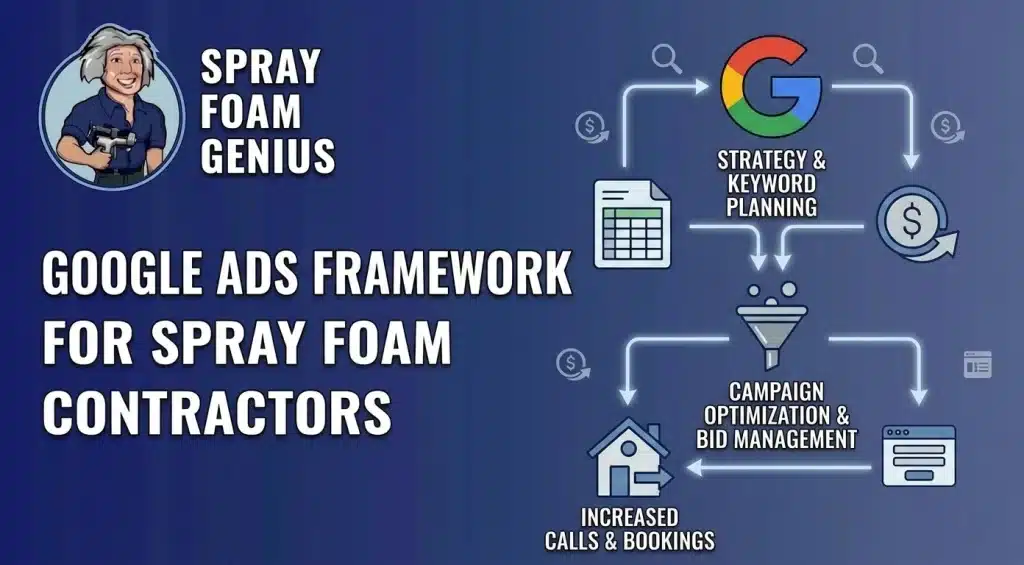

Local insulation companies compete for a shrinking pool of clicks and a growing pool of competitors. Homeowners search for “insulation near me” and expect an answer within seconds, and Google now answers many of those questions with AI Overviews before a user even reaches the ad section. If you run an insulation business, you need a Google Ads account that wins both the paid auction and the trust of an increasingly impatient buyer.
Use these 7 proven strategies to build campaigns that generate qualified leads, lower your cost per lead, and position your insulation company as the obvious local choice in 2026.
1. Target High Intent Local Keywords First
Start every campaign with keywords that signal a homeowner is ready to buy, not just researching. Terms like “spray foam insulation near me,” “attic insulation cost,” or “insulation contractor [city name]” convert far better than broad terms like “insulation.”
Local search intent now makes up roughly half of all Google queries, and near me searches have grown dramatically over the past two years. Build a keyword list around service plus location plus intent, then add negative keywords such as “DIY,” “jobs,” or “wholesale” to filter out traffic that will never call you. Google’s own Local Services Ads platform confirms that home insulation is a recognized category, which means Google already understands your industry and rewards precise targeting.
2. Run Local Services Ads Alongside Search Campaigns
Local Services Ads (LSAs) appear above traditional search ads and show your Google Screened or Google Guaranteed badge, business rating, and phone number directly in results. Homeowners trust this format because Google verifies your license and insurance before you can run.
Pair LSAs with standard Search campaigns so you capture leads at every stage of the funnel. LSAs charge per lead rather than per click, which protects your budget from accidental clicks and tire kickers. Track your cost per booked appointment, not just cost per lead, so you know which channel actually produces sold jobs and real gross profit.
3. Write Ad Copy That Speaks to Local Homeowners
Generic ad copy blends into the results page. Mention your city, your response time, and a specific benefit such as energy savings or a lifetime warranty on spray foam. Include numbers whenever possible, since specific claims like “Save up to 40% on heating bills” outperform vague promises.
Add a clear call to action in every headline. Phrases like “Call Now for a Free Estimate” or “Get Your Free Marketing Audit Today” push users toward action instead of leaving them to compare five open tabs. Test at least three headline variations per ad group so Google’s algorithm can identify the strongest performer for your market.
4. Use Every Relevant Ad Extension
Ad extensions increase your ad’s visibility and click through rate without raising your bid. Add these extensions to every insulation campaign:
- Call extensions so mobile users can dial you directly from the ad
- Location extensions to show your address and distance from the searcher
- Sitelink extensions linking to your services page, reviews, and financing options
- Structured snippets listing your services, such as spray foam, blown-in, and batt insulation
- Price extensions for transparent starting rates, which build trust before the first call
Google rewards ads with strong extension coverage by improving your Quality Score, which lowers your cost per click over time. WordStream’s guide to Google Ads performance explains how these small additions compound into meaningful savings across a full campaign.
5. Build Dedicated Landing Pages for Every Service
Do not send paid traffic to your homepage. Create a dedicated landing page for each core service, such as attic insulation, crawl space insulation, and commercial spray foam. Match the page headline to the ad headline so the message stays consistent from click to conversion.
Every landing page should load fast, display your phone number above the fold, and include a short lead form with no more than four fields. Add customer reviews and before and after photos near the top of the page, since visual proof reduces hesitation faster than paragraphs of text. A dedicated page also improves your Quality Score, which directly lowers your cost per click.
6. Retarget Website Visitors Who Did Not Convert
Most homeowners research insulation contractors for days or weeks before calling. Set up a remarketing campaign that follows website visitors with display ads reminding them of your free estimate offer or seasonal discount. Segment your audience so visitors who viewed your pricing page see a different message than visitors who only read a blog post.
Retargeting typically produces a lower cost per lead than cold search traffic because you are re-engaging people who already showed interest. Combine remarketing with Customer Match lists built from past estimate requests to bring warm leads back into your funnel before a competitor does.
7. Track Calls, Form Fills, and Booked Jobs, Not Just Clicks
Clicks and impressions tell you almost nothing about profit. Set up call tracking, form conversion tracking, and, if possible, integration with your CRM so you can see which keywords and ads produce booked appointments and closed jobs. According to Google’s official Search Ads guidance, advertisers who track full funnel conversions consistently outperform those who optimize for clicks alone.
Review this data weekly. Pause keywords with high spend and low booked jobs, and shift budget toward the campaigns producing real revenue. A campaign with a higher cost per lead can still be your most profitable channel if it produces higher value jobs and stronger close rates.
Frequently Asked Questions
How much should an insulation company spend on Google Ads?
Most local insulation contractors start with a monthly budget between $1,500 and $5,000, then scale up once cost per booked job data confirms profitability.
Are Local Services Ads better than regular Google Search Ads for insulation contractors?
LSAs generally produce higher-trust and higher-intent leads because of the Google Guaranteed badge, while Search Ads give you more control over keyword targeting. Most successful contractors run both together.
How long does it take to see results from Google Ads?
Expect meaningful data within 30 to 60 days. Full optimization—including negative keyword refinement and landing page testing—typically takes around 90 days to reach peak efficiency.
What is a good cost per lead for insulation Google Ads campaigns?
Cost per lead varies by market, but most insulation contractors see anywhere from $40 to $120 per lead. Focus less on the raw number and more on cost per booked job, since a $100 lead that closes into a $6,000 attic insulation project is far more valuable than a $40 lead that never converts.
Do I need a separate landing page for every insulation service I offer?
Yes. Sending all your ad traffic to one general homepage lowers your Quality Score and can confuse visitors about your specialties. Dedicated landing pages for services like spray foam insulation, blown-in insulation, and crawl space insulation align your ad copy with page content, improving both conversion rates and cost per click (CPC).
Get Your Free Insulation Marketing Audit
Building and managing profitable Google Ads campaigns takes constant testing, tracking, and refinement. If you would rather focus on installing insulation than managing bids and negative keyword lists, let an insulation marketing specialist handle it for you.
Spray Foam Genius Marketing offers a free marketing audit for insulation contractors ready to generate more qualified leads in 2026.
Call 877-840-FOAM (USA) or 844-741-FOAM (Canada), or email [email protected] to claim your free audit and start booking more insulation jobs today.

Spencer is a Google ranking expert and SEO consultant who has helped businesses in the spray foam marketing industry achieve their online marketing goals. Spray Foam Genius Marketing has a proven track record of success, having achieved some impressive results for his clients.
- You’re Ranking on Google, So Why Aren’t You Making More Sales? - September 7, 2026
- How Spray Foam Companies Get Recommended in ChatGPT, Claude, Gemini, and Perplexity - September 3, 2026
- Why Your Insulation Company Needs a Digital Marketing Strategy - August 31, 2026