
Google Ads can be worth it for a small insulation or spray foam business, but only when three things are in place: tight targeting, a fast follow-up process, and a landing page built for homeowners who are ready to hire. If any of those is missing, you pay for clicks that never turn into booked jobs. No one can promise results in advance, so the goal of this guide is to help you work out what ads may cost in your market and how to tell, with your own numbers, whether they pay.
Quick Answer for Busy Owners
Ads tend to work best when you have a budget large enough to gather real data, a phone that gets answered within minutes, and a website that loads fast and shows real proof of your work. If you do not have those yet, fix the foundation first. If you want a second opinion on your market, ask us for a free marketing audit before you spend on ads.
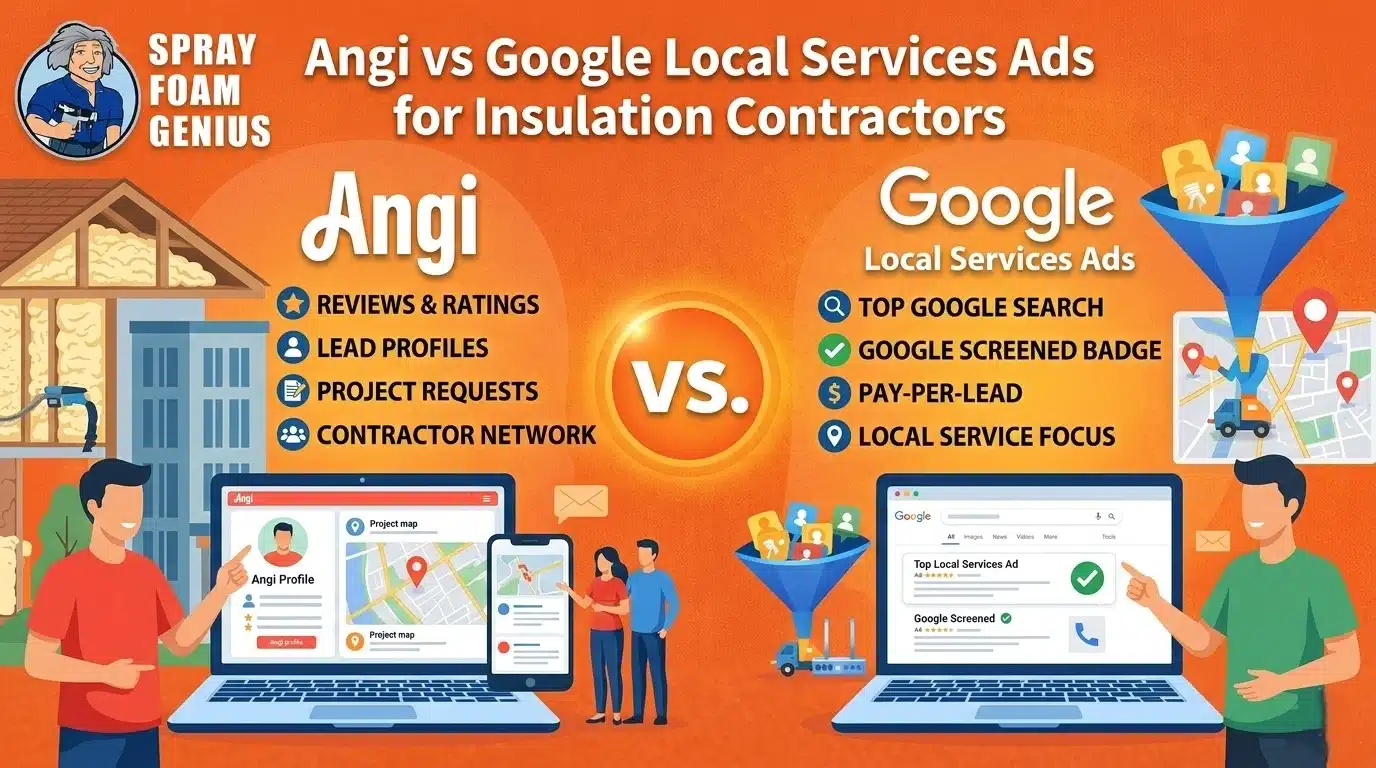
Related reading: Angi, HomeAdvisor and Google Local Services Ads for Insulation Contractors: What Is Worth It?
What Drives Google Ads Cost for Insulation Contractors
You pay when someone clicks (or, with Local Services Ads, for each valid lead), and the price comes from an auction. Per Google’s documentation on the ad auction, where your ad appears and what you pay depends on your bid, the quality of your ad and landing page, and other auction factors. In practice, these things move your costs most:
- Your market: large metro areas with many bidders usually cost more per click than small towns.
- Competition for your services: spray foam, attic and retrofit keywords can be competitive in some areas.
- Keywords: specific phrases, such as “attic spray foam insulation installation”, tend to be cheaper and more focused than broad terms like “insulation”.
- Ad and landing page quality: relevant ads and pages that match the search generally perform better.
- Conversion rate: if more visitors call or fill out the form, each lead costs less.
- Seasonality: demand for insulation changes through the year, and so do costs.
- Wasted clicks: without negative keywords you pay for searches like “DIY insulation” or “insulation jobs”.
A Benchmark to Use as a Starting Point
Published numbers for insulation specifically are hard to find, so treat any figure as a rough guide. For a broad reference, LocaliQ’s 2026 search advertising benchmarks list the Home & Home Improvement category at an average $8.33 cost per click, a 6.47 percent click-through rate, an 8.05 percent conversion rate and a $90.92 cost per lead (page updated June 2026). That is a cross-industry average for the category. Your insulation or spray foam market could be higher or lower, so use your own account data as soon as you have it.
From Cost Per Click to Cost Per Booked Job
Clicks are not the goal. Work backward from the jobs you want. Here is a simple example using the benchmark above, only to show the math:
- You want 20 leads in a month. At an 8.05 percent conversion rate, that takes about 248 clicks.
- At $8.33 per click, 248 clicks cost about $2,070.
- That works out to roughly $103 per lead. If you close 1 in 4 leads, that is about 5 jobs, or roughly $414 in ad spend per booked job.
Now compare that with your margin. If an average job leaves you $1,000 in gross profit, a $414 cost per booked job may be acceptable. If it leaves $400, it is not. This is why cost per booked job matters more than cost per click or cost per lead. Your close rate and job value decide the answer, and only your own tracking can tell you what they are.
How to Think About Budget
There is no single right number, and anyone who quotes one without knowing your market is guessing. Think in terms of what you need to learn and what you can afford to test:
- Enough to collect real data: tiny budgets in competitive areas can take a long time to produce enough clicks and calls to improve results.
- Focused first: start with one service area and your core keywords, such as spray foam and attic insulation, with call tracking and a simple dedicated landing page.
- Expand when it pays: add services (residential and commercial), more landing pages and nearby cities once cost per booked job looks good.
- Plan for more than clicks: setup work such as landing pages, call tracking and analytics takes time or money, and agency management fees, if you use one, are separate from ad spend.
Be wary of promises that a particular spend will produce a particular number of leads. Costs and results vary by market and by how well the account is run.
Why Google Ads Can Work for Insulation Businesses
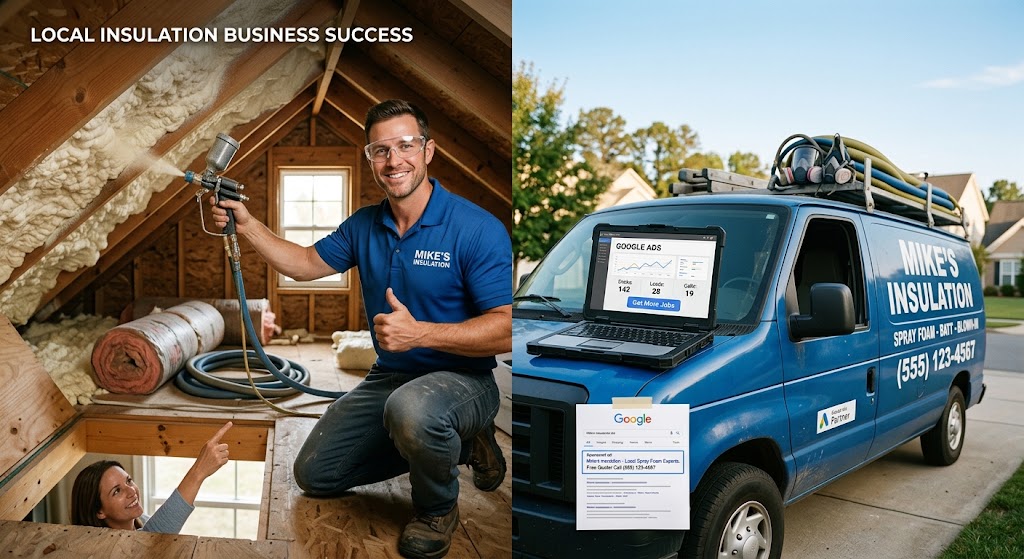
The main reason is intent. A homeowner searching “spray foam insulation near me” or “attic insulation cost” already has a problem and wants it solved. You are answering a question they already asked. Ads can offer advantages that SEO usually takes months to build:
- Speed: your ad can appear at the top of results soon after a campaign launches and is approved.
- Control: you choose the service area, keywords, hours, device and daily budget, and you can pause or change them quickly.
- Measurement: you can track clicks, calls and forms, and with the right setup connect them to booked jobs and revenue.
- Fast feedback: if an ad or keyword is not working, you can change it and see the effect sooner than with most other marketing.
For a deeper look at how the two fit together, see our guide to SEO vs Google Ads for insulation contractors.
Google Ads vs Local Services Ads
Search campaigns give you full control over your message, landing page and offer, and you pay per click whether or not the visitor calls. Local Services Ads work differently: Google says you are charged for each valid lead, and prices vary by location, job type and lead type. LSAs can lower your risk if your website is not fully optimized, but you control less of the message. Right now, Local Services Ads are available to insulation installation contractors only in California and Florida, so contractors in other states cannot run them. Google can change this, so check its Local Services Ads page for your area.
Our recommendation for many small businesses is to start with Search campaigns to learn which keywords and pages convert, then, if you are in California or Florida, where Local Services Ads are currently open to insulation installers, add them once you understand your numbers. See how they compare with lead marketplaces in our guide to Angi, HomeAdvisor and Local Services Ads.
Is Google Ads Worth It for Your Business? A Quick Gut Check
- Do you have a dedicated landing page for each major service, not just a generic homepage?
- Can your team answer calls or reply to forms within minutes during business hours?
- Do you collect and show real customer reviews?
- Do you have crew capacity to take on more jobs?
- Can you commit to a test window of at least several weeks, and ideally a few months, before judging results?
- Can you track calls and, ideally, booked jobs by source?
If you can say yes to most of these, ads have a stronger chance of paying for themselves. If you answered no to several, fix those gaps first or get help, so you are not pouring money into a leaky funnel. Ads are a poor fit if you expect instant results in a month, cannot take on more work, or are unwilling to improve your landing page and tracking.
Common Mistakes That Waste Ad Spend
- No negative keywords, so you pay for “DIY insulation” and job seeker searches.
- Sending clicks to a homepage instead of a landing page built around one service and one call to action.
- Ignoring mobile speed. Many local searches happen on phones, and a slow page loses visitors before they see your offer.
- No geographic controls, so ads show outside your service area.
- Slow response. Fast replies tend to improve your chances of winning the job.
- Optimizing for clicks instead of calls and booked jobs.
- Set-it-and-forget-it management. Search terms, bids and budgets need regular review, especially as demand shifts with the seasons.
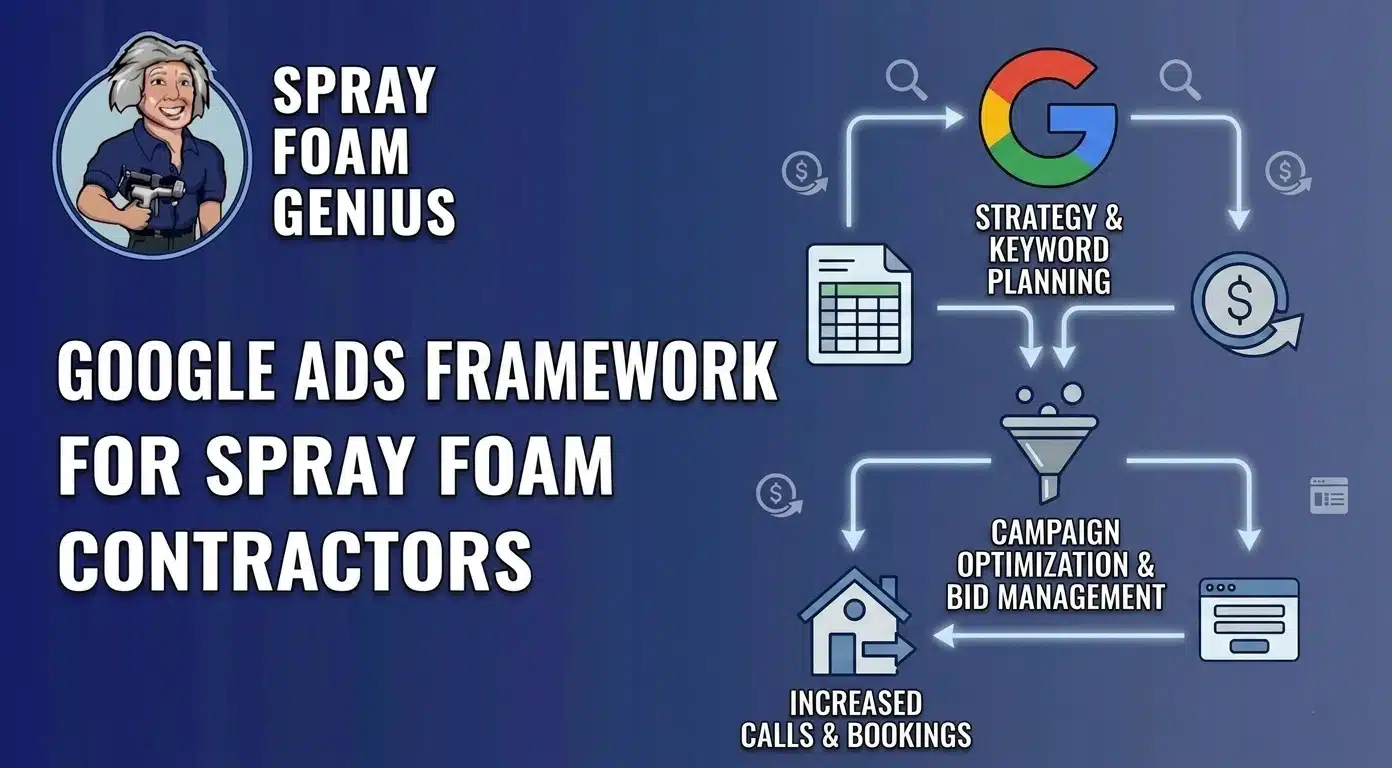
For a step-by-step build of a well-structured account, follow our Google Ads framework for spray foam contractors.
How We Help Make Google Ads Profitable
We work with insulation and spray foam contractors, so we build campaigns around the keywords, seasonal patterns and objections homeowners bring in your trade. That includes attic, wall and spray foam service keywords, plus problem keywords such as a house that is too hot upstairs. Our campaigns include:
- Keyword research built around insulation and spray foam search behavior.
- Negative keyword lists to block DIY and job seeker traffic.
- Landing pages designed to convert, not just inform.
- Call tracking, so you can see which keyword produced each lead.
- Reporting that focuses on cost per booked job.
You can read more about our Google Ads for spray foam contractors service.
Frequently Asked Questions
Is Google Ads worth it for a small insulation business?
It can be, if you have a fast follow-up process, a landing page that converts, and tracking that shows cost per booked job. If those are missing, you may be better off fixing them first.
How much should a small insulation business spend on Google Ads?
It depends on your market, your services and your goals. Choose a budget that is large enough to collect meaningful data in your area, start with a focused service area, and increase it only when your cost per booked job fits your margin. Ad management fees, if you hire help, are separate from ad spend.
How much does a click cost?
It varies by market and keyword. The LocaliQ benchmark above puts the average for the broad Home & Home Improvement category at $8.33 per click, but your own market could differ. Look at actual costs in your account after a test period.
How many leads can you expect from a given budget?
As an example only, at the benchmark average of $90.92 per lead, $1,000 would produce about 11 leads. Real results depend on your market, keywords, landing pages and follow-up, so track your own numbers.
How long before Google Ads pays off?
Campaigns can start sending clicks and calls within days of launch. Optimization takes longer, since you need enough data to refine keywords, ads and landing pages, so judge results over weeks and months rather than days.
Are Local Services Ads worth it for insulation businesses?
They can be a useful addition. Google says you are charged for each valid lead rather than per click. Only in California and Florida for now: insulation installation contractors elsewhere cannot run them yet, and Google can change that. If you are eligible, track the leads like any other source, and compare cost per booked job.
Is Google Ads better than SEO for insulation contractors?
They do different jobs. Ads are faster, while SEO takes longer and can lower your reliance on paid clicks over time. Many contractors use both, running ads while their organic visibility builds.
Find Out If Google Ads Fits Your Business
We would rather give you an honest answer than sell you a campaign you are not ready for. Ask for a free marketing audit and we will review your website, your market and your competitors before recommending anything. Call 877-840-3626 or email info@sprayfoamgeniusmarketing.com.
Further Reading
Official guidance from Google on the topics in this article: