
Direct Answer
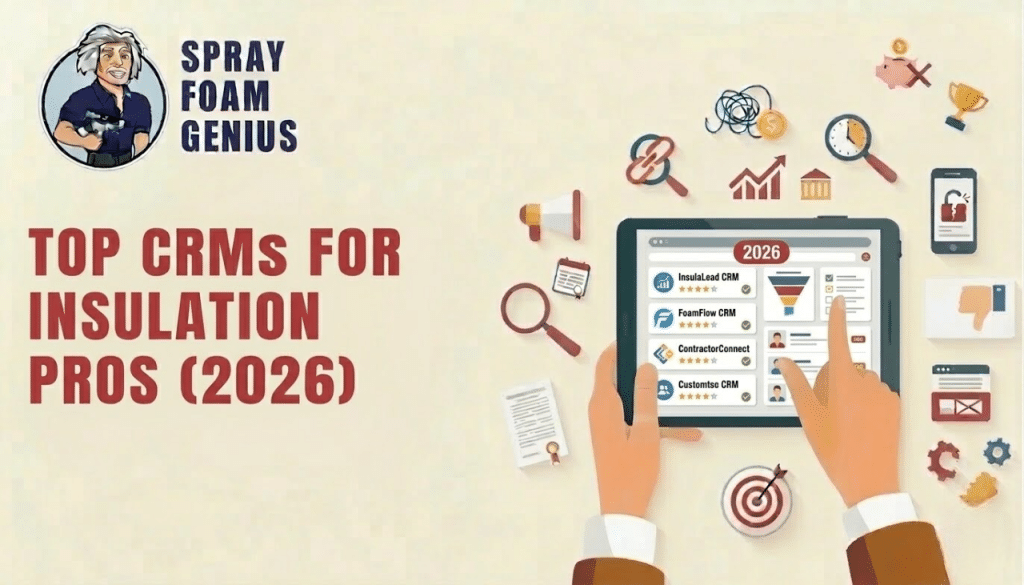
The best CRM for insulation contractors in 2026 depends on your company’s size, sales process complexity, and growth goals. Top-performing companies are not all using the same tool. Instead, they choose CRMs based on three core strategy categories: field service CRMs, sales-focused CRMs, and marketing automation platforms.
- Smaller contractors often rely on simple, mobile-first CRMs to manage leads and estimates
- Mid-sized companies prioritize pipeline tracking, automation, and integrations
- High-growth insulation businesses invest in full-stack platforms that combine CRM, marketing, and reporting
The right CRM is not just about storing contacts. It directly impacts lead conversion rates, response speed, and revenue predictability. According to HubSpot, businesses using CRM systems effectively improve sales performance through automation and better pipeline visibility. This guide breaks down what top insulation companies are actually using and how to choose the right system for your stage of growth.
TLDR / Key Takeaways
- Most insulation companies invest between $30 and $300 per user/month
- Field service CRMs can be implemented in 1 to 3 weeks, while advanced systems take up to 3 months
- Marketing-integrated CRMs generate the highest long-term ROI but require proper setup
- Automation, not contact storage, is the biggest driver of CRM success
- Poor adoption and lack of process alignment are the most common failure points
- Top companies focus on speed-to-lead, follow-up consistency, and pipeline visibility
What Makes a CRM Effective for Insulation Contractors
Most CRM failures come from poor implementation rather than poor software choice. A system only works when it reflects how insulation businesses actually sell and operate.
A high-performing CRM should:
- Track lead sources such as Google Ads, referrals, and organic traffic
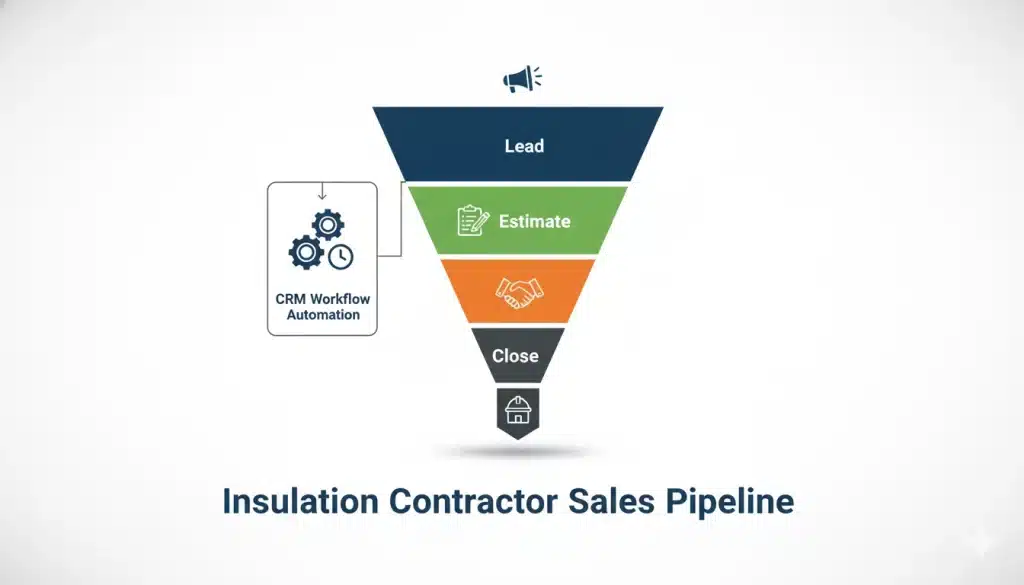
- Automate estimate follow-ups and reminders
- Show job progress stages from lead to installation
- Provide mobile access for field teams
- Integrate with marketing platforms and call tracking tools
Research from Harvard Business School shows that structured sales systems consistently outperform informal processes in both efficiency and revenue predictability.
Types of CRMs Used by Top Insulation Companies
1. Field Service CRMs
These are designed specifically for contractors managing jobs, crews, and scheduling.
Examples: Jobber, ServiceTitan, Housecall Pro
Best for: Small to mid-sized contractorsStrengths: Scheduling, dispatching, invoicingLimitations: Limited marketing automation
2. Sales-Focused CRMs
These platforms are built to manage leads, track deals, and improve closing rates.
Examples: HubSpot CRM, Pipedrive, Zoho CRM
Best for: Companies with steady lead flowStrengths: Pipeline tracking, automation, reportingLimitations: Requires integration with job management tools
3. All-in-One Marketing CRMs
These combine CRM, email marketing, automation, and reporting into one system.
Examples: GoHighLevel, ActiveCampaign, Keap
Best for: Scaling insulation companiesStrengths: Full funnel visibility and automationLimitations: More complex setup
According to Salesforce, CRM systems are most effective when they centralize customer data and automate repetitive tasks, allowing businesses to focus on closing deals rather than managing data.
CRM Comparison Table
How to Choose the Right CRM
Key Decision Factors
Strategy: Matching CRM to Business Stage
Startup / Small Contractors
- Focus on simplicity and ease of use
- Prioritize scheduling and lead tracking
- Avoid overcomplicated systems
Recommended: Field service CRM
Growing Companies
- Build structured pipelines
- Implement automated follow-ups
- Track marketing performance
Recommended: Sales CRM
Scaling Businesses
- Integrate CRM with marketing systems
- Automate lead nurturing
- Use reporting to drive decisions
Recommended: All-in-one CRM
Signs You’ve Found the Right CRM
- No leads are lost or forgotten
- Your team follows a consistent process
- You can track pipeline value in real time
- Follow-ups are automated
- Reports clearly show revenue drivers
If your CRM feels like extra work instead of a productivity tool, it is not properly implemented.
Get Expert Help Setting Up the Right CRM
Choosing the right CRM is only half the equation. The real results come from how it is configured, automated, and aligned with your sales process.
Spray Foam Genius Marketing helps insulation contractors implement CRM systems that actually drive leads and revenue.
📞 USA: 877‑840‑FOAM 📞 Canada: 844‑741‑FOAM📧 Email: info@sprayfoamgeniusmarketing.com
Build a system that turns every lead into a measurable opportunity.
FAQs
What is the best CRM for insulation contractors in 2026?
There is no one-size-fits-all solution. The best CRM depends on your business size, lead volume, and growth goals.
How much does a CRM cost?
Most insulation contractors spend between $30 and $300 per user per month depending on features and automation.
How long does CRM implementation take?
Basic systems can be set up in a few weeks, while advanced platforms may take up to 3 months.
Do I need a CRM if I already use spreadsheets?
Yes. CRMs automate follow-ups, track pipelines, and improve conversion rates, which spreadsheets cannot do effectively.
What is the biggest mistake contractors make?
Choosing a CRM without aligning it to their workflow or failing to train their team on how to use it.
Sources
- HubSpot CRM: https://www.hubspot.com/products/crm
- Harvard Business School: https://www.hbs.edu/faculty/Pages/default.aspx
- Salesforce CRM Guide: https://www.salesforce.com/crm/what-is-crm/
- McKinsey & Company: https://www.mckinsey.com/