
Introduction to Spray Foam Lead Generation
Most spray foam contractors struggle not because of poor service, but because they lack a consistent system to attract and convert new customers. This guide walks you through every component of a spray foam lead generation system built for real business growth.
If you are a spray foam contractor and your phone is not ringing consistently, the problem is almost never your spray rig, your crew, or your workmanship. The problem is visibility. You are doing excellent work in a market where homeowners and commercial property managers are actively searching for exactly what you offer, yet those searches are landing on your competitor’s website instead of yours.
Spray foam lead generation is the structured process of attracting, capturing, and converting potential customers into paying jobs. In 2025, that process is more sophisticated and more measurable than it has ever been. Contractors who treat marketing as an afterthought lose ground every month. Those who invest in a repeatable spray foam marketing system compound their growth quarter after quarter.
Why Lead Generation Matters for Spray Foam Contractors
Without a predictable flow of leads, spray foam businesses are stuck chasing referrals and riding seasonal swings. A structured system creates stability and scalability.
The spray foam insulation market in North America is expanding rapidly, driven by rising energy costs, stricter building codes, and growing awareness of building performance. According to the U.S. Department of Energy, proper insulation can reduce home energy costs by up to 15 percent, a statistic that resonates strongly with homeowners and building owners alike.
Despite market tailwinds, many spray foam contractors operate on inconsistent revenue because they depend almost entirely on word-of-mouth referrals. Referrals are valuable but unreliable. They cannot be turned up when business slows or scaled when capacity expands. A lead generation system solves both problems.
Here is what consistent lead generation does for a spray foam business:
- Reduces feast-or-famine revenue cycles
- Gives you control over job volume and job type (residential vs commercial)
- Lets you raise prices because demand exceeds availability
- Creates a sellable, scalable business asset
The contractors generating the most leads for spray foam contractors are not necessarily the best installers in their market. They are the best marketers. That gap is entirely closable with the right system.
What Is a Spray Foam Lead Generation System?
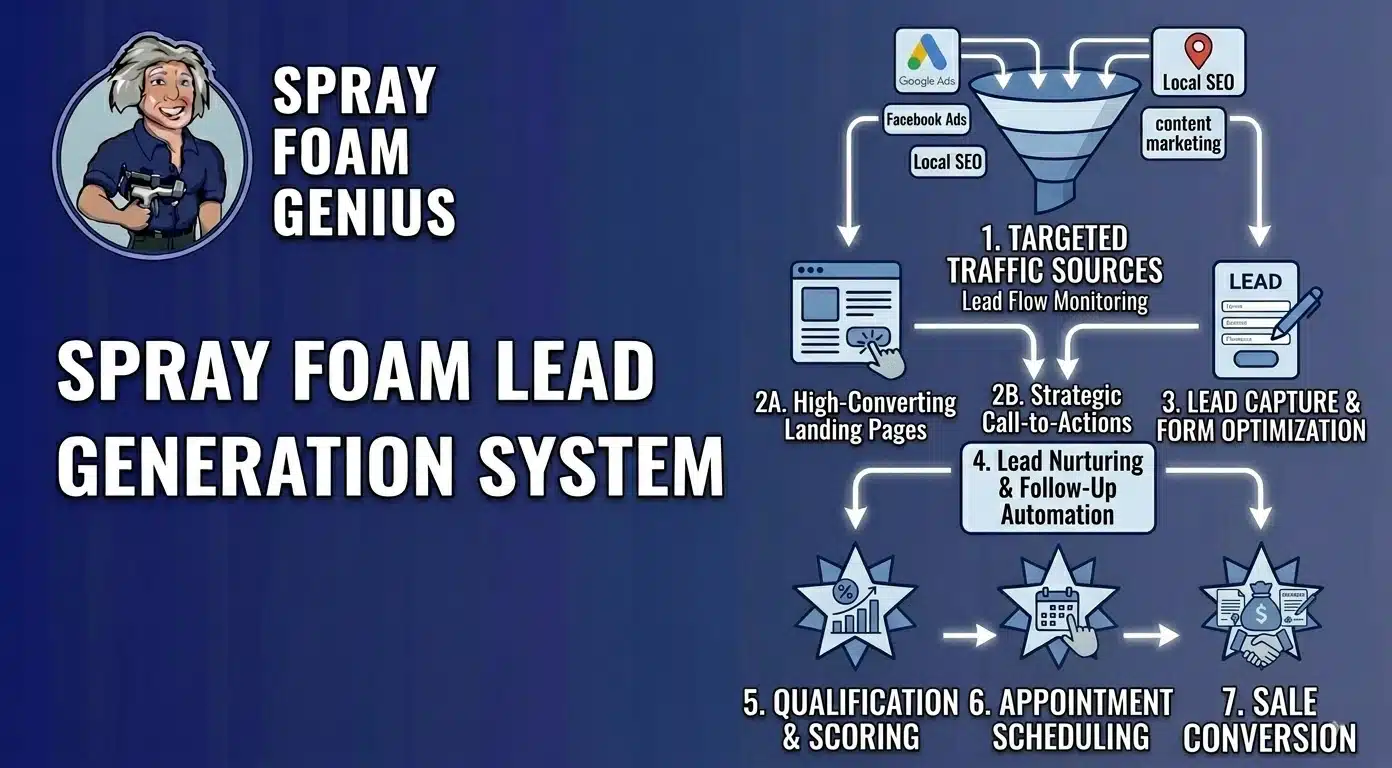
A spray foam lead generation system is a connected set of marketing channels, tools, and processes designed to attract, capture, and convert prospects into booked jobs consistently.
A lead generation system is not a single tactic. It is not just running Google Ads or posting on Facebook. It is a coordinated infrastructure where each component feeds the next.
Every component above either attracts new prospects or converts existing ones. A complete spray foam insulation marketing strategy addresses all six. Gaps in any one area create revenue leaks you may not notice until you audit your numbers.
How a Lead Generation System Helps Grow Your Business

A functional lead generation system shifts a spray foam business from reactive (waiting for the phone to ring) to proactive (generating calls on demand), which directly impacts revenue, hiring, and market positioning.
When your lead generation system is running at full capacity, several compounding effects occur simultaneously:
Revenue predictability: You can forecast monthly revenue based on ad spend, organic rankings, and conversion rates rather than guessing.
Hiring confidence: Growth in lead volume justifies adding crew members or equipment without the fear of slow months, eliminating the investment.
Market dominance: The more visible you are online, the less visible your competitors become. Top-ranked local businesses take a disproportionate share of inquiries.
Price leverage: Contractors with full calendars from strong spray foam contractor leads do not compete on price. They compete on quality and availability.
According to Forbes, over 90 percent of all buying decisions now begin with an online search, which means your digital presence is not supplementary to your sales process. It is your sales process. If you are not visible where your customers are searching, you are invisible to nearly your entire market.
Key Components of a Successful Spray Foam Marketing Strategy
Your spray foam marketing strategy should be built on six pillars: a high-converting website, local SEO, paid ads, social proof, content, and automation.
Think of your marketing strategy as an engine. Each cylinder must fire correctly. If one is misfiring, you lose power and efficiency across the entire system.
Building a High-Converting Spray Foam Website
Your website is not a digital business card. It is a 24/7 sales representative. A high-converting spray foam website accomplishes several things simultaneously:
- Communicates your services clearly and quickly (above the fold)
- Builds trust through testimonials, certifications, and project photos
- Makes it easy for visitors to call or submit a form
- Loads fast on mobile (over 60 percent of local searches happen on mobile devices)
- Ranks for relevant keywords through on-page SEO
According to Think with Google, 53 percent of mobile visitors abandon a website that takes longer than three seconds to load. For spray foam contractors relying on mobile search traffic from homeowners in-market, page speed is not a technical nicety. It is a direct revenue variable.
Weak websites lose leads at the door. Strong websites convert 5 to 15 percent of visitors into inquiries. At 100 monthly visitors, that difference is 5 vs 15 leads per month. Over a year, that gap compounds into tens of thousands of dollars in missed revenue.
Essential website pages for spray foam contractors:
- Home (primary keyword targeting, trust signals, primary CTA)
- Residential Spray Foam Services
- Commercial Spray Foam Services
- About (team, story, certifications)
- Service Area pages (for local SEO targeting by city)
- Blog or Resources (for content marketing)
- Contact (phone number prominent, form functional)
Local SEO Strategies for Spray Foam Contractors
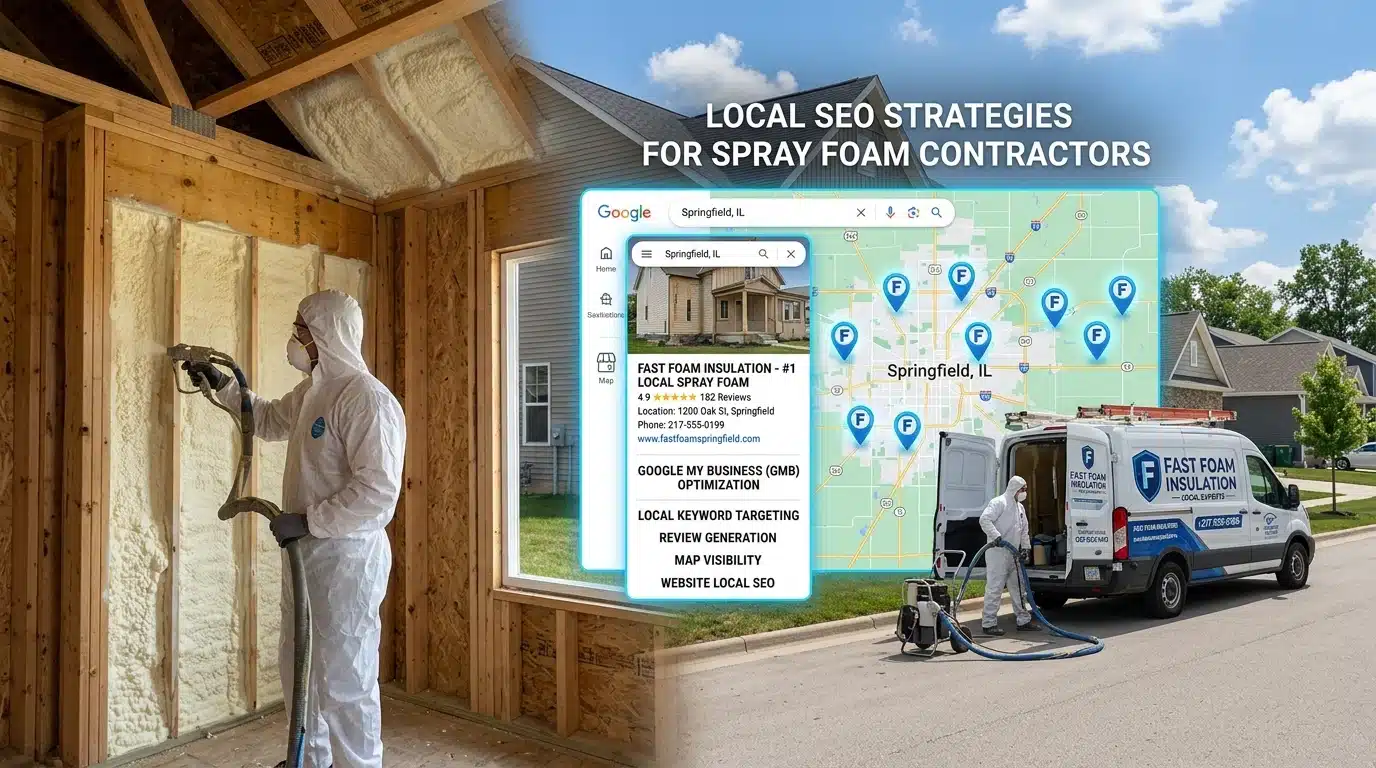
Local SEO determines whether your business appears when nearby customers search for spray foam services. It is the highest-ROI long-term marketing investment for most contractors.
Local SEO for spray foam contractors focuses on three core areas: Google Business Profile, on-page optimization, and citation building.
Google Business Profile Optimization for More Local Leads
Your Google Business Profile (GBP) is often the first thing a local customer sees before they ever visit your website. An optimized profile appears in the local 3-pack, the map results that display above organic listings for searches like “spray foam insulation near me.”
Optimization steps that directly impact lead volume:
- Complete every section of your profile (services, hours, service areas, description)
- Upload high-quality before-and-after project photos regularly
- Select the most specific primary category (“Insulation Contractor”)
- Add all relevant secondary categories
- Respond to every review, positive or negative, within 24 hours
- Post weekly updates, offers, or project highlights
- Enable messaging and respond promptly
According to Google’s own documentation on Business Profiles, businesses that add photos to their profiles receive 42 percent more requests for directions and 35 percent more clicks to their websites compared to businesses without photos. Contractors who actively manage their GBP see significantly higher call volumes than those who set it and forget it. This is one of the fastest and cheapest wins available in spray foam insulation marketing.
Using Google Ads to Generate Spray Foam Leads
Google Ads delivers immediate, high-intent leads for spray foam contractors. When structured correctly, it generates a predictable return on ad spend from the first week.
Google Ads allows you to appear at the top of search results for keywords your ideal customers are actively searching. Unlike SEO, which takes months to produce results, Google Ads can generate spray foam contractor leads within 24 to 48 hours of campaign launch.
Key factors that determine Google Ads success for spray foam businesses:
Keyword targeting: Focus on high-intent, service-specific keywords such as “spray foam insulation contractor [city],” “open cell spray foam cost,” and “attic spray foam near me.” Avoid broad match keywords that attract unqualified clicks.
Landing page quality: Sending ad traffic to your homepage is a common and costly mistake. Each ad group should direct traffic to a dedicated landing page matching the search intent exactly.
Negative keywords: Block irrelevant searches (“DIY spray foam,” “spray foam gun kit”) to prevent wasted spend.
Bid strategy: For most spray foam businesses, a Target CPA or Maximize Conversions bid strategy outperforms manual bidding once sufficient conversion data is accumulated.
Facebook and Social Media Marketing for Spray Foam Businesses

Facebook and Instagram allow spray foam contractors to build brand awareness and generate leads through targeted paid campaigns and organic community engagement.
Social media is not where most spray foam customers start their purchase journey, but it plays a critical role in building the trust and familiarity that closes deals faster. A homeowner who has seen your project photos, read your reviews, and watched a short video walkthrough of your process is far more likely to book than one who found you through a cold search.
According to HubSpot’s State of Marketing Report, short-form video content generates the highest ROI of any social media format, outperforming static images, carousels, and long-form video. For spray foam contractors, this means a 60-second clip of an attic application can outperform a polished photo gallery in driving engagement, trust, and inbound inquiries.
Organic social media best practices:
- Post project photos with before-and-after comparisons (high engagement)
- Share short video clips of application processes (builds authority)
- Publish energy savings stories from real customers
- Highlight team members and community involvement
Facebook Ads for spray foam lead generation:
- Use lead generation campaigns with instant forms (lower friction than website redirects)
- Target homeowners by zip code, age, homeownership status, and income
- Create retargeting audiences from website visitors
- Run seasonal promotions tied to heating and cooling cost messaging
Content Marketing Strategies for Spray Foam Companies
Content marketing builds organic search traffic and positions your company as the local expert, making it the highest-leverage long-term investment in spray foam business growth.
Blog content and resource pages do two things: they attract organic search traffic from people researching spray foam insulation, and they build topical authority that signals to Google that your website is the most relevant result in your market.
High-value content topics for spray foam contractors:
- “Open Cell vs Closed Cell Spray Foam: Which Is Right for Your Home?”
- “How Much Does Spray Foam Insulation Cost in [City]?”
- “Spray Foam Insulation for Crawl Spaces: Complete Guide”
- “R-Value Requirements by State: What Contractors Need to Know”
- “How Long Does Spray Foam Insulation Last?”
Each piece of content should be written to answer a specific search query, include your primary and secondary keywords naturally, and contain a clear call to action directing readers to contact your business.
Creating Landing Pages That Convert Visitors Into Customers
Dedicated landing pages for specific services and locations convert paid and organic traffic at significantly higher rates than general website pages.
A landing page has one job: convert a visitor into a lead. Unlike a homepage that serves multiple audiences and purposes, a landing page is laser-focused on a single offer and a single action.
High-converting spray foam landing page elements:
- Headline that matches the search intent (“Get a Free Spray Foam Quote in [City]”)
- Subheadline reinforcing the primary benefit
- Trust signals (years in business, certifications, number of projects completed)
- 3 to 5 bullet points covering key service benefits
- A short contact form (name, phone, email, zip code)
- Social proof (3 to 5 star reviews with customer names)
- Prominent phone number (click-to-call on mobile)
- Single, high-contrast CTA button
Avoid cluttering landing pages with navigation menus, excessive links, or unrelated content. Every element should either build trust or drive conversion.
The Importance of Online Reviews and Reputation Management

Online reviews are one of the most powerful lead generation tools for spray foam contractors. They directly influence both local search rankings and customer conversion rates.
A business with 50 five-star reviews will consistently outrank and out-convert a business with 10 reviews, regardless of how much either spends on ads. Reviews are trusted at scale.
According to the BrightLocal Local Consumer Review Survey, 98 percent of consumers used the internet to find information about a local business in the past year, and 87 percent read online reviews for local businesses before making a contact decision. For spray foam contractors, this means your review profile is actively working for or against you on every single search.
Best practices for generating more reviews:
- Ask every satisfied customer directly, ideally in person, immediately after job completion, and follow up with a text message containing a direct link to your Google review page
- Train your team to mention reviews as a standard part of job closeout
- Respond to every review, especially negative ones, professionally and constructively
- Monitor your reputation across Google, Facebook, Yelp, Houzz, and the Better Business Bureau
One unaddressed negative review can cost you dozens of leads. Reputation management is not optional for any contractor serious about spray foam business growth.
Email Marketing for Spray Foam Lead Nurturing
Email marketing keeps your business top of mind for prospects who are not yet ready to book and re-engages past customers for referrals and repeat work.
Most leads do not convert on the first contact. A homeowner requesting a quote in January may not be ready to move forward until March. Email marketing ensures your business is still visible and trusted when they are ready.
Effective spray foam email sequences:
- Lead nurture series (5 emails over 2 weeks): Educational content about spray foam benefits, cost savings, your process, and customer results
- Seasonal campaigns: Pre-winter and pre-summer messages targeting energy savings
- Referral campaigns: Post-job follow-ups asking for referrals with a small incentive
- Re-engagement campaigns: Reach out to cold leads after 60 to 90 days of inactivity
Email marketing platforms like Mailchimp, ActiveCampaign, or HubSpot allow full automation of these sequences so they run without manual effort.
CRM and Automation Tools for Managing Leads

Without a CRM, leads fall through the cracks. A simple CRM system increases close rates by ensuring every lead receives timely follow-up and proper tracking.
A Customer Relationship Management (CRM) tool is the backbone of any serious spray foam marketing system. It tracks every lead from first contact through booked job, records communication history, and automates follow-up tasks.
Speed to lead is one of the most critical variables in lead conversion. According to research cited by Harvard Business Review, businesses that respond to leads within an hour are seven times more likely to have a meaningful conversation with a decision-maker than those who wait even 60 minutes. Automation through your CRM can trigger instant text and email responses to new inquiries, even when you are on a job site.
How to Target Residential and Commercial Spray Foam Customers
Residential and commercial spray foam customers have different pain points, buying cycles, and decision-making processes. Your marketing should speak to each separately.
Residential customers are typically motivated by energy savings, comfort improvement, and home value. They search for information, compare prices, and often require 2 to 3 touchpoints before booking.
Commercial customers (property managers, general contractors, building owners) are driven by code compliance, ROI on energy costs, and project timelines. They respond to case studies, ROI calculators, and direct outreach more than advertising.
Targeting strategies by customer type:
Residential: Google Search Ads, local SEO, Facebook Ads targeting homeowners, content marketing, review generation
Commercial: LinkedIn outreach, direct mail to property management companies, partnerships with general contractors, targeted Google Ads for commercial keywords
Running separate campaigns, landing pages, and messaging for each customer type consistently outperforms mixed messaging.
Tracking ROI From Your Lead Generation Campaigns
You cannot improve what you do not measure. Every spray foam lead generation campaign should be tracked from click to closed job to understand your true cost per customer.
Marketing without tracking is guessing with money. Effective ROI tracking for spray foam businesses requires connecting three data streams: marketing data (clicks, impressions, cost), lead data (inquiries, sources, quality), and sales data (quotes, booked jobs, revenue).
Key metrics every spray foam contractor should track:
- Cost per lead (by channel)
- Lead-to-quote conversion rate
- Quote-to-job conversion rate
- Cost per booked job
- Average job value
- Return on ad spend (ROAS)
- Lifetime customer value
Use Google Analytics 4 for website tracking, Google Ads conversion tracking for paid campaigns, and your CRM for sales pipeline reporting. Review these metrics monthly and adjust underperforming channels accordingly.
Common Mistakes Spray Foam Contractors Should Avoid
Most spray foam marketing failures trace back to a small set of predictable mistakes that can be avoided with awareness and proper planning.
The most common and costly lead generation mistakes made by spray foam contractors:
- No website or a poorly performing website: If your site loads slowly, looks outdated, or does not have clear calls to action, you are converting a fraction of your potential leads.
- Ignoring local SEO: Most customers search locally. If you are not optimized for local search, you are not appearing in the searches that matter most.
- Sending ad traffic to the homepage: Dedicated landing pages always outperform homepages for paid campaigns.
- Not following up fast enough: Speed to lead is one of the biggest variables in conversion. Automated follow-up is not optional.
- Treating marketing as a one-time project: Effective marketing is an ongoing process that requires consistent optimization, content creation, and investment.
- Ignoring reviews: A business with few or poor reviews loses leads daily to competitors with stronger reputations.
Case Studies: Successful Spray Foam Business Growth Stories
Real-world results from spray foam contractors who implemented structured lead generation systems demonstrate what is achievable with the right strategy and consistent execution.
Case Study 1: Residential Contractor in the Midwest A spray foam contractor with 3 years in business and no digital presence invested in a website rebuild, Google Ads, and local SEO. Within 6 months, monthly lead volume grew from 8 to 47 leads per month. Revenue increased by 210 percent year over year.
Case Study 2: Commercial Spray Foam Contractor in Texas A commercial-focused contractor partnered with a spray foam marketing agency to build a LinkedIn outreach campaign and commercial landing pages. Within 90 days, they secured 3 new commercial contracts totalling over $180,000 in revenue.
Case Study 3: Multi-Market Expansion in the Southeast: A contractor operating in a single market used a review generation campaign and Google Business Profile optimization to reach the top 3 positions in local search across their primary city. They used that model to expand to 2 additional markets within 18 months.
Future Trends in Spray Foam Lead Generation
AI-powered tools, voice search, and video marketing are reshaping how spray foam contractors attract and convert leads. Staying ahead of these trends provides a significant competitive advantage.
The landscape of spray foam lead generation is evolving quickly. Contractors who adapt early capture market share before competitors catch up.
AI-powered ad optimization: Google and Meta now use machine learning to optimize ad delivery, creative, and bidding in real time. Contractors who embrace smart campaigns and strong creative assets are seeing better results than those relying on rigid manual structures.
Voice search: More homeowners are using voice assistants to find local services. Optimizing for conversational queries such as “who does spray foam insulation near me” is increasingly important.
Video marketing: Short-form video content on YouTube, Instagram Reels, and TikTok is generating strong organic reach for service businesses. A 60-second project walkthrough consistently outperforms static images for engagement and trust-building.
Hyper-local targeting: As digital advertising becomes more sophisticated, the ability to target specific neighborhoods, zip codes, and even individual streets allows spray foam contractors to minimize wasted ad spend and maximize relevance.
Scale Your Spray Foam Business With a Proven Lead Generation System
Building a consistent, scalable spray foam business in 2025 requires more than great workmanship. It requires a marketing system that works as hard as your crew does. From a high-converting website and local SEO to Google Ads, reputation management, and automated lead follow-up, every component of your spray foam lead generation system compounds over time to produce more leads, more booked jobs, and stronger revenue.
The contractors dominating their local markets did not get there by accident. They invested in a structured approach to spray foam insulation marketing, tracked their results, and refined their strategy month after month.
The framework in this guide gives you everything you need to build that system. The question is whether you implement it yourself or partner with a team that already has.
Ready to grow your spray foam business with a proven lead generation system?
Contact Spray Foam Genius Marketing today: USA: 877-840-FOAM | Canada: 844-741-FOAM Email: info@sprayfoamgeniusmarketing.com
Frequently Asked Questions
1. How long does it take to see results from spray foam lead generation?
Paid advertising such as Google Ads can produce leads within 24 to 72 hours of launch. Local SEO typically produces measurable results within 3 to 6 months of consistent optimization. A fully integrated system reaches peak performance between 6 and 12 months.
2. How much should a spray foam contractor spend on marketing?
Most industry benchmarks suggest allocating 5 to 10 percent of gross revenue to marketing. For a contractor generating $500,000 annually, that is $25,000 to $50,000 per year, or roughly $2,000 to $4,000 per month. The right number depends on your growth goals and current market position.
3. What is the best lead generation channel for spray foam contractors?
Google Search Ads and local SEO consistently produce the highest-quality leads because they target customers who are actively searching for spray foam services at the moment of intent. Social media and content marketing support brand awareness and nurture leads over time.
4. How do I get more Google reviews for my spray foam business?
Ask every satisfied customer directly, ideally in person immediately after job completion, and follow up with a text message containing a direct link to your Google review page. Make the request personal and specific rather than generic.
5. Do I need a specialized spray foam marketing agency or can I use a generalist?
A specialized agency like Spray Foam Genius Marketing delivers faster results because they understand your industry, your customers, your seasonality, and your competitive landscape without a learning curve. Generalist agencies apply generic strategies that rarely account for industry-specific dynamics.