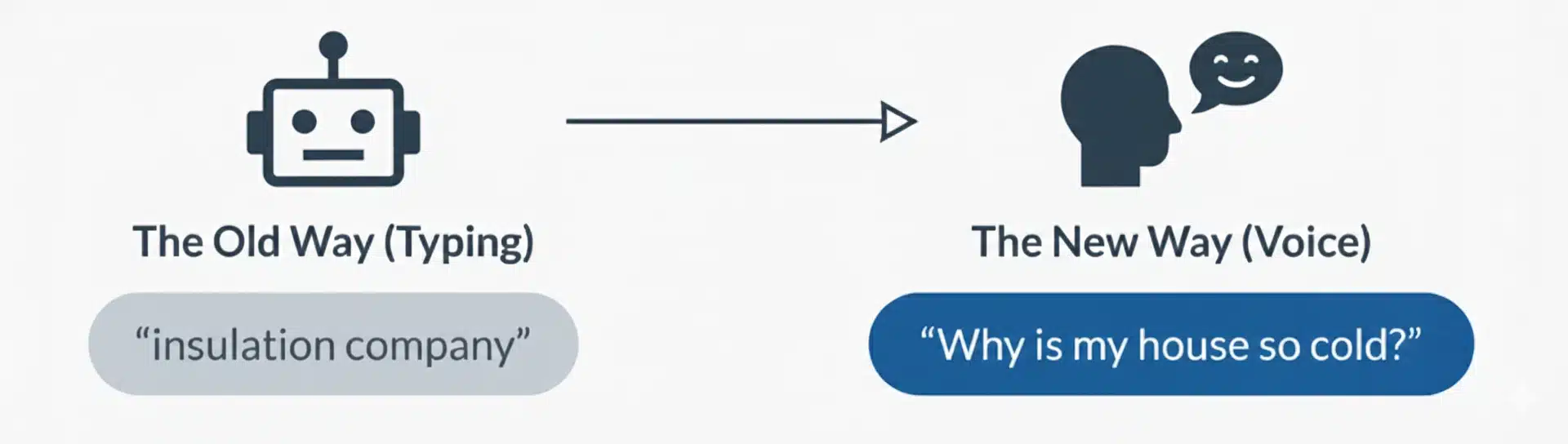


Homeowners have started asking AI tools the same questions they used to type into Google: “who’s the best spray foam insulation company near me” or “which insulation contractor has the best reviews in my area.” According to BrightLocal’s 2026 Local Consumer Review Survey, consumer use of AI tools like ChatGPT, Gemini, and Perplexity to find local businesses grew from 6% to 45% in a single year. That is not a niche behavior anymore. It is quickly becoming a normal part of how people hire contractors.
The catch is that AI search can be far more selective than a Google search page. A 2026 SOCi Local Visibility Index analysis of more than 350,000 locations across 2,751 multi-location brands found that ChatGPT recommends only about 1.2% of brand locations, and that Perplexity and Gemini are also far more selective than traditional local search. Meanwhile, those same locations show up in Google’s local 3-pack roughly 36% of the time. In plain terms, ranking on Google no longer guarantees an AI assistant will recommend you when a homeowner asks for a spray foam contractor.
This article covers what tends to help a spray foam or insulation company show up when homeowners ask AI tools for a recommendation, and what a contractor can realistically do about it. None of the AI companies publish exact selection rules, so treat this as practical guidance, not documented fact.
For Google's own AI features, Google says the work is the same as good SEO. Its guidance on AI features in Search says special files, special markup and AI-only rewriting are not needed, and that original, helpful content written for people matters most.
Why This Matters for Spray Foam Contractors
Spray foam insulation is a considered purchase. Homeowners research before they call, and increasingly that research starts with a question typed into an AI assistant instead of a search bar. If your company has no consistent presence across the sources these tools rely on, you are simply invisible in that conversation, no matter how good your installs are or how long you have been in business.
The upside is that nobody can buy a spot for you in a regular AI answer, and nobody can promise you one. The businesses that tend to be mentioned are the ones with clean, consistent, well-supported information across the web, which means a smaller spray foam company can compete with a large regional player if the fundamentals are in place.
Related reading: Google Search Console Explained: How Spray Foam Contractors Can Track Their SEO Performance
What Tends to Help You Get Mentioned
The companies behind AI assistants do not publish how they choose which businesses to mention, and it can change at any time. What we can say is that the sources below matter because they are the same places real customers look.
Reviews Help You Get Considered
Reviews help a business get considered, and they matter to the homeowners reading them too. Our working rule of thumb is to aim for at least 30 reviews with a rating of about 4.3 or higher, and more in competitive markets. That is our own guideline from working with contractors, not a documented requirement of any AI platform or of Google.
Directory and Listing Consistency
Google Business Profile, Yelp, BBB and industry directories are places customers and search tools look for your business. Keep your name, address and phone number consistent everywhere.
Structured Data Is Housekeeping, Not a Shortcut
JSON-LD structured data gives search engines a clean, machine-readable version of your business details, such as your name, services, location and hours, and it can make a page eligible for rich results. Google says structured data is not required for its AI features. Keep it accurate and matching what is visible on the page, but do not expect it to move AI recommendations on its own.
Third-Party Coverage and Mentions
Mentions on local news sites, industry publications and associations can help build trust beyond your own website.
Platform Differences: General Observations
- ChatGPT can draw on live web results for some questions, so current, consistent information about your business online helps. OpenAI does not publish how it chooses which businesses to mention.
- Perplexity shows the sources next to its answers, so you can see which pages and directories it used for a given question. That makes it a useful place to check what is being said about your business.
- Gemini is a Google product, and your Google Business Profile is Google's own record of your business, so keeping it accurate is worth doing for every reason.
- Claude and other assistants vary, and none of them publish a formula. The same basics apply: consistent, well-documented, well-reviewed businesses are easier to describe accurately than ones with thin or conflicting information.
These are not four separate campaigns. The same fundamentals, accurate listings, genuine reviews, a clear website and mentions on other trusted sites, are what we work on, and they also help ordinary Google search.
What Spray Foam Contractors Can Do Now
- Audit your listings. Check Google Business Profile, Apple Maps, Yelp, Bing Places, and Facebook for matching NAP information, correct service areas, and up-to-date hours.
- Build a steady review cadence. A handful of five-star reviews from years ago will not carry a recommendation today. Aim for a consistent flow of recent reviews and respond to as many as possible, because it shows real customers that you are active.
- Keep your structured data accurate. LocalBusiness schema with your service area, phone number and hours helps search engines read your business details. It is not required for Google's AI features, so treat it as housekeeping.
- Get mentioned beyond your own website. Local press, industry directories and trade association listings add outside validation that customers and search tools can see.
- Answer real customer questions directly on your site. Content that clearly answers questions like “how much does spray foam insulation cost” or “is spray foam safe for attics” in plain language helps people, and the tools they use, find a clear answer to quote.
- Test it yourself. Periodically ask ChatGPT, Gemini, Perplexity, and Claude questions a real homeowner might ask, such as “best spray foam insulation company in [your city],” and see whether your business shows up and what it cites when it does not.
Getting this right takes ongoing attention across listings, reviews, website structure, and off-site mentions, which is exactly where a focused spray foam SEO strategy makes a measurable difference. Consistent reputation management and a properly optimized local business profile are two of the fastest levers a contractor can pull.
Getting Started
Checking how AI tools describe your business is easy to start and costs nothing. Ask a few questions the way a homeowner would, write down what comes up, and fix any wrong or missing details at the source.
Spray Foam Genius Marketing works specifically with spray foam and insulation contractors on the listing accuracy, review generation, and content work that feeds AI recommendations. If you want a look at where your business currently stands, ask about a free marketing audit.
USA: 877-840-FOAM Canada: 844-741-FOAM Email: info@sprayfoamgeniusmarketing.com
Frequently Asked Questions
Can spray foam companies pay to be recommended by ChatGPT or Perplexity?
Nobody can guarantee a mention in an AI assistant's answer, and we do not sell one. Each platform sets its own rules, so check its own documentation for any advertising options.
How many reviews does a spray foam company need for AI search?
There is no official minimum. Our own working rule of thumb is about 30 reviews with a rating around 4.3 or higher, and more in competitive markets. That is a guideline from our work, not a documented requirement of any AI platform.
Does ranking well on Google guarantee AI recommendations?
No. A strong Google ranking does not guarantee an AI assistant will recommend your company.
What is schema markup, and does a spray foam contractor need it?
Schema, or structured data, is code that gives search engines a clean, machine-readable version of your business details, and it can make a page eligible for rich results. Google says structured data is not required for its AI features, so a contractor should treat it as useful housekeeping, not a requirement.
Which AI platform matters most for local spray foam businesses?
Each of them can matter, and they do not publish how they choose. Focus on accurate listings, genuine reviews, a helpful website and consistent information everywhere, because the same basics help all of them.