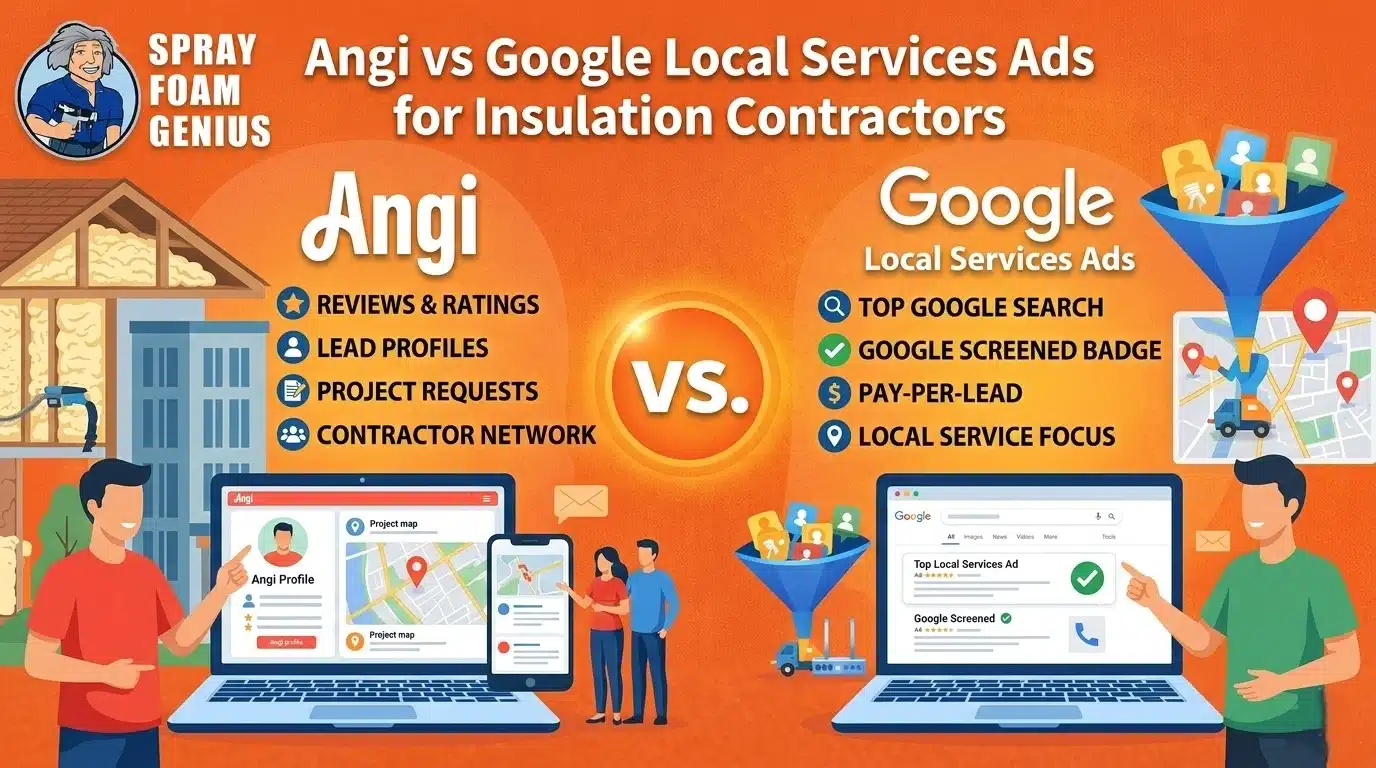


Direct Answer:
An effective marketing plan for an insulation business is built on three pillars: a clearly defined target market, a strong local digital presence, and a structured lead generation system that converts homeowners and contractors into paying customers. To succeed, insulation companies must combine SEO-driven content marketing, paid advertising, and referral partnerships while tracking measurable KPIs like cost per lead and conversion rate. Unlike general contracting services, insulation demand is highly influenced by energy efficiency awareness, seasonal weather changes, and government incentives, making a data-informed, locally optimized strategy essential for consistent growth.
A complete insulation marketing strategy depends on combining targeting, local SEO, advertising, and performance tracking, as outlined in this marketing guide for spray foam contractors.
TLDR
- Define a specific target audience (homeowners, builders, commercial property managers) to avoid wasted marketing spend
- Build a strong local SEO foundation since 46% of Google searches are local intent-driven
- Invest in high-intent channels like Google Ads and Google Local Services Ads for immediate leads
- Use educational content marketing to build trust around energy efficiency and insulation ROI
- Optimize your sales funnel from awareness to quote request to close
- Track KPIs such as cost per lead, conversion rate, and customer lifetime value
- Allocate 5% to 10% of revenue into marketing for sustainable growth
Building a Predictable Lead Generation System for Long-Term Growth
A successful insulation business does not rely on seasonal referrals or word-of-mouth alone. Instead, it builds a structured marketing system that consistently generates qualified leads, educates customers on energy savings, and converts them into booked jobs. With rising energy costs and increasing awareness of sustainability, insulation demand is growing steadily. According to the U.S. Department of Energy, proper insulation can reduce heating and cooling costs by up to 20%.
To capture this demand, your marketing plan must combine digital visibility, trust-building content, and conversion-focused advertising.
Sustained lead flow and higher conversion rates are achieved through a structured marketing system designed specifically for insulation contractors, as explained in this spray foam lead generation system.
1. Understand Your Market and Ideal Customer
Before spending on ads or SEO, insulation businesses must define who they are targeting.
Primary Customer Segments:
- Homeowners upgrading energy efficiency
- New construction builders
- Commercial property managers
- Government or energy rebate program participants
Key Insight:
According to Harvard Business Review, businesses that clearly define customer personas achieve significantly higher conversion rates due to message alignment.
Customer Pain Points:
- High utility bills
- Poor indoor comfort
- Moisture or mold issues
- Lack of knowledge about insulation benefits
2. Set SMART Marketing Goals
Your marketing plan should follow SMART principles:
- Specific: Generate 50 insulation leads per month
- Measurable: Track cost per lead under $40
- Achievable: Based on market size
- Relevant: Focused on insulation services
- Time-bound: Achieve within 6 months
3. Build a Strong Brand Positioning Strategy
Insulation companies often compete on price, but successful brands compete on value.
Positioning Statement Example:
“We help homeowners reduce energy bills by up to 20% using high-performance spray foam insulation installed in just one day.”
What builds trust:
- Certifications and licensing
- Before-and-after project photos
- Energy savings calculators
- Customer reviews and testimonials
According to Wikipedia, branding plays a critical role in shaping consumer perception and trust in service-based industries.
4. Choose High-Impact Marketing Channels
Marketing Channels for Insulation Businesses
5. Local SEO: The Most Powerful Growth Driver
Local SEO ensures your business appears when homeowners search “insulation contractor near me.”
Key Optimization Steps:
- Google Business Profile setup
- Local keyword targeting (e.g., “spray foam insulation in Texas”)
- Online reviews management
- Location-based landing pages
Google reports that 76% of people who search for a local service visit a business within 24 hours.
6. Paid Advertising Strategy (Google Ads + LSAs)
Paid ads are essential for immediate lead flow.
Best Practices:
- Target high-intent keywords like “attic insulation cost”
- Use call-only ads for mobile users
- Focus on geographic targeting
- Add trust signals in ad copy (licensed, insured, energy savings)
Industry data shows that Google Ads generate an average ROI of 200% when properly optimized.
7. Content Marketing That Educates and Converts
Insulation is a technical service, so education builds trust.
High-performing content ideas:
- “How much does spray foam insulation save per year?”
- “Fiberglass vs spray foam comparison”
- “Energy efficiency rebate guide by state”
Content formats:
- Blog posts
- YouTube videos
- Case studies
- Infographics
HubSpot research shows that companies using content marketing generate 3x more leads than traditional outbound marketing.
8. Build a Conversion-Focused Sales Funnel
A strong funnel turns visitors into paying customers.
Funnel Structure:
- Awareness: SEO blogs, ads, social media
- Interest: Educational landing pages
- Consideration: Free estimates or calculators
- Conversion: Quote request or call booking
Optimization Tip:
Use lead magnets such as “Free Energy Savings Assessment” to increase conversions.
9. Budget Allocation Strategy
Example Marketing Budget Breakdown:
Small insulation businesses typically invest 5% to 10% of annual revenue into marketing for stable growth.
10. Track Performance with KPIs
Without measurement, marketing fails.
Key KPIs:
- Cost per lead (CPL)
- Conversion rate
- Customer acquisition cost (CAC)
- Return on ad spend (ROAS)
- Lead-to-close ratio
KPI Table Example:
Grow Your Insulation Business with a Proven Marketing System
If your insulation company is struggling to generate consistent leads, the problem is not your service quality; it is your marketing structure. A strategic, data-driven marketing plan can transform your business into a predictable revenue engine. From high-intent Google Ads campaigns to local SEO domination, the right system ensures you stay ahead of competitors year-round.
Our team specializes in building high-performance marketing systems specifically for insulation contractors that increase visibility, reduce lead costs, and maximize job bookings.
USA: 877-840-FOAMCanada: 844-741-FOAMEmail: info@sprayfoamgeniusmarketing.com
Take control of your lead generation and build a business that grows consistently, not seasonally.
Frequently Asked Questions
1. What is the most effective marketing strategy for insulation companies?
Local SEO combined with Google Ads is the most effective strategy because it captures both long-term organic traffic and immediate high-intent leads from homeowners searching for insulation services.
2. How much should an insulation business spend on marketing?
Most insulation businesses invest 5% to 10% of revenue in marketing. This allows for balanced spending across SEO, paid ads, and brand building for sustainable growth.
3. How long does SEO take to work for insulation contractors?
SEO typically takes 3 to 6 months to show strong results, depending on competition, content quality, and local optimization efforts.
4. Are Google Ads worth it for insulation businesses?
Yes. Google Ads are highly effective because they target users actively searching for insulation services, often delivering an ROI of 2x to 5x when properly optimized.
5. What type of content should insulation companies publish?
Educational content, such as energy-saving guides, insulation comparisons, and cost breakdowns, performs best because it builds trust and improves search rankings.
Sources
- https://www.energy.gov/energysaver/insulation
- https://www.hubspot.com/marketing-statistics
- https://www.thinkwithgoogle.com
- https://www.sba.gov/business-guide
- https://hbr.org/2016/03/know-your-customers-jobs-to-be-done
- https://en.wikipedia.org/wiki/Brand
- https://www.wordstream.com/google-ads
- https://www.google.com/business/