
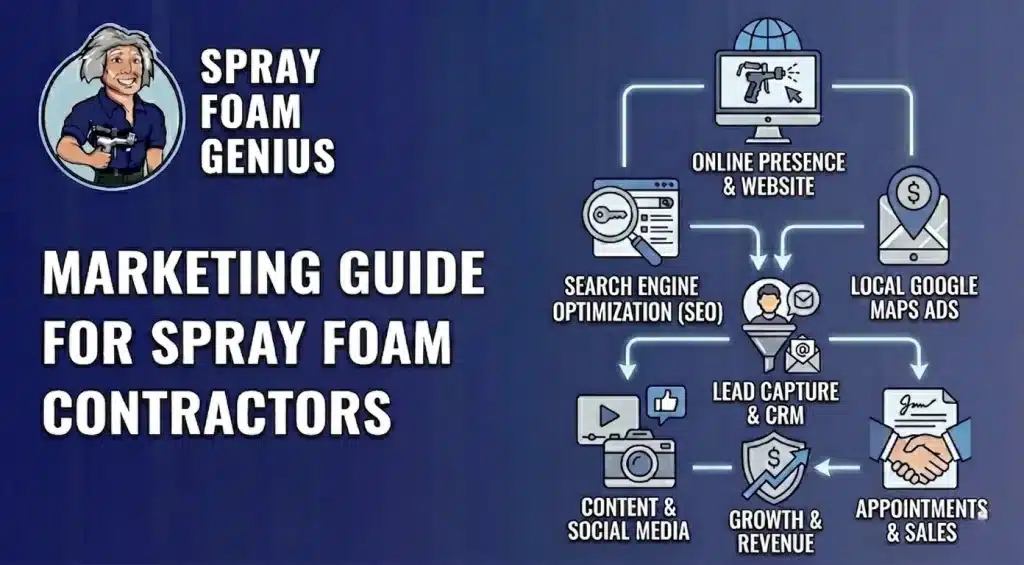
Most spray foam contractors are exceptional at their craft. They know the R-values, the equipment, the two-component chemistry, and the safety protocols. What they often lack is a clear, scalable system for generating consistent leads and growing their business beyond word-of-mouth.
Spray foam marketing is not a luxury. In today’s competitive market, it is the difference between a fully booked schedule and a slow season that drains your cash flow. The insulation industry has become increasingly competitive, with new contractors entering local markets and larger brands running aggressive paid campaigns.
This guide gives you a complete, practical playbook for marketing a spray foam insulation business. Whether you are just starting or running a multi-crew operation, these strategies are built specifically for the insulation industry, not recycled from generic small business advice.
By the end of this guide, you will understand how to build a dominant local presence, generate leads through search, convert website visitors into customers, and build a reputation that sells your services before you ever answer the phone.
TL;DR
- Spray foam contractors who invest in local SEO consistently outrank competitors in Google Maps and organic search
- A contractor website with clear service pages, trust signals, and fast load speed is your highest-ROI marketing asset
- Google Business Profile optimization is the single fastest way to generate local leads at zero ad spend
- Paid search (Google Ads) works best when paired with conversion-optimized landing pages, not generic homepages
- Reviews and reputation management directly influence both search rankings and buyer decisions
- Social media, particularly Facebook and Instagram, drives awareness for residential and commercial spray foam jobs
- Hiring a niche insulation contractor marketing agency outperforms general digital agencies in most contractor markets
What Is Spray Foam Marketing?
Spray foam marketing refers to the strategies, channels, and tactics insulation contractors use to attract new customers, generate qualified leads, and grow their business. It includes digital marketing channels such as SEO, paid advertising, content marketing, and social media, as well as offline methods like referral programs and trade partnerships. Effective spray foam marketing is highly local, niche-specific, and conversion-focused. Investing in specialized SEO services for insulation contractors can help improve local visibility, increase organic traffic, and generate consistent long-term leads.
Why Generic Marketing Fails Insulation Contractors
Before diving into tactics, it is worth understanding why most insulation businesses get poor results from marketing agencies and generic advice.
Spray foam is a high-ticket, high-consideration purchase. Homeowners and commercial property managers do not impulse-buy insulation. They research, compare contractors, read reviews, and often wait weeks before calling. This buying behavior requires a marketing strategy built around trust, education, and local visibility, not just traffic.
General marketing agencies treat spray foam like any other service business. They run broad Google Ads, build cookie-cutter websites, and post generic social content. The result is wasted budget and leads who are not ready to buy.
Contractors who win in competitive markets approach marketing differently:
- They dominate local search with hyper-targeted content
- They build review profiles that convert skeptical prospects
- They run ads with messaging specific to spray foam applications (open cell vs. closed cell, attic insulation, crawl space encapsulation)
- They educate buyers with content that builds trust before the first call
This is the foundation of effective insulation marketing.
Local SEO for Spray Foam Contractors
What Is Local SEO for Insulation Companies?
Local SEO for insulation contractors is one of the most effective ways to generate consistent, high-quality leads because it connects your business with homeowners and commercial clients who are actively searching for your services. For most insulation contractors, local SEO delivers more qualified opportunities than almost any other marketing channel because it captures buyers who are ready to take action.
Google Business Profile Optimization
Your Google Business Profile (GBP) is the most visible piece of digital real estate you control. When someone searches “spray foam insulation near me” or “insulation contractor [city],” your GBP listing appears in the Map Pack, a three-result block that dominates the top of local search results.
Steps to optimize your GBP for maximum visibility:
- Complete every section of your profile, including services, hours, service areas, and business description
- Use your primary keyword naturally in your business description
- Upload high-quality photos of completed jobs, equipment, and your team
- Select the most specific category available (“Insulation Contractor”)
- Post weekly updates to signal active management to Google
- Respond to every review, positive and negative, within 48 hours
- Add a Q&A section with common customer questions pre-answered
According to Google’s local search documentation, businesses with complete profiles receive significantly more direction requests and website clicks than incomplete listings.
On-Page SEO for Insulation Websites
Your website needs dedicated service pages for each spray foam application you offer. A single “Services” page is not enough to compete in local search.
Create individual pages for:
- Open-cell spray foam insulation
- Closed-cell spray foam insulation
- Attic insulation
- Crawl space encapsulation
- Commercial spray foam insulation
- New construction insulation
- Retrofit insulation
Each page should target a specific local keyword such as “closed cell spray foam insulation in [city]” and include:
- A clear H1 with the target keyword
- 600 to 1,000 words of informative content
- FAQs addressing common buyer questions
- A strong call-to-action with your phone number
- Photos from local jobs
Local Citations and Directory Listings
Citations are mentions of your business name, address, and phone number (NAP) across the web. Consistency matters. Ensure your NAP is identical on:
- Your website
- Google Business Profile
- Yelp
- Angi (formerly Angie’s List)
- HomeAdvisor
- BBB (Better Business Bureau)
- Industry directories like the Spray Polyurethane Foam Alliance (SPFA)
Key Takeaways: Local SEO
- Optimize your Google Business Profile completely and post updates weekly
- Build individual service pages for every spray foam application you offer
- Maintain consistent NAP information across all directories and listings
Spray Foam Website Optimization

What Makes a High-Converting Contractor Website?
A spray foam contractor website must do two things well: rank in search engines and convert visitors into leads. Most contractor websites fail at both because they are built for aesthetics, not performance.
Your website is your 24/7 salesperson. It needs to communicate trust, demonstrate expertise, and make it frictionless for a prospect to contact you.
Technical SEO Fundamentals
Technical SEO ensures search engines can crawl, index, and rank your website. Core requirements include:
- Page load speed under 3 seconds (test with Google PageSpeed Insights)
- HTTPS security certificate
- Clean URL structure (/services/closed-cell-spray-foam-insulation/)
- XML sitemap submitted to Google Search Console
- Schema markup for local business, reviews, and services
Conversion Rate Optimization
Driving traffic without optimizing for conversions is one of the most common and costly mistakes contractors make.
To improve your website’s conversion rate:
- Place your phone number in the header and make it clickable on mobile
- Add a contact form on every service page, not just the contact page
- Use specific calls-to-action (“Get a Free Spray Foam Estimate”) instead of generic ones (“Contact Us”)
- Display Google and Facebook review scores prominently on the homepage
- Include trust badges for certifications, insurance, and industry memberships
- Add a live chat or chat widget for visitors who prefer messaging over calling
Key Takeaways: Website Optimization
- Build individual service pages optimized for local keywords
- Prioritize mobile speed and technical SEO fundamentals
- Place conversion elements (phone, form, CTA) above the fold on every page
Google Ads & Paid Lead Generation for Spray Foam Businesses
Google Ads for Spray Foam Businesses
Google Ads allows insulation contractors to appear at the top of search results immediately, bypassing the time required to build organic rankings. When managed correctly, it delivers a reliable stream of high-intent leads.
The most effective campaign type for spray foam contractors is Search Ads targeting bottom-of-funnel keywords such as:
- “spray foam insulation contractor [city]”
- “closed cell spray foam cost [city]”
- “attic spray foam insulation near me”
Common mistakes that waste ad budget:
- Sending traffic to the homepage instead of a dedicated landing page
- Running broad match keywords without negative keyword lists
- Not tracking calls as conversions
- Running ads in areas outside your service territory
- Ignoring the quality score, which directly affects the cost per click
Local Services Ads (LSAs)
Google Local Services Ads appear above standard search ads and display your business name, rating, and a “Google Guaranteed” or “Google Screened” badge. Contractors pay per verified lead, not per click.
For insulation contractors, LSAs often deliver a lower cost per lead than traditional Google Ads because they target local searchers with high purchase intent, making them an effective channel for generating consistent spray foam insulation leads. Setting up LSAs requires a background check and license verification through Google, but the “Google Guaranteed” badge can significantly improve conversion performance.
Facebook and Instagram Ads
Social ads are most effective for awareness and retargeting in the spray foam industry. Homeowners who visit your website but do not call can be retargeted with Facebook ads showing before/after photos, special offers, or social proof.
Campaign types that work for insulation contractors:
- Retargeting campaigns targeting website visitors
- Lookalike audiences built from your existing customer email list
- Lead generation ads with a pre-filled form for quote requests
- Video ads showing the spray foam application process (high engagement)
Key Takeaways: Paid Advertising
- Use Google Search Ads for high-intent, bottom-of-funnel leads
- Set up Local Services Ads to earn the Google Guaranteed badge
- Retarget website visitors with Facebook and Instagram ads to recapture lost leads
Reputation Management and Review Generation

Why Reviews Are a Marketing Asset, Not Just Feedback
Online reviews are one of the most powerful marketing tools available to spray foam contractors, and most underuse them. Reviews influence both search rankings and buyer decisions.
According to research from BrightLocal’s Local Consumer Review Survey, 98% of consumers read online reviews for local businesses, and 78% trust them as much as personal recommendations.
For insulation contractors, a strong review profile does three things:
- Improves your Google Business Profile ranking in local search
- Increases click-through rates from search results
- Converts skeptical prospects who are comparing multiple contractors
Building a Review Generation System
Waiting for satisfied customers to leave reviews voluntarily produces inconsistent results. Build a repeatable system:
- Send a review request via text message within 24 hours of job completion
- Include a direct link to your Google Business Profile review page
- Follow up once if no response within 72 hours
- Train your crews to verbally mention reviews at the end of every job
- Use a reputation management platform to automate requests and monitor new reviews
Responding to Negative Reviews
Negative reviews are inevitable. How you respond matters more than the review itself. A professional, solution-focused response demonstrates accountability and often converts the negative impression for future readers.
Response framework for negative reviews:
- Thank the reviewer for their feedback
- Acknowledge the issue without admitting fault
- Offer to resolve the matter offline (include a direct contact)
- Keep the response brief and professional
Key Takeaways: Reputation Management
- Build an automated system to request reviews within 24 hours of job completion
- Respond professionally to every review, including negative ones
- A strong review profile improves both rankings and conversion rates
Content Marketing and SEO Authority Building
Why Content Marketing Matters for Spray Foam Contractors
Content marketing builds topical authority, which tells Google your website is the most relevant and trustworthy resource in your niche. For insulation contractors, this means creating educational content that answers the questions your target customers are actively searching for. Effective content marketing for insulation companies helps improve search visibility, attract qualified local traffic, build trust with homeowners and commercial buyers, and generate more leads over time through valuable, informative content.
Building a Content Cluster Strategy
A content cluster strategy organizes your website content around a central pillar page (like this one) supported by multiple interlinked blog posts and service pages covering subtopics in depth.
For a spray foam contractor, a content cluster might look like:
- Pillar page: Ultimate guide to spray foam insulation
- Supporting posts: Open cell vs. closed cell comparison, spray foam cost guide, spray foam for pole barns, spray foam for commercial buildings, spray foam R-value explained
This structure builds topical authority faster than isolated blog posts and improves internal linking, which strengthens the entire site’s SEO.
According to Moz’s research on internal linking, internal links distribute page authority across your site and help Google understand the relationship between content.
Key Takeaways: Content Marketing
- Create educational content that answers specific questions your buyers are searching for
- Organize content into topic clusters around a central pillar page
- Target cost and comparison keywords to capture buyers in the research phase
Social Media Marketing for Insulation Contractors

Which Platforms Work Best for Spray Foam Businesses?
Not all social platforms deliver equal results for insulation contractors, which is why social media marketing for the insulation industry should focus on where your buyers spend time and where visual content performs well.
Facebook remains the highest-ROI social platform for home service contractors. Homeowners actively use Facebook to research local services, read recommendations in community groups, and engage with business pages.
Instagram drives strong results for before/after content and project showcases. Visual transformations (dirty crawl space to clean encapsulation, bare attic to spray foam coverage) perform exceptionally well in Reels and Stories.
YouTube is underused by most insulation contractors but offers significant long-term value. Educational videos (“How Spray Foam Insulation Works,” “Closed Cell vs Open Cell Explained”) attract homeowners during the research phase and build authority that converts later.
Content Strategy for Social Media
Post consistently rather than sporadically. A realistic and effective posting cadence for most contractors:
- 3 to 4 posts per week on Facebook and Instagram
- 1 YouTube video per month
- Daily Stories on Instagram for job progress and team content
Content ideas that consistently perform:
- Time-lapse videos of spray foam application
- Before/after photos from completed projects
- Customer testimonial videos
- Educational posts (“5 Signs Your Attic Insulation Is Failing”)
- Behind-the-scenes content showing your equipment and crew
Key Takeaways: Social Media
- Focus on Facebook and Instagram as primary channels for spray foam marketing
- Post before/after photos and application videos consistently
- Use YouTube for educational content that builds long-term organic reach
Marketing Channel Comparison (What Actually Works Best)
Working With an Insulation Contractor Marketing Agency
When to Hire a Niche Marketing Agency
Many spray foam contractors try to manage marketing in-house or hire general digital agencies. Both approaches often underdeliver because spray foam marketing requires deep familiarity with the insulation industry, local service business dynamics, and the specific buyer journey of homeowners and commercial clients.
A niche insulation contractor marketing agency understands:
- The seasonal demand patterns in different climate regions
- How to position closed-cell vs open-cell applications for different buyer segments
- Which keywords convert in insulation markets, versus which drive informational traffic
- How to write ad copy that speaks to energy savings, comfort, and long-term value
The right agency partner becomes an extension of your business, not just a vendor running ads.
What to Expect from a Spray Foam Marketing Partner
When evaluating agencies, look for:
- Demonstrated experience working specifically with insulation or home service contractors
- Transparent reporting on leads, cost per lead, and conversion rates
- Clear ownership: you own your website, ad accounts, and content
- No long-term lock-in contracts
- A strategy that integrates SEO, paid, and reputation management rather than relying on a single channel
Building a Spray Foam Marketing System That Scales
Growing a spray foam insulation business requires more than great work on the job site. It requires a deliberate, multi-channel marketing strategy built around local visibility, conversion-focused content, and a reputation that earns trust before the first conversation.
The contractors who dominate their local markets share a common approach: they invest in their digital presence consistently, they treat reviews as a marketing asset, and they use content to build authority that compounds over time.
Start with the foundations. Optimize your Google Business Profile. Build a fast, conversion-ready website. Create service pages for every application you offer. Then layer in paid advertising, content marketing, and social media as your capacity allows.
Marketing a spray foam business is a system, not a single tactic. Build the system, and the leads follow.
Ready to grow your spray foam insulation business with marketing that actually works?
Spray Foam Genius Marketing specializes exclusively in marketing for spray foam and insulation contractors across the USA and Canada. We build websites, run SEO campaigns, manage Google Ads, and handle your online reputation so you can focus on the work.
Call us today: USA: 877-840-FOAM Canada: 844-741-FOAM
Email: info@sprayfoamgeniusmarketing.com
FAQs
How much should a spray foam contractor spend on marketing?
Most insulation contractors allocate 5 to 10 percent of gross revenue to marketing. For a business generating $500,000 annually, this means a marketing budget of $25,000 to $50,000 per year. Early-stage businesses investing in growth often spend at the higher end of this range.
How long does SEO take to work for insulation contractors?
Most contractors begin seeing measurable improvements in local rankings within 3 to 6 months of consistent SEO work. Highly competitive markets or brand-new websites may take 6 to 12 months before significant organic lead flow begins.
What is the best way to get more spray foam leads fast?
Google Local Services Ads and standard Google Search Ads deliver leads fastest. They can generate calls within days of launching a properly structured campaign. Pair them with a conversion-optimized landing page for maximum ROI.
Do spray foam contractors need a website or just a Google Business Profile?
Both are essential. Your Google Business Profile drives local map visibility, but your website is where serious buyers go to evaluate your credibility, read reviews, understand your services, and request a quote. A GBP without a supporting website limits your ability to rank for non-map search results.
How do reviews affect spray foam marketing performance?
Reviews directly impact your Google Business Profile ranking, your click-through rate from search results, and your overall conversion rate. Contractors with 50 or more Google reviews consistently outperform competitors with fewer reviews in both rankings and lead volume.