


Direct Answer
The best insulation companies in 2026 measure marketing performance by combining data-driven attribution, CRM-based tracking, and revenue-focused analytics rather than relying on surface metrics like clicks or impressions. Their primary goal is to identify which marketing channels generate profitable jobs and long-term customers, not just leads.
High-performing companies rely on systems such as call tracking, CRM platforms, and analytics tools to connect marketing activity directly to revenue outcomes. The right approach depends on business size, growth stage, and goals, but the underlying principle remains consistent: optimize for revenue, not vanity metrics.
According to Harvard Business Review, companies that rely on data-driven decision-making are significantly more likely to outperform competitors in growth and profitability.
Common approaches include:
- Lead generation tracking (SEO, PPC, referrals)
- Conversion tracking (lead → appointment → sale)
- Revenue attribution (channel-level ROI)
- Customer lifetime value (LTV) analysis
TLDR
- Top insulation companies track cost per closed job, not just cost per lead.
- CRM + call tracking integration is essential for accurate attribution.
- Strong marketers optimize for LTV (lifetime value) vs CAC (customer acquisition cost).
- Multi-touch attribution is replacing last-click tracking in 2026.
- Conversion rate optimization often outperforms increasing ad spend.
- Lead quality scoring is more valuable than raw lead volume.
- Weekly performance tracking leads to faster growth and better decisions.
- Common mistake: focusing on clicks instead of revenue.
What Makes Marketing Measurement Effective in 2026
Modern marketing measurement is centered on profitability, transparency, and attribution clarity. Companies that succeed use integrated systems that connect every lead to revenue.
Analytics platforms like Google Analytics 4 allow tracking across multiple devices and touchpoints, helping businesses understand user behavior and conversions more accurately.
For insulation contractors looking to implement a more structured and performance-driven marketing system, see this spray foam contractor marketing guide.
Key Principles
- Revenue-focused tracking: Every dollar ties to actual sales
- Accurate attribution: Identify which campaigns drive conversions
- Lead quality analysis: Not all leads are equal
- Cross-channel tracking: Combine SEO, PPC, and referrals
- Real-time insights: Weekly or daily dashboards
Core Metrics Insulation Companies Track
Lead Metrics vs Revenue Metrics
The most successful companies focus on revenue metrics, not just lead volume.
Conversion Metrics
Improving conversion rates is often more impactful than increasing traffic.
Customer Acquisition Cost (CAC) vs Lifetime Value (LTV)
- CAC: Total cost to acquire a customer
- LTV: Total profit from a customer over time
Top insulation companies aim for:
- LTV:CAC ratio of 3:1 or higher
- Fast payback within 1–3 projects
Key Marketing Measurement Systems
CRM + Call Tracking Integration
Leading companies use tools like:
- CallRail for call tracking
- HubSpot for CRM and automation
- Analytics platforms like Google Analytics 4
These systems allow businesses to:
- Attribute phone calls to specific ads or keywords
- Track leads through the entire sales pipeline
- Measure which campaigns generate actual revenue
Multi-Touch Attribution Models
Instead of assigning credit to a single interaction, companies distribute credit across multiple touchpoints:
- First-touch attribution
- Last-touch attribution
- Linear attribution
- Time-decay attribution
Example customer journey:
- Google Ad
- Blog content
- Video ad
- Phone call → sale
This reflects how real customers behave.
Marketing Dashboards
A high-performing dashboard typically includes:
- Leads by channel
- Cost per acquisition
- Revenue by campaign
- Conversion rates
- Pipeline value
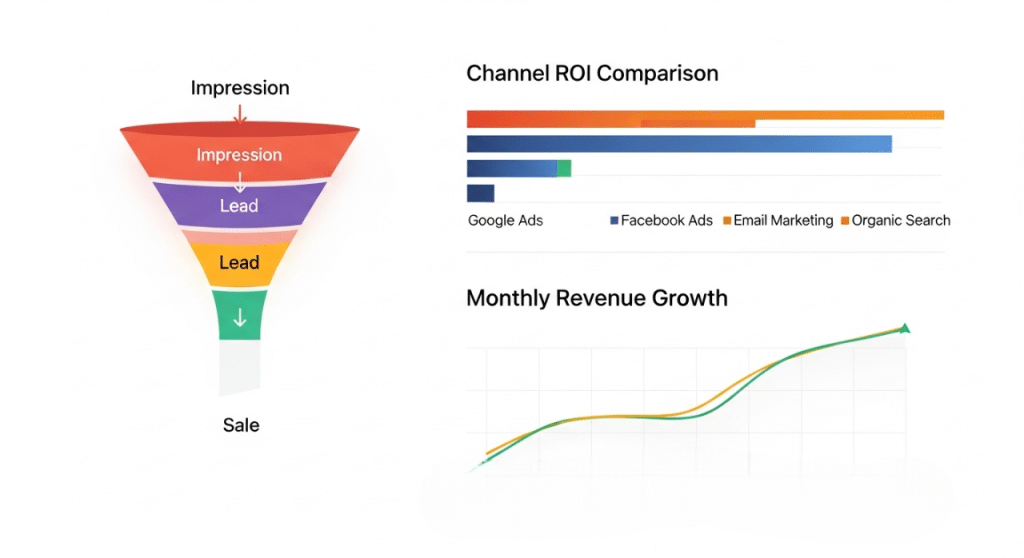
Strategy Comparison Table
Example: Measuring ROI
Scenario: Texas Insulation Company
- Monthly ad spend: $5,000
- Leads: 120
- Cost per lead: ~$41
- Jobs closed: 30
- Revenue per job: $1,200
Total Revenue: $36,000Cost per job: ~$166ROI: Strong (7.2x return)
Without tools like Google Analytics 4, this level of insight would not be possible.
Common Mistakes in Marketing Measurement
- Tracking leads instead of revenue
- Ignoring phone call attribution
- Overvaluing clicks and impressions
- Not integrating CRM systems
- Missing offline conversions
These mistakes often lead to inefficient spending and missed growth opportunities.
How to Evaluate Marketing Performance
Ask these questions:
- What percentage of leads convert into customers?
- Which channels generate the highest revenue?
- What is our cost per closed job?
- How quickly do we recover CAC?
- Are all calls and inquiries tracked?
If you cannot answer these clearly, your tracking system needs improvement.
Recommendations by Audience / Use Case
Small Companies (1–5 Employees)
- Focus: Google Ads + SEO
- Priority: Lead generation + basic tracking
- Goal: Consistent monthly revenue
Growing Companies (6–20 Employees)
- Focus: Multi-channel campaigns
- Priority: Conversion optimization + CRM
- Goal: Scalable growth
Large Companies (20+ Employees)
- Focus: Multi-touch attribution + LTV
- Priority: Advanced analytics and retention
- Goal: Market leadership
Signs You’ve Found the Right Approach
- Clear revenue attribution across channels
- Data-driven decision-making
- Focus on cost per sale instead of cost per lead
- Integrated CRM and tracking tools
- Continuous optimization
- Alignment between sales and marketing
Turn Your Marketing Data Into Predictable Revenue Growth
If you want to understand exactly which marketing channels are generating revenue, and which are wasting your budget, you need a system built specifically for insulation contractors.
Spray Foam Genius Marketing specializes in performance tracking, lead generation, and scalable marketing systems for insulation companies.
📞 USA: 877-840-FOAM📞 Canada: 844-741-FOAM📧 Email: info@sprayfoamgeniusmarketing.com
Take control of your marketing performance and turn data into predictable growth.
FAQs
How do insulation companies track marketing performance?
They use CRM systems, call tracking tools like CallRail, and analytics platforms like Google Analytics 4 to connect leads to revenue.
What is the most important marketing metric?
Cost per closed job is the most important because it directly reflects profitability.
How often should marketing performance be reviewed?
Weekly reviews are recommended, with deeper monthly analysis for strategy optimization.
Why is lead quality important?
Higher-quality leads convert more often, improving ROI and reducing wasted ad spend.
What tools are commonly used?
Popular tools include HubSpot, CallRail, and Google Analytics 4.