
Direct Answer
Pay-per-lead (PPL) can work for insulation companies in the short term, especially for startups that need immediate jobs, but it is rarely a sustainable long-term growth strategy. While it provides quick access to homeowner inquiries, the lack of exclusivity, inconsistent lead quality, and competitive pressure often reduce profit margins. Most insulation contractors see better long-term results by combining selective pay-per-lead with owned marketing channels like SEO and Google Ads rather than relying on it as a primary system.
TLDR
- Pay-per-lead delivers fast inquiries, but often with inconsistent quality
- Shared leads reduce close rates due to competitor overlap
- SEO and Google Ads build long-term, compounding customer acquisition
- Speed-to-lead is critical, responding within minutes dramatically improves conversion
- PPL works best as a supplement, not a foundation
- Poor tracking of ROI is the #1 reason contractors lose money on PPL
What Is Pay-Per-Lead in the Insulation Industry?
Pay-per-lead marketing is a model where insulation companies pay for each homeowner inquiry instead of paying for clicks or impressions. A lead is simply a potential customer who has shown interest in a service.
According to Wikipedia, lead generation is the process of attracting and converting strangers into potential customers.
In insulation contracting, this typically includes:
- Spray foam insulation requests
- Attic insulation upgrades
- Crawl space insulation inquiries
- Energy efficiency retrofits
Leads are usually sold as:
- Shared leads (multiple contractors receive the same inquiry)
- Exclusive leads (only one contractor receives it)
Contractors evaluating shared and exclusive lead sources can benefit from understanding how a structured lead generation system works. Learn more in this spray foam contractor lead generation framework.
How Pay-Per-Lead Works in Real Life
- Homeowner searches for insulation services online
- A lead provider captures the request through ads or SEO
- The lead is sold to one or more contractors
- Contractors contact the homeowner immediately
Speed is everything. Research from Harvard Business Review shows that companies responding within the first hour are 7x more likely to qualify a lead compared to slower responses. In insulation, where multiple contractors may call the same homeowner, response time becomes even more critical.
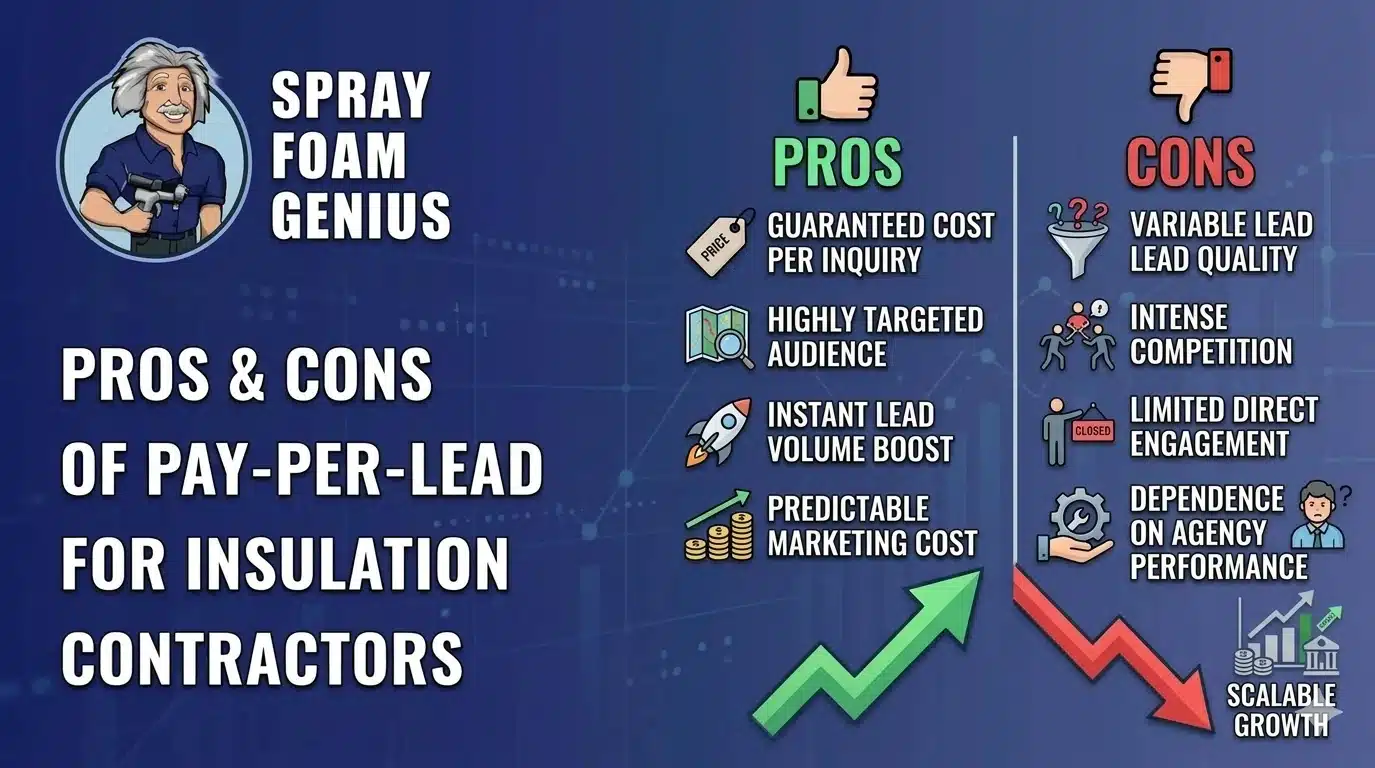
Pros of Pay-Per-Lead for Insulation Companies
1. Fast and Predictable Lead Flow
PPL provides immediate inquiries without waiting for SEO rankings or ad optimization.
2. Low Barrier to Entry
No need for advanced marketing systems, just pay and receive leads.
3. Scalable on Demand
You can increase or decrease lead volume based on installation capacity.
4. Helpful for New Companies
Startups without visibility can quickly generate job opportunities.
Pros Summary Table
Cons of Pay-Per-Lead (What Most Contractors Experience)
1. Shared Lead Competition
Many leads are sold to multiple contractors, creating immediate bidding wars. This forces companies to compete on price rather than value.
3. Hidden Costs
Beyond the lead fee, contractors lose money through:
- Fuel and travel for low-intent leads
- Estimator time on unqualified prospects
- Lost opportunity cost from wasted scheduling
4. No Brand Equity
You do not own the traffic or customer relationship.
5. Inconsistent Quality
Some leads may be outdated, duplicated, or low intent.
6. Increasing Costs Over Time
As competition grows, providers often increase prices while quality remains the same or declines.
Cons Summary Table
Pay-Per-Lead vs Other Marketing Channels
According to Google Ads Help, search ads capture high-intent users actively looking for services, making them more valuable than cold or shared traffic sources.
Why Pay-Per-Lead Often Fails Insulation Companies
1. Speed War Competition
The fastest contractor wins, not the best. This leads to rushed pricing and lower margins.
2. Service Commoditization
Instead of competing on insulation quality or R-value performance, companies compete on price alone.
3. Low Trust Environment
Homeowners receiving multiple calls often feel overwhelmed, reducing trust in all providers.
4. No Compounding Growth
Unlike SEO or content marketing, PPL stops working the moment you stop paying.
When Pay-Per-Lead Actually Works
PPL can be effective when:
- You are a new contractor needing immediate revenue
- You have a strong inside sales system
- You operate in underserved markets
- You carefully filter for exclusive leads
However, even in these cases, it should be treated as a temporary acquisition channel.
Data-Driven Insights for Insulation Marketing
- Home insulation upgrades can reduce heating and cooling energy use significantly according to the U.S. Department of Energy
- Inbound marketing generates 54% more leads than outbound methods, according to HubSpot
- Local “near me” searches often produce the highest conversion rates in home services
- Businesses that respond within 5–15 minutes see dramatically higher close rates compared to delayed responses
These insights consistently show one trend: owned traffic outperforms rented leads.
Actionable Strategy for Insulation Contractors
Step 1: Use PPL Only as a Fill Tool
Do not rely on it for full pipeline generation. Use it only to fill schedule gaps.
Step 2: Track ROI Strictly
Monitor:
- Cost per lead
- Close rate
- Cost per acquisition
Eliminate underperforming providers quickly.
Step 3: Prioritize Exclusive Leads
Even if more expensive, exclusive leads generally deliver higher margins.
Step 4: Build Owned Lead Channels
Invest in:
- Local SEO (Google Business Profile optimization)
- Website optimization targeting insulation keywords
- Retargeting ads for warm traffic
Step 5: Implement Speed-to-Lead Systems
- Respond within 5–10 minutes
- Use SMS + call automation
- Follow up multiple times within first hour
Build a Predictable Lead System for Your Insulation Business
Stop Competing on Price. Start Owning Your Leads.
Pay-per-lead systems may keep your schedule full, but they rarely build sustainable long-term profit. For consistent growth, stronger margins, and exclusive customer acquisition, you need a system built on owned traffic and conversion optimization.
At Spray Foam Genius Marketing, we help insulation contractors scale through SEO, Google Ads, and conversion-focused funnels designed specifically for spray foam and insulation businesses.
USA: 877-840-FOAMCanada: 844-741-FOAMEmail: info@sprayfoamgeniusmarketing.com
FAQs
1. Is pay-per-lead worth it for insulation companies?
It can be useful for short-term growth, but most companies struggle with inconsistent quality and shared competition, which reduces profitability over time.
2. Why are shared leads less effective?
Shared leads are sold to multiple contractors, creating price wars and reducing trust, which significantly lowers conversion rates.
3. What is better than pay-per-lead marketing?
SEO and Google Ads generally outperform PPL because they generate exclusive, high-intent leads that are not shared with competitors.
4. How fast should I respond to insulation leads?
Ideally within 5–10 minutes. According to Harvard Business Review research, speed is one of the strongest predictors of lead conversion.
5. How do I know if my PPL provider is profitable?
Track cost per closed job. If acquisition cost exceeds your profit margin or close rates are consistently low, the system is not sustainable.
Sources:
Wikipedia – Lead Generation https://en.wikipedia.org/wiki/Lead_generationHarvard Business Review – The Short Life of Online Sales Leads https://hbr.org/2011/03/the-short-life-of-online-sales-leadsU.S. Department of Energy – Insulation Guide https://www.energy.gov/HubSpot Marketing Statistics https://www.hubspot.com/marketing-statisticsGoogle Ads Help – Search Ads Overview https://support.google.com/google-ads/answer/2615875