
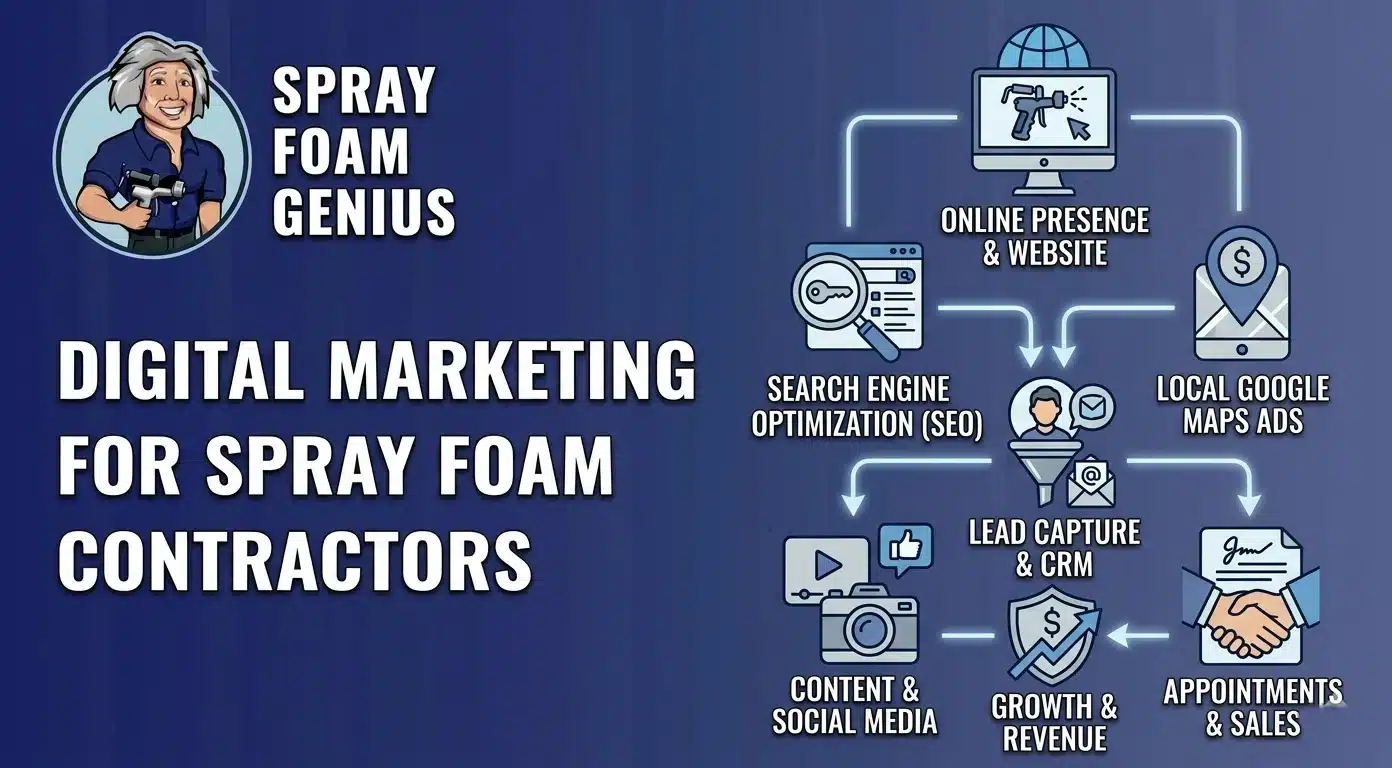
Spray foam work speaks for itself, but only after someone hires you. The problem for most contractors is not craftsmanship. It is that homeowners and commercial buyers find a competitor first on Google, in the map results, or in a friend’s recommendation. This guide pulls together how digital marketing works for spray foam and insulation contractors in 2026: what to build first, what to add, and how to tell what is working.
It is written by Spray Foam Genius Marketing, an agency that works with spray foam and insulation contractors, so we have a view. We stick to practical steps, and we do not promise rankings or specific results, because no one can.
How Spray Foam Buyers Find and Choose a Contractor
Spray foam is a high-ticket, high-consideration purchase. Homeowners and property managers do not impulse-buy insulation. They research, compare contractors, read reviews and often wait before calling. A typical search might be “spray foam insulation cost,” “open cell vs closed cell spray foam,” or “spray foam contractor near me.”
There is also plenty of reason for them to look. ENERGY STAR says EPA estimates homeowners can save an average of 15% on heating and cooling costs by air sealing and adding insulation, so many people are searching for exactly what you do. Your job is to be found, look trustworthy, and make it easy to call.
It also explains why generic marketing underperforms. Broad ads, cookie-cutter websites and stock social posts attract people who are not ready to buy. Specific pages, real proof of work and fast follow-up convert better. Layered tactics work together: a website, local search, reviews, ads and follow-up each make the others more effective.
Decide who you are mainly targeting before you spend anything. Homeowners upgrading comfort and energy bills, builders on new construction, and commercial property managers all search differently and care about different things, so each needs its own messages and pages. Set one or two measurable goals, such as more qualified estimate requests from a particular service area, so you can tell whether the plan is working.
Related reading: How to Create a Comprehensive Digital Advertising Strategy for Insulation Contractors
1. Build a Website That Turns Visitors into Estimate Requests
Every channel sends people to your website, so it has to do its job. A good contractor site:
- Loads quickly and works well on a phone. Google explains how page experience is measured in its Core Web Vitals guidance.
- Shows your phone number and a clear call to action on every page.
- Lists your service areas clearly.
- Uses real photos of completed jobs, not stock images.
- Displays real reviews, licenses, insurance and certifications.
- Has a dedicated page for each service: open-cell spray foam, closed-cell spray foam, attic, crawl space, metal buildings, new construction and commercial.
A single “Services” page is not enough. Separate pages let you answer specific questions and match specific searches. If you serve several cities, build location pages that say something real about the area, such as common housing types, climate and moisture issues, rather than only swapping in a city name.
Google says that optimizing for its AI features is still SEO, and that you do not need special files, markup or schema to appear in them. See Google’s guidance on AI features. Helpful, original pages that answer real buyer questions are the best preparation.
2. Win Local Search and Your Google Business Profile
Most spray foam work is local, so local search matters. Google’s local ranking guidance says local results are based on relevance, distance and prominence, and that businesses with complete and accurate information are more likely to show up. It also says there is no way to request or pay for a better local ranking.
Practical steps for your Google Business Profile:
- Complete every section, including services, hours and service areas, and choose the most accurate categories.
- Add real photos of jobs regularly, and post updates to show the business is active.
- Respond to every review, positive or negative.
- Keep your phone number, hours and website up to date.
- Keep your name, address and phone number identical on your website and every directory, including Yelp, Angi, the Better Business Bureau and trade directories.
3. Make Reviews Part of How You Work
Reviews are a trust signal for buyers and part of how Google judges prominence. Waiting for customers to leave reviews on their own produces inconsistent results, so build a routine:
- Ask soon after job completion, by text or email, with a direct link to your Google review page.
- Train your crew to mention reviews at the final walkthrough.
- Follow up once if there is no response.
- Respond to every review. For a negative one, thank the reviewer, acknowledge the concern without arguing, and offer to resolve it offline.
Google’s own tips to get more reviews are worth reading. More detail is in our guide to Google reviews for spray foam businesses.
4. Publish Content That Answers Buyer Questions
Most contractors have no blog and no educational resources, which leaves room for those who answer what customers are already asking. Helpful topics include:
- How much spray foam insulation costs for an attic, crawl space or commercial building, and what affects the price
- Open-cell versus closed-cell spray foam, and spray foam versus fiberglass or blown-in
- Spray foam for metal buildings and pole barns
- Local questions, such as whether spray foam is worth it in your climate
Organize related posts around a main guide and link them together so visitors and search engines can follow the topic. Short videos of real jobs also help buyers trust you, and they cost little to make: a phone, decent light and an honest explanation of what you are doing. Content builds slowly, and no one can promise when a page will rank. Google’s guidance on creating helpful, reliable, people-first content is a good standard.
5. Use Paid Ads Where They Make Sense
Ads can bring in inquiries sooner than SEO, which makes them useful for slow seasons, new service areas or new services. They stop when the budget stops, so they work best alongside the foundations above.
Google Search Ads
- Target buyer-intent searches like “closed cell spray foam cost [city]” and “spray foam contractor near me.”
- Send clicks to a dedicated landing page, not the homepage.
- Add negative keywords to exclude searches such as “DIY spray foam” and “spray foam kits.”
- Limit ads to your actual service area.
- Track calls as conversions so you know which keywords produce real inquiries.
See our guide to Google Ads for insulation businesses for more.
Local Services Ads
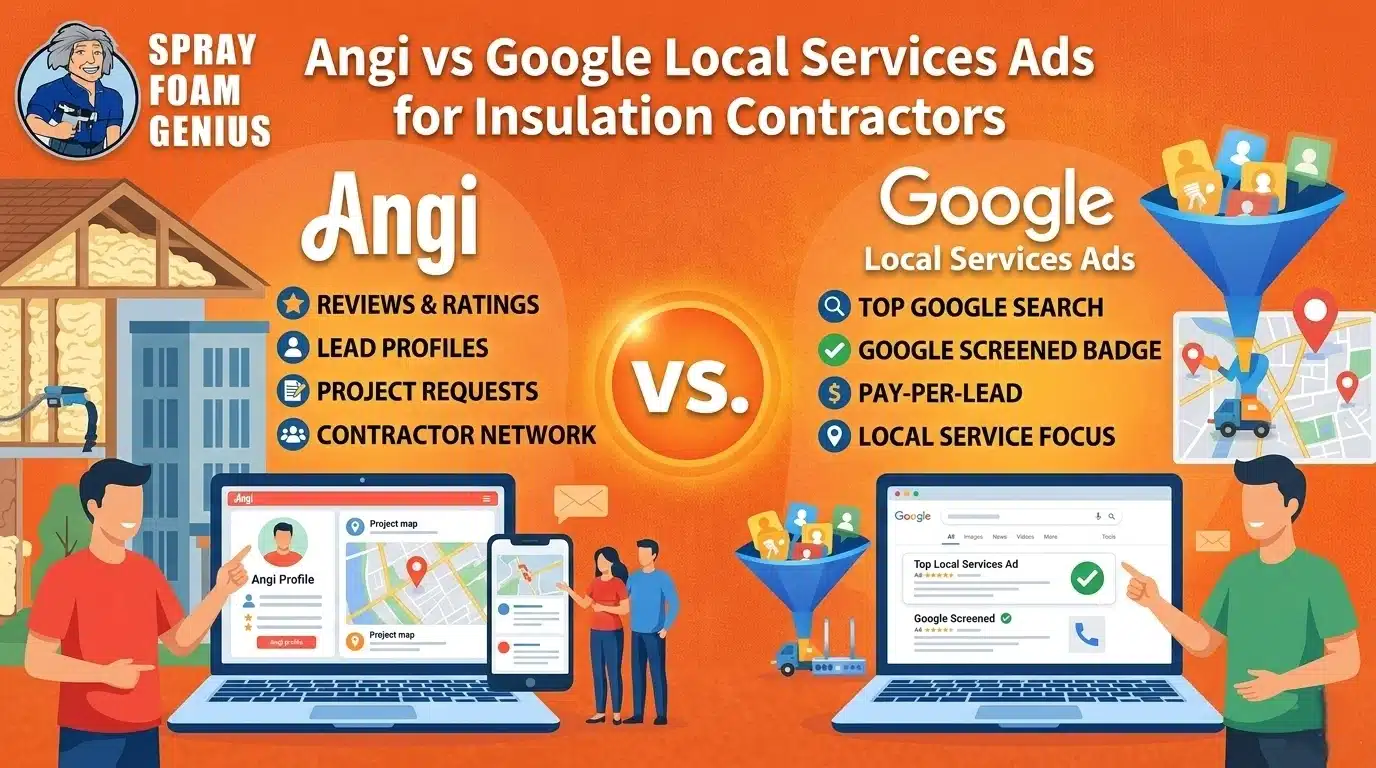
Where available for your trade and area, Google’s Local Services Ads are pay-per-lead rather than pay-per-click and include Google’s verification process, which can add credibility. Right now, Local Services Ads are available to insulation installation contractors only in California and Florida, so contractors in other states cannot run them. Google can change this, so check its Local Services Ads page for your area.
Facebook and Instagram ads
Social ads are better at reaching people who are not searching yet and at retargeting website visitors who did not call. Before-and-after photos, short job videos and seasonal messages tend to work better than generic claims. Lead-form ads can capture a request without a website visit.
Shared lead marketplaces
Shared leads are sold to several contractors at once, which often means price shopping and uneven quality. Consider them a gap-filler, not the core of your plan. Leads from your own website, Business Profile and referrals are assets you control.
6. Build a Brand Buyers Remember
Most spray foam websites look alike, with the same stock photos and claims of “licensed, insured, quality work.” Stand out by showing real work, telling your real story and choosing a niche you can own, such as crawl space encapsulation, attic retrofits, agricultural buildings or new construction. Keep your logo, colors and voice consistent across the website, trucks, uniforms and social profiles.
Social media helps by keeping you visible and proving your work. Facebook, Instagram and YouTube are the usual fits. Post real job photos, short recaps, customer testimonials and behind-the-scenes content with your crew. Consistency matters more than volume.
7. Respond Fast and Follow Up
Many leads will not book on the first contact, and many are lost simply because nobody replied quickly. Set up a way to answer calls and forms promptly, with an automatic text or email that acknowledges new inquiries. A simple follow-up sequence for people who requested a quote but did not book might include a confirmation with your reviews and portfolio, a follow-up with a before-and-after story, an educational email on the value of spray foam, and an easy scheduling link.
8. Add Referral Partners
HVAC companies, roofers, builders, energy auditors and real estate agents all meet homeowners who need insulation. A written referral arrangement with a few of them can produce high-trust leads at a modest cost. Agree on how referrals are handed off, how fast you respond, and how you will thank or compensate partners, and track what each partner sends.
9. Track What Actually Matters
You cannot improve what you do not measure. Use Google Analytics 4, Google Search Console and call tracking to see where leads come from, then record which ones became booked jobs. Track:
- Calls and form submissions by source
- Cost per lead and, more importantly, cost per booked job
- Lead-to-estimate and estimate-to-job rates
- Revenue by channel
- Review count and rating over time
Review it monthly and adjust. Our guides to KPIs to track monthly and using Google Analytics for a spray foam business can help you set it up.
A Sensible Order of Operations
You do not need to do everything at once. A common sequence:
- Claim and complete your Google Business Profile, and start a review routine.
- Fix your website basics: speed, mobile use, phone number and service pages.
- Set up call and form tracking so every lead has a source.
- Add location pages and helpful content for your best services.
- Layer in Google Ads, and then social ads, once the site can convert visitors.
- Add email or text follow-up and referral partnerships, then review results monthly.
Skipping to ads before the website and tracking are ready usually means paying for clicks that go nowhere.
What Is Changing in 2026
Search keeps changing, with AI-generated answers appearing alongside traditional results. Google says optimizing for them is still SEO, so the fundamentals remain: a technically sound site, useful content and a strong local presence. Video, honest reviews and proof of work help in a market where many sites look alike, and first-party data such as your own lead records is worth keeping as privacy and tracking rules change. Our post on how AI search tools recommend spray foam companies goes further.
Working With an Agency
Some contractors handle parts of this themselves and bring in help for SEO, ads and tracking. If you hire out, look for contractor experience, clear reporting on calls and booked jobs, written ownership of your accounts and website, and no guarantees. Our guides to choosing a spray foam marketing agency and in-house vs agency marketing cover this in detail.
If you would like a second opinion, Spray Foam Genius Marketing offers a free marketing audit that reviews your website, local search visibility and lead generation setup. Call USA: 877-840-3626 or email info@sprayfoamgeniusmarketing.com.
Frequently Asked Questions
How much should a spray foam contractor spend on digital marketing?
There is no universal percentage. Budget depends on your market, competition, goals and capacity to take on work. Start with the foundations, track cost per booked job, and increase spending on what works. See How Much to Spend on Insulation Marketing.
How long does SEO take to generate leads?
It usually takes months, and the pace depends on your competition and site. Ads can start producing inquiries sooner. No one can promise a timeline, so look for early signs such as better Business Profile activity and more calls from search.
What is the most important channel for spray foam contractors?
For most local contractors, Google is central: a strong Business Profile, a site that answers buyer questions and, where useful, search ads. Reviews support all of it.
Do you need a website or just a Google Business Profile?
You need both. The profile helps with map visibility, while your website is where serious buyers check your credibility, services and reviews before requesting an estimate.
How do spray foam contractors get more Google reviews?
Make it routine and easy: ask soon after the job, send a direct review link by text or email, and respond to every review you receive.
Is social media worth it for spray foam contractors?
It can be, mostly for visibility, proof of work and retargeting. It rarely replaces search and referrals as a lead source, so treat it as support.
Do you need special optimization for AI search results?
Google says no special schema, files or markup are needed, and that optimizing for its AI features is still SEO. Focus on helpful content, clear service pages and a strong local presence.