
Introduction
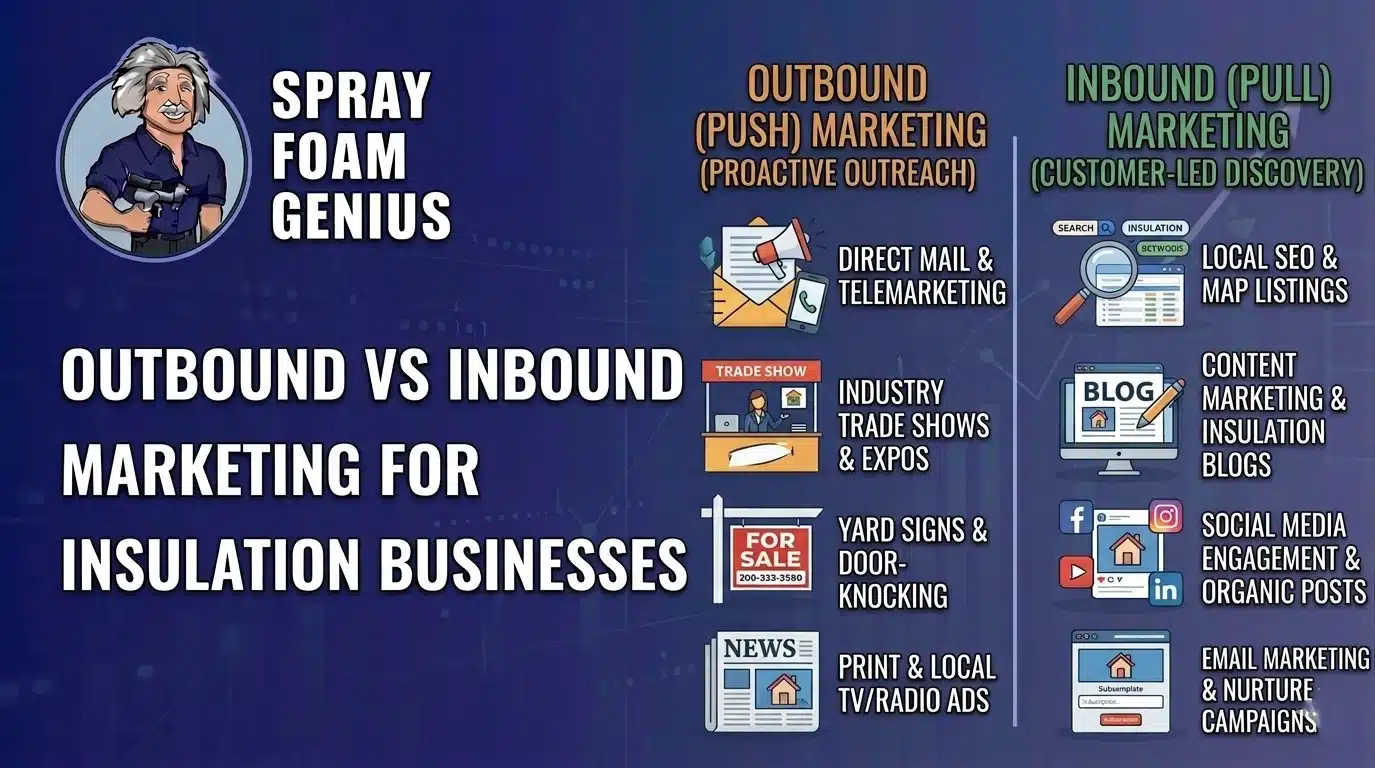
Marketing for insulation businesses has become increasingly competitive due to rising digital advertising costs and stronger local competition. Contractors today must choose between two core strategies: outbound marketing and inbound marketing.
Outbound marketing focuses on actively pushing services to potential customers through paid ads, cold outreach, direct mail, and outbound calling. Inbound marketing focuses on attracting customers through SEO, content marketing, and search visibility.
Both approaches can generate leads, but they differ significantly in cost structure, speed, sustainability, and long-term return on investment.
As explained by HubSpot’s inbound marketing framework, modern customers prefer discovering businesses through helpful content and search engines rather than being interrupted by ads. This shift is especially important for insulation companies, where customers often conduct extensive research before hiring a contractor. A well-structured marketing guide for spray foam contractors can help businesses balance inbound and outbound strategies for sustainable growth.
What Is Outbound Marketing?
Outbound marketing is a traditional, push-based strategy in which businesses actively reach out to potential customers rather than waiting for them to find the business.
For insulation contractors, outbound marketing typically includes:
- Google Ads (Search & Display)
- Facebook and Instagram Ads
- Direct mail campaigns
- Cold calling and outbound sales teams
- Pay-per-lead services
The primary advantage of outbound marketing is speed. Insulation companies can generate leads within days of launching campaigns. This is especially useful during seasonal spikes when demand for insulation services increases due to extreme temperatures.
However, outbound marketing is often described as “rented attention.” Once the budget stops, visibility disappears.
This concept is reinforced in Forbes Agency Council insights, which highlight that outbound marketing provides immediate reach but lacks long-term sustainability without continuous investment.
Key Characteristics of Outbound Marketing
Outbound marketing is defined by:
- Immediate lead generation
- High dependency on ad spend
- Strong targeting control
- Short-term ROI cycles
- High competition in paid ad spaces
For example, Google Ads in home services industries can become expensive due to bidding competition for high-intent keywords like “spray foam insulation near me.”
According to Search Engine Journal, paid search costs continue rising as more local service businesses compete for limited high-intent traffic.
What Is Inbound Marketing?
Inbound marketing is a long-term strategy that focuses on attracting customers through valuable content, SEO optimization, and organic search visibility.
Instead of pushing ads, inbound marketing makes your insulation business discoverable when customers actively search for solutions.
Common inbound channels include:
- Local SEO optimization
- Service pages (attic insulation, spray foam, etc.)
- Educational blog content
- Google Business Profile optimization
- YouTube and video content marketing
Google emphasizes that ranking in search results depends on helpful, reliable, user-focused content, as outlined in their Search Central documentation.
This means insulation companies that create high-quality content about insulation costs, energy savings, and installation processes can attract highly qualified leads organically.
Why Inbound Works for Insulation Businesses
Inbound marketing is particularly effective in the insulation industry because customers typically:
- Research costs before making decisions
- Compare multiple contractors
- Look for energy efficiency information
- Seek trust signals before buying
According to Moz’s Beginner’s Guide to SEO, search engine optimization builds long-term authority by aligning content with user intent and improving organic visibility over time.
Inbound traffic is also considered higher quality because users are actively searching for a solution, not being interrupted by ads.
Outbound vs Inbound Marketing Comparison
Inbound marketing builds trust because customers discover your business naturally through search results rather than paid interruptions, as supported by HubSpot research.
Outbound marketing, on the other hand, excels in speed but requires constant spending to maintain results.
Cost Breakdown for Insulation Marketing
Marketing costs vary widely depending on geography, competition, and service type.
Typical Monthly Costs
- Google Ads: $1,000–$15,000+
- Facebook Ads: $1,500–$8,000
- SEO (Inbound Marketing): $2,000–$10,000
- Direct Mail: $2,000–$12,000
According to Search Engine Journal, paid advertising costs continue increasing due to competition in local service industries, especially for high-value home services.
Inbound marketing, however, becomes more cost-efficient over time as content begins to rank and generate organic traffic without additional spending.
Why Insulation Companies Need Both Strategies
The insulation industry is highly seasonal. Demand increases significantly during extreme cold and hot weather conditions, making lead flow inconsistent throughout the year.
This is why combining inbound and outbound marketing is essential.
Outbound Marketing Benefits:
- Immediate lead flow
- Fast revenue generation
- Strong seasonal scalability
Inbound Marketing Benefits:
- Long-term lead stability
- Lower cost per lead over time
- Higher trust and conversion rates
Marketing experts, including HubSpot, recommend hybrid strategies because they balance short-term performance with long-term growth.
This balance ensures that businesses generate immediate revenue while building long-term organic traffic assets.
Business Model Comparison
1. Outbound-Only Businesses
- Fast growth initially
- Heavy reliance on ad budgets
- Revenue stops when ads stop
2. Inbound-Only Businesses
- Slow initial growth (3–6 months)
- Strong compounding over time
- Lower long-term acquisition cost
3. Hybrid Businesses (Best Performing)
- Immediate leads from ads
- Long-term SEO compounding
- Lower blended cost per acquisition
- Stable year-round lead flow
Hybrid models are widely considered the most scalable and stable approach in competitive home service industries.
Strategic Insight
Outbound marketing rents attention.Inbound marketing is owned equity.
Outbound buys speed. Inbound builds assets.
This distinction is a core principle of modern digital marketing strategy, reinforced across multiple industry sources, including HubSpot and Moz.
Build a Predictable Lead System for Your Insulation Business
If your insulation company relies only on paid ads, you are exposed to rising costs and unstable lead flow. A combined inbound + outbound strategy creates both immediate revenue and long-term organic growth.
Spray Foam Genius Marketing helps insulation contractors improve search visibility, reduce lead costs, and build compounding inbound lead systems.Contact us:
PHONE: 877-840-FOAM| 844-741-FOAMEmail: info@sprayfoamgeniusmarketing.com
FAQs
1. What is the main difference between outbound and inbound marketing for insulation businesses?
Outbound marketing pushes services through paid ads, cold outreach, and direct mail, while inbound marketing attracts customers through SEO, content, and organic search visibility. Outbound delivers faster results, while inbound builds long-term, compounding lead generation.
2. Which marketing strategy works faster for insulation companies?
Outbound marketing works faster, often generating leads within days through platforms like Google Ads and paid social media. Inbound marketing typically takes 3–6 months to build momentum as SEO and content begin ranking and attracting organic traffic.
3. Is inbound marketing better than paid ads for insulation businesses?
Inbound marketing is not necessarily “better,” but it is more cost-efficient long term. Paid ads provide immediate leads but stop when spending stops, while inbound marketing continues generating traffic and leads even without ongoing ad spend.
4. How long does SEO take to work for an insulation company?
SEO for insulation businesses usually takes 3–6 months to show noticeable improvements and up to 12 months for strong rankings in competitive local markets. This timeline depends on competition, website quality, and content consistency.
5. What is the best marketing strategy for insulation contractors?
The most effective approach is a hybrid strategy that combines outbound marketing (for immediate leads) and inbound marketing (for long-term growth). This balance ensures consistent lead flow while building sustainable organic traffic over time.