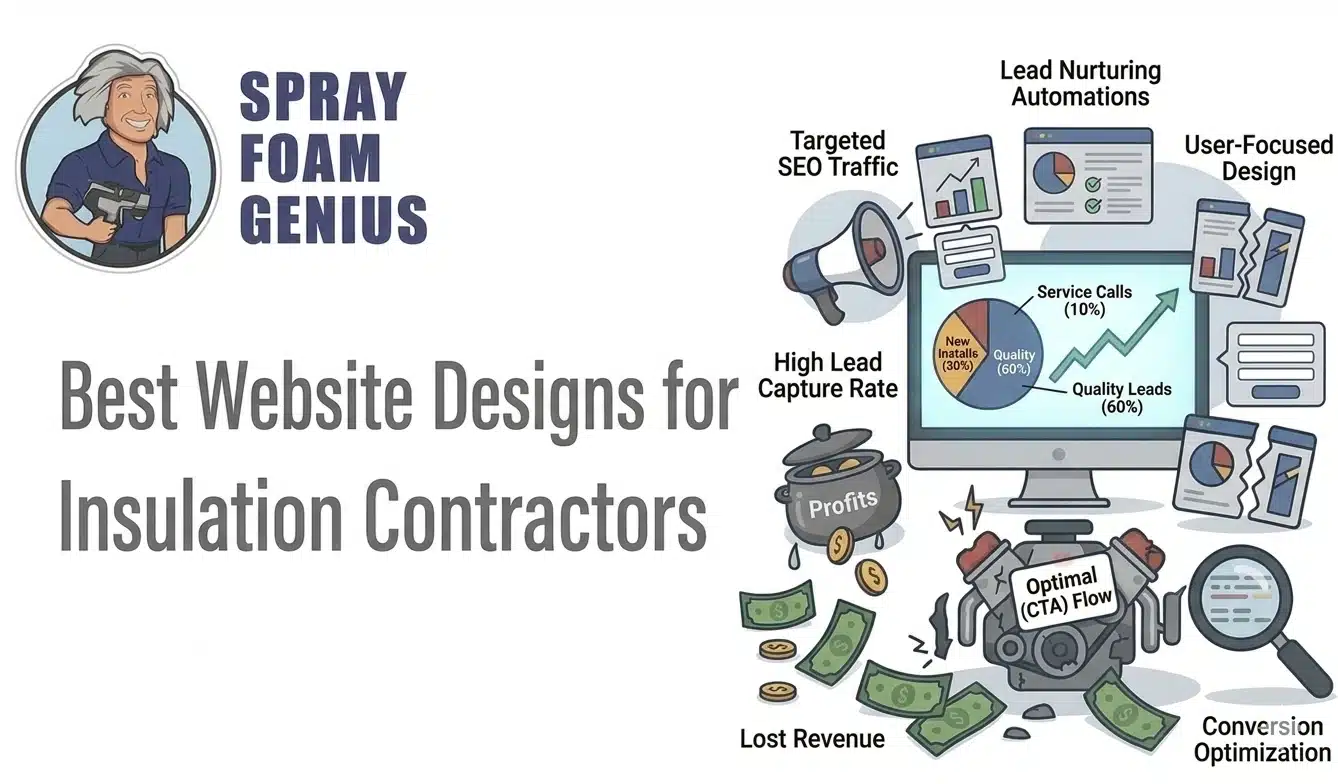

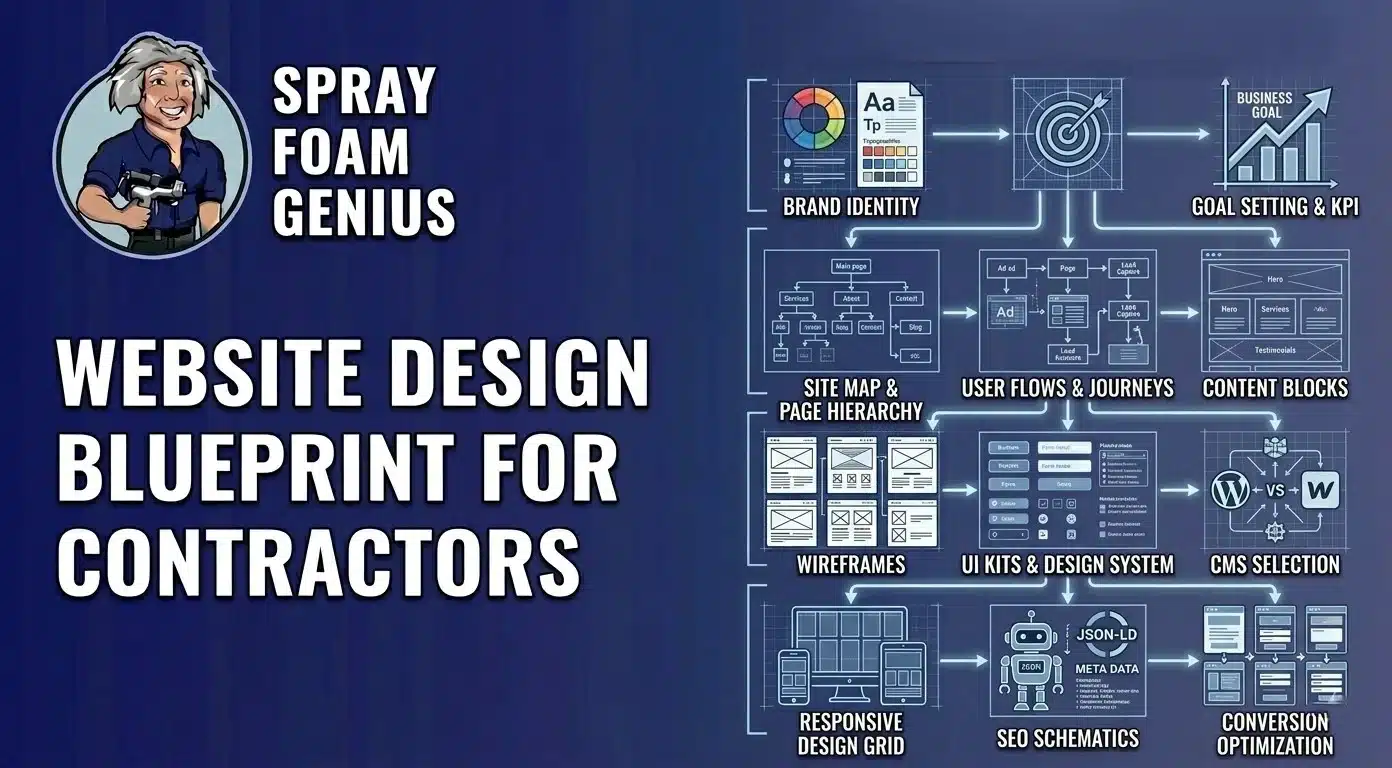
Your website is not a digital brochure. It is a 24/7 salesperson, and right now, it is either winning jobs while you sleep or silently sending customers to your competitors. For spray foam contractors, a high-converting website is the single most important marketing asset you own. This blueprint covers every element of spray-foam contractor website design you need to attract qualified traffic, build trust, and convert visitors into booked jobs.
Whether you are starting from scratch or overhauling an existing site, this guide gives you the exact structure, strategy, and systems used by top-performing insulation contractor websites in 2025.
Why Website Design Is Critical for Spray Foam Contractors
Your website design directly affects how many leads you get. Poor design loses jobs before you ever pick up the phone.
Spray foam is a high-ticket service. Homeowners and commercial clients do not hire the first contractor they find. They research, compare, and make a judgment call based largely on what your website communicates in the first 10 seconds.
Research from the Nielsen Norman Group shows that users form an opinion about a website within milliseconds, and most leave within 10 to 20 seconds unless the page immediately speaks to their needs.
For spray foam contractors, that means your site needs to instantly signal:
- You are local and available
- You are credible and experienced
- You solve the exact problem they have
- Contacting you is easy and low-risk
Most contractor websites fail all four of these tests. They are slow, generic, visually dated, and buried on page 4 of Google, where no one sees them. A professionally designed, conversion-focused site changes that entirely.
According to BrightLocal’s local SEO statistics, customers are 2.7 times more likely to consider a business reputable when they find a complete, well-optimized online presence, and businesses with complete profiles are 70% more likely to attract a visit. That trust starts on your website.
Key Elements of a High-Converting Contractor Website

High-converting sites share a predictable set of elements. Nail all of them, and leads become consistent.
Not every contractor website converts at the same rate. The difference between a site that generates 5 leads a month and one that generates 50 comes down to specific, measurable design and content decisions.
The core elements of a high-converting contractor website include:
Clear value proposition. Within the first 5 seconds, the visitor should understand who you serve, what you do, and where you operate. “Spray Foam Insulation for Residential and Commercial Properties in [City]” is infinitely better than “Welcome to our website.”
Trust stack above the fold. Logos of certifications (Icynene, SPFA), years in business, number of projects completed, and a Google rating with star icons should all appear high on the homepage.
Single dominant CTA. Every page should have one primary goal. On most spray foam contractor sites, that is either a phone call or a quote request form. Do not split attention with five different offers.
Proof and credibility content. Photos of your actual work, before-and-after comparisons, video walkthroughs, and written testimonials with full names and cities are non-negotiable.
Fast, clean navigation. Visitors should find what they need within two clicks. Services, About, Service Areas, and Contact should all be accessible from the top nav.
Essential Structure of a High-Converting Contractor Website
Your site needs a logical page architecture that guides visitors toward conversion and tells Google what you do and where.
A spray foam contractor website needs more than a homepage and a contact page. It needs a deliberate structure that supports both user experience and search engine visibility.
Recommended page structure:
- Homepage
- About Us
- Service Pages (one per service: open cell, closed cell, commercial spray foam, attic insulation, crawl space, etc.)
- Location/Service Area Pages (one per target city or region)
- Blog/Resources
- Testimonials or Case Studies
- Contact / Free Quote
Each page has a specific job. Service pages rank for service-specific searches. Location pages rank for city-level searches. The homepage builds authority and points users deeper into the funnel. The blog builds topical authority and captures informational search traffic.
Homepage Design That Builds Instant Trust
Your homepage has one job: convince a stranger to take the next step. Every element should serve that goal.
The homepage is the most visited and most important page on your site. It needs to do the heavy lifting of establishing who you are and why someone should call you instead of the next contractor in their search results.
Hero Section Requirements:
- A headline that names your service and location
- A sub-headline that speaks to the core benefit (energy savings, comfort, faster installation)
- One CTA button: “Get a Free Quote” or “Call Now”
- A real photo of your crew at work or a completed project, not a stock image
- Social proof: star rating, number of reviews, years in business
Below the fold sections should include:
- A brief “Why Choose Us” section with 3 to 5 differentiators
- Service cards linking to individual service pages
- A short video or photo gallery of recent work
- A testimonial strip with real customer names and locations
- A trust bar showing certifications, insurance badges, and associations
Service Page Optimization for Maximum Local Leads
Each spray foam service needs its own dedicated page built around a specific keyword and conversion goal.
Generic service pages kill conversions. If you offer open cell foam, closed cell foam, attic insulation, and crawl space encapsulation, each of those needs its own page. Here is why:
A homeowner searching “closed cell spray foam attic [city]” has a specific problem. If they land on a generic “insulation services” page, you have failed to match their intent, and they will bounce.
Each service page should include:
- A keyword-specific H1 (e.g., “Closed Cell Spray Foam Insulation in [City]”)
- A clear description of what the service involves
- Why spray foam is the best solution for their specific situation
- The installation process in plain language
- Cost range or “how pricing works” section to pre-qualify leads
- FAQ addressing common objections
- A strong CTA to request a quote
Service Page Content Checklist:
Location Pages and Local SEO Structure

If you serve multiple cities, each city deserves its own page. This is how you dominate local search in every market you work.
Location pages are one of the most underused assets in insulation contractor website design. If your spray foam business operates across 10 to 20 cities or towns, you need a dedicated page for each one. These pages allow Google to index your relevance to specific geographic searches.
A proper location page is not a copy-paste template with the city name swapped. It needs unique content that includes:
- The city name and service in the H1
- Local-specific details (neighborhoods, landmarks, climate considerations)
- A Google Map embed showing your service area
- Unique testimonials from customers in that city, when possible
- Local schema markup (Service + LocalBusiness)
- Internal links to related service pages
Spray foam demand spikes seasonally in cold climates before winter and in hot, humid markets before summer. Your location pages should reflect regional language and seasonal messaging to increase relevance. According to data compiled by BrightLocal, businesses that appear in Google’s local 3-Pack receive 42% of all clicks for local queries, making location page optimization one of the highest-ROI activities available to spray foam contractors.
How to Use SEO in Website Design for Higher Rankings
SEO and design are not separate disciplines. The structure, speed, and code of your website are ranking factors.
Spray foam SEO web design means your site is built from the ground up to rank. That starts with keyword research but extends into every technical and structural decision made during development.
On-page SEO fundamentals for every page:
- Title tag: 50 to 60 characters, includes primary keyword
- Meta description: 140 to 155 characters, includes keyword and a clear value hook
- H1: One per page, contains target keyword
- H2s and H3s: Break content into logical sections, include secondary keywords
- Image alt text: Descriptive and keyword-informed
- URL structure: Short, clean, keyword-rich (e.g., /spray-foam-insulation-nashville/)
- Internal links: Connect related pages using descriptive anchor text
- Schema markup: LocalBusiness, Service, FAQ, Review
Content length matters too. According to research from Backlinko, top-ranking pages for competitive local service keywords average over 1,400 words. Your service and location pages should not be three paragraphs long.
Creating High-Converting Calls-to-Action (CTAs)
Your CTA is the bridge between visitor and customer. Weak CTAs bleed leads. Strong CTAs compound them.
Most contractor websites treat the CTA as an afterthought. A button that says “Contact Us” buried at the bottom of the page is not a CTA strategy. It is a missed opportunity.
High-converting CTAs for spray foam contractor websites use specific, benefit-driven language:
- “Get My Free Spray Foam Estimate” beats “Submit”
- “Call for Same-Day Quotes” beats “Call Us”
- “See How Much You Could Save” beats “Learn More”
CTA placement rules:
- Always include one in the hero section
- Repeat at the midpoint of long pages
- Include at the bottom of every service and location page
- Add a sticky header CTA (phone number with click-to-call) on mobile
Color contrast matters. Your CTA button should be the most visually prominent element on the page, never blending into the background.
Building Trust with Reviews, Proof, and Case Studies
In spray foam contracting, trust is the product. Reviews, photos, and case studies sell the job before you even show up.
Spray foam is a significant investment. Homeowners and building owners want to see evidence before they commit. Your website needs to be loaded with social proof at every stage of the funnel.
Types of proof that convert:
- Google Reviews embedded on-site: Display your star rating dynamically using a review widget
- Before and after photos: Show the actual transformation, crawl space encapsulation, attic jobs, and commercial projects
- Video testimonials: Even a 60-second smartphone video of a happy customer dramatically increases trust
- Case studies: A brief write-up of a notable project (square footage, energy savings achieved, time to complete) adds authority and differentiates your services
- Certifications and credentials: SPFA membership, manufacturer certifications, contractor licenses, and insurance documentation should all be visible
Case studies, in particular, are a content gap most spray foam websites completely ignore. A 400 to 600-word write-up about a real project, with photos, measurable outcomes, and a customer quote, can rank for long-tail keywords while simultaneously converting skeptical visitors.
According to local SEO data from Wiser Review, over 90% of homeowners read reviews before contacting a service business, and 75% of local companies report that consistent review management generates more leads than paid ads. Those numbers make your review strategy a direct revenue driver, not a nice-to-have.
Mobile Optimization and Website Speed Best Practices
If your site is slow or broken on a phone, you are handing jobs to competitors.
Google’s mobile-first indexing means your mobile experience is your SEO experience. A site that looks great on desktop but loads slowly or displays poorly on a phone will rank lower and convert worse.
Mobile optimization checklist:
- Responsive design that adapts to all screen sizes
- Tap-to-call button visible without scrolling
- Forms with minimal required fields (name, phone, and zip code are enough to start)
- Font size at least 16px for body text
- Buttons large enough to tap without zooming
- No horizontal scrolling
Speed optimization priorities:
- Image compression (use WebP format)
- Lazy loading for images below the fold
- Minified CSS and JavaScript
- A reliable hosting provider with fast servers (avoid shared hosting for business sites)
- A content delivery network (CDN) for regional traffic
- Target a Core Web Vitals score in the “Good” range for LCP, CLS, and INP
As Google’s official Core Web Vitals documentation confirms, a Largest Contentful Paint (LCP) under 2.5 seconds, an Interaction to Next Paint (INP) under 200 milliseconds, and a Cumulative Layout Shift (CLS) score under 0.1 are the benchmarks every contractor website should be hitting. These are direct ranking factors that also reduce bounce rates and increase conversion rates.
Technical SEO Elements Every Contractor Website Needs

Technical SEO is the foundation. Without it, great content stays invisible.
Even the best-written spray foam contractor website will struggle to rank if the technical foundation is broken. These are non-negotiable elements:
- SSL certificate: Your site must be HTTPS, not HTTP
- XML sitemap: Submitted to Google Search Console
- Robots.txt: Properly configured to allow Google to crawl your pages
- Canonical tags: Prevents duplicate content issues across location pages
- Structured data markup: LocalBusiness, Service, Review, and FAQ schema
- Google Business Profile integration: Consistent NAP (Name, Address, Phone) across your site and GBP listing
- 404 error management: Redirect broken URLs to relevant live pages
- Core Web Vitals monitoring: Regularly check via Google Search Console
Lead Capture Systems That Turn Visitors into Customers
Getting traffic is half the job. Capturing that traffic into a lead pipeline is where the money is made.
A lead generation website for contractors does more than display information. It actively captures contact details and creates follow-up opportunities from every visitor who does not convert immediately.
Lead capture tools to install:
- Quote request form: Short (3 to 5 fields), prominently placed, mobile-optimized
- Live chat widget: Even a bot that captures name and phone number is valuable
- Exit-intent pop-up: Triggered when a user moves to close the tab, offering a free estimate or resource
- Call tracking: Use a dynamic number insertion service to track which pages and campaigns generate calls
- Lead magnet: A downloadable guide like “How to Choose the Right Spray Foam Insulation for Your Home” captures email addresses from visitors not yet ready to buy
The goal is to convert as many site visitors as possible into a named contact, even if they are not ready to book today. With a proper follow-up system, those contacts become jobs weeks or months later.
CRM, Follow-Ups, and Automation for Consistent Leads
Most leads go cold because no one follows up. A CRM and automation system fixes that permanently.
A website that generates leads means nothing if those leads disappear into a spreadsheet and get called once. Studies show that following up within 5 minutes of a form submission increases conversion rates dramatically. Most contractors follow up hours or days later, if at all.
Recommended automation workflow:
- Lead submits a quote form on your website
- CRM automatically logs the lead and sends an immediate confirmation email to the prospect
- An automated SMS is sent within 2 minutes: “Thanks for reaching out, [Name]. We will call you within the hour to discuss your project.”
- A task is created for your sales rep or owner to call within 60 minutes
- If no contact is made, automated follow-up texts and emails go out at 24, 48, and 72 hours
- Unconverted leads enter a long-term nurture sequence
Tools like GoHighLevel, HubSpot, or Jobber integrate well with contractor websites and enable this kind of automation without requiring a full-time marketing team.
Common Website Design Mistakes Contractors Must Avoid
Avoiding these mistakes is just as important as implementing best practices.
After auditing hundreds of contractor websites, the same problems appear repeatedly. These are the most damaging mistakes in spray foam website optimization:
Using stock photos exclusively. Stock images of insulation or construction workers undermine authenticity. Real photos of your team and real jobs build trust immediately.
No clear service area. If a visitor cannot immediately tell where you operate, they assume you are not local and leave.
One page for all services. Lumping everything under “Services” destroys your ability to rank for specific, high-intent keywords.
Slow load times. Every additional second of load time reduces conversions significantly. Page speed is a measurable revenue issue, not just a technical one.
No mobile CTA. Desktop users can navigate to a contact page. Mobile users need a tap-to-call button visible immediately. Data from Wiser Review shows that 88% of mobile local searches lead to a store visit or contact within 24 hours, meaning your mobile experience directly determines how many of those searchers reach out to you.
Ignoring Google Business Profile. Your GBP and website work together. Inconsistent NAP data confuses Google and suppresses local rankings.
No blog or content strategy. A static website slowly loses rankings over time. Regular, relevant content keeps your site authoritative and growing.
Examples of High-Converting Spray Foam Contractor Websites
The best contractor websites share a consistent formula: clarity, speed, local relevance, and trust stacked above the fold.
The highest-performing insulation contractor websites tend to share several observable characteristics:
Fast, visual hero sections. Real project photos or short video backgrounds in the hero. A headline that names the service and city. One obvious CTA.
Prominent contact options. Phone number in the top right corner, always visible. A quote request form accessible from the nav. A live chat option on mobile.
Rich service and location architecture. 10 to 20 dedicated service and location pages, each targeting a specific keyword and geography. No two pages have the same content.
Active review strategy. 50 or more Google reviews with a dynamic widget pulling the average rating onto the homepage. New reviews are added regularly.
Case study or project gallery pages. Photos organized by project type (attic, crawl space, commercial, new construction) with brief project summaries.
A blog with consistent publishing. Monthly posts addressing common customer questions, seasonal topics, and comparison guides (spray foam vs fiberglass, open cell vs closed cell, etc.).
The formula is not complicated. What separates high performers from average sites is simply the execution and consistency. For industry credibility standards and certification references, the Spray Polyurethane Foam Alliance (SPFA) is the definitive resource, and prominently featuring your membership or certification from this body on your website adds a layer of authority that competitors without it simply cannot match.
Ready to Turn Your Website Into a Lead-Generating Machine?
Your next customer is searching for spray foam insulation right now. The question is whether they find you or your competitor.
At Spray Foam Genius Marketing, we build high-converting websites exclusively for spray foam contractors. No guesswork. No generic templates. Just proven strategies built around your trade.
Get your free website audit today.
Call 877-840-FOAM (USA) or 844-741-FOAM (Canada) Email: info@sprayfoamgeniusmarketing.com
Your next job starts with your website. Let’s make it count.
FAQs
Q1: How much does a spray foam contractor website cost?
A well-built lead generation website for a spray foam contractor typically ranges from $2,500 to $8,000 for design and development, with ongoing SEO and maintenance costing $500 to $2,000 per month, depending on market competitiveness and the number of service areas targeted.
Q2: How long does it take for a new contractor website to rank on Google?
For competitive local keywords like “spray foam insulation [city],” expect 3 to 6 months before seeing meaningful rankings with a properly optimized site. Less competitive markets or long-tail keywords can rank in 4 to 8 weeks. Consistent content and link building accelerate this timeline.
Q3: Do I need separate pages for each city I serve?
Yes. A dedicated location page for each target city significantly increases your chances of ranking in local searches for that area. Generic “service areas” pages with a list of cities do not rank nearly as well as individual, content-rich location pages.
Q4: What is the most important thing on my spray foam website homepage?
The single most important element is a clear, benefit-driven headline that names your service and location, paired with an obvious call to action (phone number or quote form) visible without scrolling. Social proof, such as your Google rating and years in business, should also appear above the fold.
Q5: How do I get more reviews for my spray foam business?
Send an automated SMS or email to every completed job asking for a Google review within 24 hours of project completion. Include a direct link to your Google Business Profile review page. Contractors who follow this consistently average 10 to 30 new reviews per month, which significantly boosts both local rankings and on-site conversion rates.