
Direct Answer
Most insulation company landing pages fail to convert because they prioritize traffic over intent, lack message match between ads and page content, over-rely on generic “free estimate” offers, and fail to build immediate trust. To fix this, you must align your landing page with the exact search intent behind your ads, simplify your value proposition, strengthen credibility signals (reviews, certifications, before/after results), reduce friction in your forms, and optimize for mobile speed and clarity. When these elements work together, insulation contractors typically see conversion rates increase from below 2% to 5% or higher depending on traffic quality and market competitiveness.
TLDR
- Match your landing page headline directly to your ad keyword intent (message match is critical)
- Improve page speed and mobile UX to reduce bounce rates (over 50% of users abandon slow pages)
- Replace generic offers with specific, high-value incentives (e.g., “Home Energy Loss Inspection”)
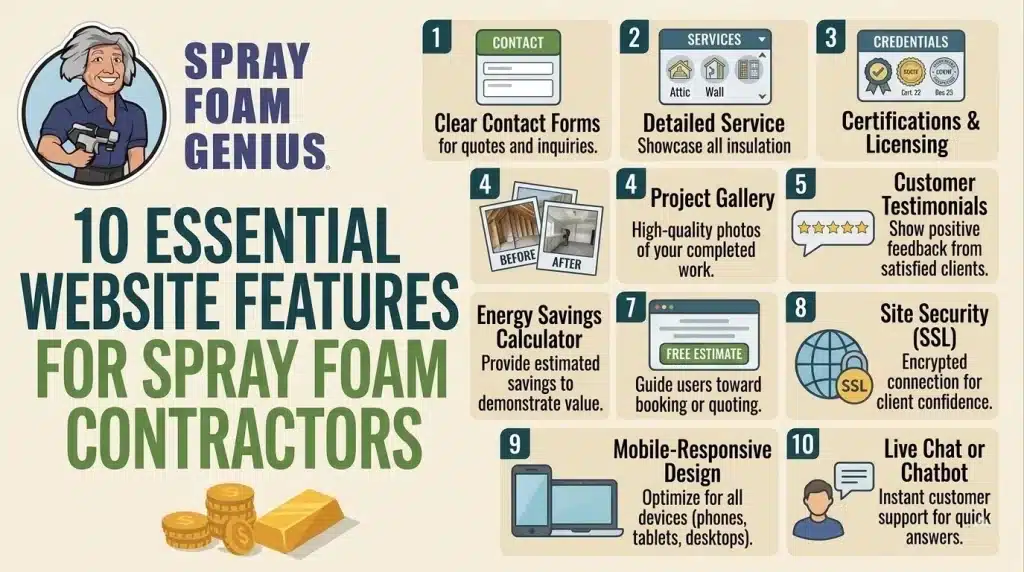
- Add trust signals like reviews, certifications, and real project photos
- Reduce form friction by asking only for essential information
- Use clear, high-contrast CTAs placed above the fold and mid-page
- Leverage call tracking and analytics to optimize lead quality, not just volume
- Optimize for local intent and service-area relevance
Why Insulation Landing Pages Fail (And What’s Really Happening)
Insulation contractors often invest heavily in PPC ads or SEO but send traffic to poorly optimized pages that act like digital brochures instead of conversion tools. According to research from Google, 53% of mobile users abandon sites that take longer than 3 seconds to load. In-home services like insulation, where decisions are urgent but high-consideration, even small friction points drastically reduce lead generation.
A key issue is reliance on “shared leads” or generic landing funnels that treat all visitors the same. This creates low-intent inquiries and forces contractors into price competition instead of value positioning.
Additionally, many pages fail basic conversion principles outlined by Nielsen Norman Group; relevance and trust are often missing within the first 5 seconds. Contractors looking to improve landing page performance and convert more visitors into qualified leads can review this high-converting contractor website guide.
The Core Problems Killing Your Conversion Rate
1. Message Mismatch Between Ads and Landing Page
If someone clicks “attic insulation cost in New Jersey” but lands on a generic “home insulation services” page, they feel lost and bounce quickly. This disconnect is one of the biggest conversion killers.
2. Weak or Generic Offer
“Free Estimate” is no longer compelling. Users expect value upfront. Without differentiation, you become interchangeable with every competitor.
3. Lack of Trust Signals
Homeowners need reassurance before inviting contractors into their homes. Without reviews, certifications, and real project photos, trust drops significantly.
4. Poor Mobile Experience
More than 60% of home service searches happen on mobile devices (Think with Google). If your page is not mobile-first, you are losing majority traffic.
High-Impact Fixes That Increase Conversions
1. Align Intent with Message Match
Your landing page headline must mirror the ad or search query exactly.
Example:
- Ad: “Spray Foam Insulation Cost in Newark NJ”
- Landing Page Headline: “Get Exact Spray Foam Insulation Pricing in Newark, NJ Today”
This alignment increases relevance and reduces bounce rate significantly, as supported by conversion optimization studies from HubSpot.
2. Improve Page Speed and Technical Performance
Speed is not optional. According to Google research, as page load time increases from 1 to 5 seconds, bounce probability increases by 90% .
Fixes:
- Compress images (especially project photos)
- Use lightweight landing page builders
- Remove unnecessary scripts
- Enable lazy loading
3. Replace Generic Offers with High-Value Hooks
Instead of:
- “Free Estimate”
Use:
- “Free Home Energy Loss Audit”
- “Attic Efficiency Report + Cost Savings Estimate”
- “Insulation Upgrade ROI Assessment”
This reframes your service from commodity to consultation.
| Offer Type | Conversion Impact | Perceived Value |
| Free Estimate | Low | Generic |
| Energy Audit | High | Expert-level insight |
| ROI Assessment | Very High | Financial value focus |
4. Strengthen Trust Signals Immediately
Trust must be visible above the fold.
Include:
- Google reviews embed
- Certifications (e.g., BPI, ENERGY STAR)
- Before/after project photos
- Local job references
According to Harvard Business Review insights on trust and decision-making, consumers make trust judgments in milliseconds, especially in high-stakes services like home improvement.
5. Optimize Forms for Maximum Completion
Long forms destroy conversions. In insulation marketing, every additional field reduces submission rates.
Recommended form structure:
- Name
- Phone
- Zip Code
- Property Type
Avoid:
- Budget fields
- Detailed project descriptions upfront
- Multiple-step unnecessary funnels
| Form Length | Average Conversion Rate |
| 3–4 fields | 6–12% |
| 5–7 fields | 3–6% |
| 8+ fields | Under 3% |
6. Improve CTA Placement and Messaging
Your call-to-action must be:
- Visible above the fold
- Repeated every scroll section
- Action-oriented, not passive
Examples:
- “Get My Insulation Quote Today”
- “Check My Home’s Efficiency Now”
- “Schedule Free Energy Inspection”
Avoid vague CTAs like “Submit” or “Learn More.”
Common Landing Page Problems vs Fixes
| Problem | Why It Hurts Conversions | Fix |
| Generic messaging | Low relevance | Match ad keywords exactly |
| Slow load speed | High bounce rate | Compress assets |
| Weak trust signals | Low credibility | Add reviews and certifications |
| Long forms | Friction increases drop-off | Reduce to 3–4 fields |
| Weak CTA | Low urgency | Use action-driven CTAs |
| No local focus | Poor SEO relevance | Add city-specific content |
Advanced Conversion Strategies
1. Add Call Tracking + Analytics
Without tracking, you are guessing. Tools like call tracking reveal which keywords generate actual booked jobs, not just leads.
2. Use Heatmaps for Behaviour Insights
Heatmap tools show where users scroll, click, and drop off. This helps refine the layout for maximum engagement.
3. Retargeting Campaigns
Most visitors do not convert on the first visit. Retargeting ads can increase conversion rates by up to 70% when paired with optimized landing pages.
4. Local SEO Alignment
Ensure your landing page includes:
- City-specific headers
- Embedded map
- Local testimonials
Why Shared Leads Hurt Conversion Strategy
Shared leads force insulation contractors into competing on price instead of value. This reduces ROI from advertising and leads to inconsistent sales pipelines. A dedicated landing page strategy eliminates competition at the lead level by capturing exclusive, high-intent users and nurturing them through tailored messaging.
Instead of fighting over the same lead with 3–5 contractors, your landing page should function as a filtering system that qualifies and pre-sells the customer before.
Turn Your Landing Page into a Lead-Generating Machine
If your insulation landing page is getting clicks but not producing consistent booked jobs, the issue is not traffic. It is structure, messaging, and conversion design. A properly optimized landing page can double or even triple your lead conversion rate without increasing ad spend.
Spray Foam Genius Marketing specializes in building high-converting landing pages for insulation contractors designed to turn paid traffic into booked appointments.
Ready to improve your lead conversion rate?
Contact us today: 877-840-FOAM or 844-741-FOAM
Email us at: [email protected]
FAQs
1. What is a good conversion rate for an insulation landing page?
A strong insulation landing page typically converts between 4% and 8%, depending on traffic quality and market competition. Below 2% usually indicates structural or messaging issues.
2. Why do insulation landing pages fail to convert clicks?
Most fail due to poor message match, weak trust signals, slow loading speed, and overly generic offers that do not differentiate the contractor.
3. Should I use “free estimate” or a more specific offer?
More specific offers like “Energy Loss Audit” or “Insulation ROI Report” consistently outperform generic estimates because they communicate value upfront.
4. How important is mobile optimization for insulation marketing?
Extremely important. Over 60% of users search on mobile, and slow or poorly optimized mobile pages can reduce conversions by more than half.
5. How many fields should my lead form include?
Ideally, 3–4 fields. Adding more fields significantly increases drop-off and reduces total leads.
Sources
- https://en.wikipedia.org/wiki/Landing_page
- https://www.nngroup.com/articles/convert-visitors-into-customers/
- https://www.hubspot.com/conversion-rate-optimization
- https://www.thinkwithgoogle.com/marketing-strategies/app-and-mobile/page-load-time-statistics/
- https://developers.google.com
- https://hbr.org/2017/01/the-neuroscience-of-trust
- https://www.optimizely.com/optimization-glossary/conversion-rate/

Spencer is a Google ranking expert and SEO consultant who has helped businesses in the spray foam marketing industry achieve their online marketing goals. Spray Foam Genius Marketing has a proven track record of success, having achieved some impressive results for his clients.
- The Future of Search for Insulation Contractors Goes Beyond Google Rankings - September 30, 2026
- AI Search Is Changing How Homeowners Find Insulation Contractors - September 30, 2026
- Finding Affordable SEO Services for Your Insulation Business Growth - September 16, 2026