
If your insulation or spray foam company does good work but the phone does not ring consistently, the cause is usually somewhere in your online presence. Most contractors with slow seasons and unpredictable lead flow are not failing on service quality or price. Buyers cannot find them, do not trust what they see when they do, or land on a website that does nothing to turn a visit into a call.
This article covers the most common reasons insulation companies do not get leads online, gives you a self-audit checklist, and puts the fixes in a sensible order. Nobody can promise a rankings result or a timeline, but these are the gaps we see most often.
Why Slow Seasons and Feast-and-Famine Cycles Keep Happening
Seasonality is real, but contractors in the same market who stay busier through slow stretches usually are not doing different work. They have more than one dependable way for a homeowner to find them. The feast-and-famine pattern is often a sign of leaning on one lead source, usually referrals. When referrals flow, business is good. When they slow down, nothing else fills the pipeline.
Referrals are valuable, but they do not scale on demand. The answer is not more networking. It is being findable by homeowners and builders who have never heard of you but are searching for exactly what you do. For a closer look at how the two compare, see SEO vs referral marketing for insulation contractors.
Related reading: Buying Insulation Leads vs Building Your Own Lead System: What Should You Pay For?
What Buyers Are Actually Doing Online
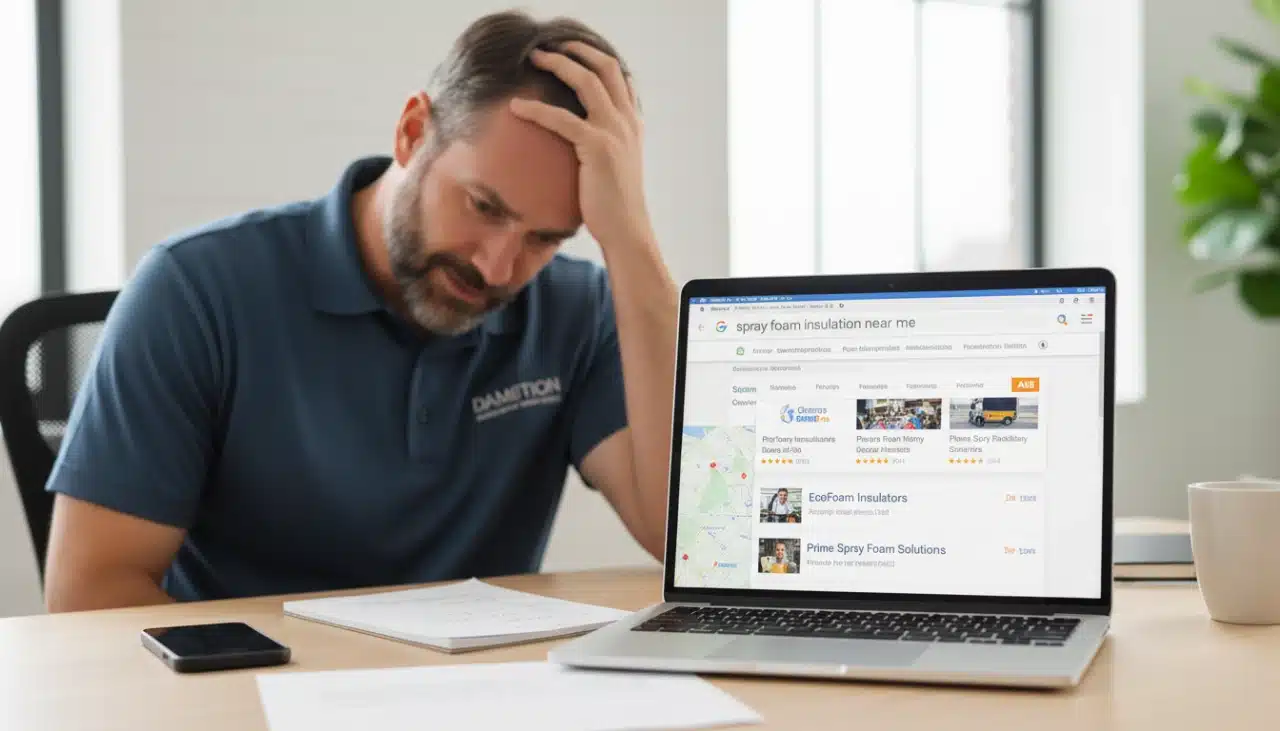
Most of the owners we talk to search their own company name and conclude they are showing up on Google. Buyers do not search that way. They type things like:
- spray foam insulation near me
- attic insulation contractor [city]
- spray foam vs fiberglass cost
- why is my attic so hot in summer
- crawl space encapsulation cost
If you do not appear for searches like these, you are invisible to buyers at the moment they are choosing. You are also competing with more than other spray foam companies: insulation and HVAC contractors, national directories and lead-selling sites all fight for the same screen space. The companies that get the calls are often not better installers. They are simply easier to find.
Problem 1: Your Google Business Profile Is Incomplete or Weak
When a homeowner searches for a local contractor, Google often shows a map with a short list of local businesses, with ratings, photos and a click-to-call button. If you are not in that list, or your listing looks thin, those calls go to whoever is.
Google says local results are based mainly on relevance, distance and prominence, and that complete, accurate business information helps it match you to a search. See Google’s tips to improve your local ranking. Common profile gaps for insulation contractors:
- Incomplete or unverified profile, missing hours, phone number or website link
- Wrong or too few categories and services, so Google cannot tell what you do
- No service areas set, or only your office address showing
- Few photos, or photos that are not your real jobs
- Few or old reviews, and no activity such as posts or answered questions
Many contractors appear in the map results only near their shop. Drive 10 miles toward the next town and they disappear, which means competitors capture jobs across most of your real service area. For the full process, see our guide to using Google Business Profile for insulation marketing.
Problem 2: Your Website Is Not Showing Up on Google
A common situation: a contractor has a website, pays for hosting and considers the online side covered. Then they search "spray foam insulation [their city]" and the site is nowhere on the first pages. When your site does not appear, the customers who would have called you call whoever does.
Typical reasons an insulation contractor’s website does not show up:
- The site is designed to look good, not to be found, with no real service pages or location pages
- One generic "services" page tries to cover spray foam, blown-in, attic, crawl space and commercial work at once
- Pages are thin, duplicated or missing the city and service words buyers actually type
- Few trustworthy sites mention or link to you, and your name, address and phone number differ across listings
- Technical problems such as slow loading or pages Google cannot easily crawl
Nobody outside Google knows exactly how it ranks pages, and we do not claim to. What we can say is that clear, useful pages that match what people search for, on a site that works well, give you the best chance. Our spray foam SEO strategy and local SEO guide cover this in more detail.
Problem 3: You Have No Reviews or Too Few to Be Trusted
Reviews do two jobs. They help buyers trust you, and Google says review count and score can help your local ranking: "More reviews and positive ratings can help your business’s local ranking." Insulation is a high-trust purchase. Homeowners are spending real money and letting strangers into their home, and a thin or stale review profile creates doubt even when you do show up.
The fix is a system, not hoping happy customers remember to post. Ask at job completion, text the customer a direct link to your Google review page, and reply to every review. The number of asks drives the number of reviews. See how important Google reviews are for spray foam businesses for scripts and timing.
Problem 4: Your Website Is Slow, Broken or Hard to Use on a Phone
Getting someone to your site is only half the job. If it loads slowly, looks outdated or is awkward on a phone, they go back and call the next contractor. Many local searches happen on a phone, often right after someone spots a problem in an attic or crawl space.
Speed matters for real. Google research found that as mobile page load time goes from one second to seven seconds, the probability of a visitor bouncing increases by 113%. For you, a conversion is a phone call or a form submission, so every visitor who leaves because of a slow page is a lead gone before you could answer. Practical checks: open your own site on a phone, count the taps to reach your phone number, and try submitting your quote form with a thumb. Our guide to fast-loading sites for spray foam contractors goes deeper.
Problem 5: No Content Answering How Buyers Actually Search
Many buyers research before they call anyone. They look for answers to the problem they have right now, and the companies that show up with clear, local, helpful answers are the ones remembered when the buyer is ready to move. A site with only a "Contact Us" page and a services list is not part of that conversation.
Content that attracts buyers at different stages:
- Problem searches: why an attic is hot, why a basement is damp, why heating bills are high
- Comparison searches: open-cell vs closed-cell spray foam, spray foam vs blown-in or fiberglass
- Cost and process searches: what affects the price, how long a job takes, whether a home is a good fit
- Local searches: service area pages that mention your city, local climate, codes and incentives
Answer questions plainly and end each page with a clear next step, such as booking an inspection. Most contractor sites only cover the last stage, which leaves them competing with every other local company for the same "insulation contractor near me" searches.

Problem 6: Your Site Targets the Wrong Keywords
There is a big difference between searches that bring traffic and searches that bring calls. Many insulation sites are built around terms that are too broad to win, too generic to attract buyers, or industry jargon homeowners never type. Common mistakes:
- Targeting broad educational terms like "insulation tips" and never ranking for service plus city searches
- Using trade vocabulary the homeowner does not use
- Having no page for a service you want more of, such as crawl space, commercial or metal building work
- Missing the cities you actually serve
Problem 7: Ads, Tracking and Past Marketing Mistakes
Some contractors have already tried marketing and concluded it does not work. Often the strategy was the issue: cheap SEO with no local focus, ads run without call tracking, or an agency that did not understand spray foam. Without tracking calls and forms by source, you cannot tell which channel works, and money drifts to the wrong place.
Paid ads can fill a slow pipeline while organic visibility builds, but paid leads stop when spending stops, and you build no lasting asset. Most contractors do best combining paid and organic. See SEO vs Google Ads for insulation contractors for how to split effort.
Also check what happens after the call. If leads come in but you respond slowly or follow up once, the problem is conversion, not visibility. Harvard Business Review research found that most companies are not responding to online leads nearly fast enough. Our guide on why insulation leads do not convert into jobs covers that side.
The Insulation Company Online Presence Self-Audit
Be honest. Mark each item that is missing, incomplete or out of date:
- Google Business Profile is claimed, verified and complete, with the right categories, services, hours and service areas
- You have recent photos of real jobs and a steady flow of new reviews, and you reply to them
- Searching your main service plus your city shows you on the map or in the results
- You have a separate page for each main service and each major city you serve
- Your site loads quickly and your phone number is tappable on mobile
- Every page has one clear next step: call, request a quote or book an inspection
- You have content answering the questions buyers ask before they call
- Your name, address and phone number match everywhere online
- You track calls and form submissions by source
- Every new lead gets a fast reply and a follow-up plan
How to Score It
Count the items you marked. A few gaps mean targeted fixes. Gaps across most items mean visibility, trust and conversion all need work, so fix them in the order below rather than all at once.
What to Fix First: The Priority Order
Some problems block others. Ranking in the map results with no reviews means the traffic will not convert. A fast site with no visibility means nobody visits it. A sensible sequence:
- Fix your Google Business Profile and start a review system, the quickest levers to move
- Make the website usable: speed, mobile layout, click-to-call and one clear next step per page
- Add service and location pages that match how buyers search
- Publish content that answers buyer questions and links to those pages
- Set up call and form tracking so you can see what is working
- Tighten response time and follow-up for every lead
What to Expect on Timing
Nobody can guarantee a timeline for rankings or leads. In general, profile cleanups, review requests and website usability fixes can show up sooner because they do not depend on Google re-evaluating your whole site. New service pages and content usually take longer, and building steady organic lead flow is measured in months rather than weeks. The mistake we see most often is quitting before the longer-term work has had time to compound.
Frequently Asked Questions
Can an owner fix all of this without hiring an agency?
Some of it, yes. Claiming and completing your Google Business Profile, asking for reviews and testing your site speed are things an owner can do. Writing service and location pages takes more time but not advanced skill. Where most contractors run out of capacity is consistent content, link building and tracking what works. If you have the time you can do it yourself, but many owners find their time is worth more on the job.
How quickly will fixing these problems produce more leads?
It depends on the market and the starting point, and nobody can promise a timeline. Profile and review improvements and website usability fixes tend to be the quickest to show up. Ranking improvements from new pages and content usually take longer and build over time.
Why does a competitor with a poor website rank higher?
Google cares less about how attractive a site looks and more about relevance, location and how well known and trusted a business appears. Review count, a complete profile, relevant pages and how many trusted sites mention a business all play a part. A competitor with a weak site can still lead on those. The gap can close with consistent work, though no one can promise how fast.
Is paying for Google Ads a faster solution?
Ads can start producing inquiries quickly, which makes them useful for a slow pipeline. The tradeoff is that paid leads stop when spending stops, and clicks in competitive markets can be costly. Running ads while building organic visibility is usually more effective than either alone.
What about buying leads from a lead-selling site instead?
Purchased leads can fill gaps, but they are often shared with several contractors and are not exclusive, so you compete on speed and price. They do not build a lasting asset the way your own profile, reviews and website do.
How can you tell if your SEO agency is actually doing something?
Ask to see three things: your Google Business Profile call trend over the past 90 days, your rankings for your main services plus city terms, and the new content published on your site recently. Reports that show only impressions or authority scores, with no calls or rankings, are not enough.
The Bottom Line
Most insulation companies are not short on leads because the market is slow. They are invisible when homeowners search, or something in their online presence loses the lead before it becomes a call. An incomplete profile, weak visibility, too few reviews, a slow site, missing content and wrong keywords are all fixable, and none require starting over.
Not sure where your gaps are? Ask us for a free marketing audit. Call 877-840-3626 or email info@sprayfoamgeniusmarketing.com, and we will look at your profile, rankings, website and lead handling with you.