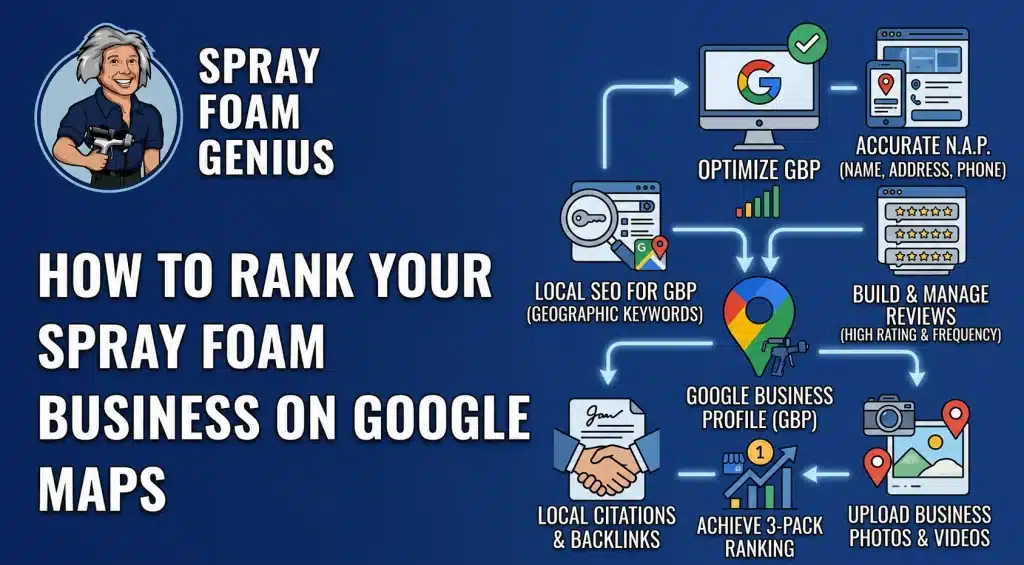
When a homeowner searches “spray foam insulation near me” or “insulation contractor [your city]”, three business names appear at the top of the results. Those three businesses get the bulk of the calls. Everyone else is invisible. If your insulation company is not in that three-pack also known as the map pack, you are losing jobs to competitors every single day, and most of those competitors are not better than you. They just have better Google Maps visibility.
The good news is that Google Maps rankings are not random. There are specific, documented reasons why contractors disappear from the map pack, and almost every one of those reasons is fixable. This guide walks you through the nine most common reasons insulation companies are invisible on Google Maps, backed by data, and gives you a clear action plan for each one. You can explore the full breakdown in our local SEO guide for spray foam contractors.
| TL;DR: Why Your Insulation Company Isn’t Showing Up on Google Maps Google Maps rankings come down to three things: Relevance, Distance, and Prominence. Here are the nine most common reasons insulation contractors are invisible in the local pack: 1. Unverified or incomplete Google Business Profile: Your profile is your ranking foundation. Missing fields, wrong category, or unverified status tanks visibility. 2. Wrong or missing primary category: Selecting the wrong category is one of the most common and damaging mistakes for insulation contractors. 3. Too few reviews or review velocity too slow: Per the Whitespark 2026 Local Search Ranking Factors survey, review signals carry major ranking weight. Recency matters as much as total count. 4. NAP inconsistency across the web: Google cross-checks your Name, Address, and Phone across all directories. Mismatches destroy trust and rankings. 5. No service area pages on your website: Your website must match your GBP. No local landing pages means Google cannot confirm you actually serve those cities. 6. Profile is not active (no posts, no updates): An inactive profile signals an inactive business. Engagement signals now carry more ranking weight than ever. 7. No photos, or only stock photos: Per Google, businesses with photos get 42% more direction requests and 35% more website clicks. 8. Competitor spam and fake listings: Legitimate contractors often rank below spammy competitors. Knowing how to report violations matters. 9. You are too far from the searcher’s location: Proximity is a real factor. Understanding how to work within it is the strategy. Fixing all nine issues is a 30-to-90 day project. Most contractors see movement in the map pack within 4-8 weeks of active optimization. Call Spray Foam Genius Marketing at 877-840-FOAM or visit sprayfoamgeniusmarketing.com to get started. |
Why Google Maps Visibility Is a Revenue Problem, Not a Branding Problem
Before fixing anything, it helps to understand what you are missing. According to Backlinko, 42% of all local searches result in a click on the Google Map Pack. That means when someone searches for an insulation contractor in your area, nearly half of all the people searching go directly to one of the three map listings without ever scrolling to organic results or paid ads.
Businesses in the Google 3-Pack receive 93% more actions, including calls, website clicks, and direction requests, than businesses ranked in positions 4 through 10. They also receive 126% more website traffic. This is not a small edge. Being outside the three-pack means you are largely invisible to nearly half of your potential customers before they ever have a chance to see your name.
| What Happens in Local Search | Why It Matters for Your Business |
| 42% of local searchers click a Map Pack result | Nearly half your potential customers go here first |
| 3-Pack businesses get 93% more calls and clicks | Being outside the 3-pack means near-total invisibility |
| 68% of searchers trust 3-Pack listings over organic | Map presence is a trust signal, not just traffic |
| 88% of consumers search on mobile, often near the time of purchase | They’re calling from the job site or neighborhood where they want the work done |
| 41% of consumers always read reviews before calling (BrightLocal 2026) | Reviews visible in the 3-pack directly influence who gets the call |
Reason 1: Your Google Business Profile Is Incomplete or Unverified
Your Google Business Profile (GBP) is the single most important asset in your local search presence. Whitespark’s 2026 Local Search Ranking Factors survey, compiled from 47 of the world’s leading local SEO experts evaluating 187 factors, found that GBP signals account for roughly 32% of local pack ranking influence, the highest of any single category. If your profile is not complete, verified, and consistently maintained, you are starting the race with a flat tire.
The most common GBP mistakes insulation contractors make: missing or outdated business hours, no business description, service list not filled out, and unverified profile status. Per Birdeye’s State of Google Business Profiles report, verified profiles with complete information receive 1,803 monthly views on average and 66 new Google reviews per year per location, while incomplete profiles lag significantly on both measures.
GBP Completeness Checklist for Insulation Contractors
| GBP Element | Status | Impact if Missing |
| Business verified by Google | Required | Profile may not appear at all in local pack |
| Primary category: Insulation Contractor | High | Wrong category = wrong searches; biggest single error |
| Business hours (accurate and updated) | High | Profiles shown as closed rank lower; wrong hours lose calls |
| Phone number (matches website exactly) | High | NAP inconsistency hurts trust signals |
| Website URL (links to your real site) | High | Google cross-checks GBP vs website for consistency |
| Service area (up to 20 cities/zip codes) | Medium | Google uses this to understand where you serve |
| Services list (spray foam, blown-in, etc.) | High | Required for keyword matching in discovery searches |
| Business description (with local keywords) | Medium | Signals relevance to Google and to searchers |
| Photos (at least 15 real job photos) | High | 42% more direction requests, 35% more website clicks |
| Regular posts (at least weekly) | Medium | Signals active business; behavioral ranking factor |
| Fix: Go to business.google.com and complete every field. Verify via postcard, phone, or video if you have not already. An unverified profile is invisible in competitive markets. |
Reason 2: You Selected the Wrong Primary Category
Your primary GBP category is the single highest-weighted relevance signal in local pack rankings, according to the 2026 Local Search Ranking Factors survey. Most insulation contractors make one of two mistakes: they select a vague category like “Contractor” instead of “Insulation Contractor”, or they select a related but incorrect category like “HVAC Contractor” because they also do energy audits. Google uses this signal to decide what searches your listing is eligible to appear for.
| Category Used | Searches You Show For | What You Miss |
| “Contractor” (generic) | Very broad, mostly irrelevant | All spray foam, insulation, and energy searches |
| “HVAC Contractor” | Heating and cooling searches | Dedicated insulation searchers; wrong intent match |
| “Insulation Contractor” (correct) | Spray foam, blown-in, insulation install queries | Nothing significant; this is the right choice |
Reason 3: Too Few Reviews, or Review Velocity Has Stalled
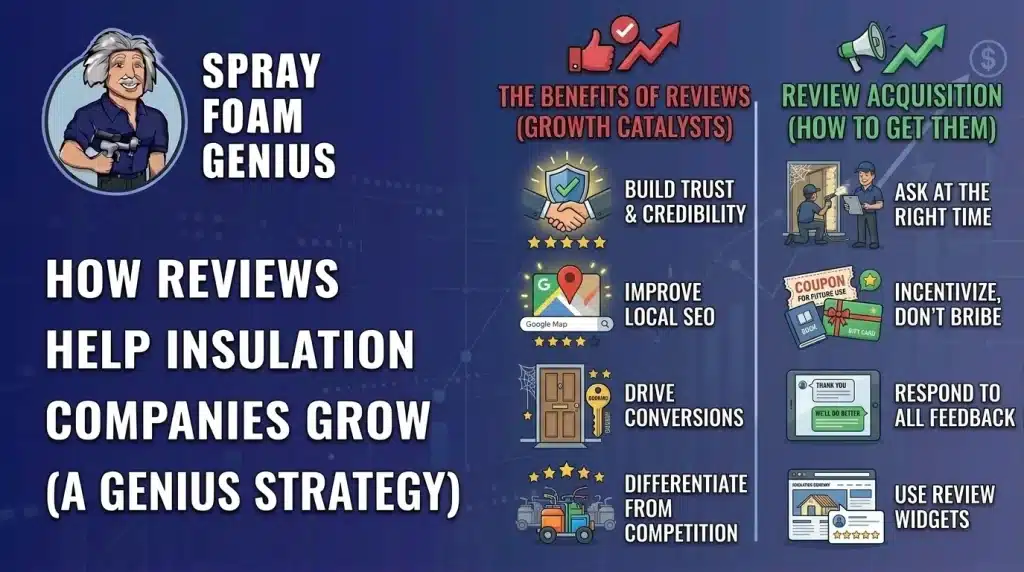
Reviews are the second most powerful category of local ranking signals. BrightLocal’s 2026 Local Consumer Review Survey, which polled 1,002 US adult consumers, found that 41% of consumers now always read reviews when browsing for businesses, a jump from 29% the previous year. Review signals account for over 15% of local pack ranking influence according to industry data. Volume matters, but recency matters just as much.
A Localo analysis of over 2 million Google Business Profiles found that businesses ranking in positions 1 through 3 have an average of approximately 240 Google reviews, while businesses ranking lower have significantly fewer. More importantly, the 2026 ranking survey found that recency of reviews is now a top-10 ranking and conversion factor. A pile of old reviews is not as valuable as a steady incoming flow.
How Review Count Affects Local Pack Visibility
| Review Count | Avg Star Floor | Visibility Impact | Consumer Trust Impact |
| 0-4 reviews | N/A | Critical risk | Nearly invisible; 41% of consumers will not use a business with no reviews |
| 5-14 reviews | 4.0+ | Weak | Visible but low credibility; consumers treat this as a new or unproven business |
| 15-24 reviews | 4.2+ | Moderate | Competitive in low-competition markets; trust building underway |
| 25-49 reviews | 4.5+ | Good | Strong in most mid-size markets; ranks well with active profile |
| 50-99 reviews | 4.6+ | Strong | Competitive in most metro markets; conversion rates improve significantly |
| 100+ reviews | 4.7+ | Dominant | Top-3 contender in most markets; review recency becomes primary differentiator |
Review Volume: Top-3 vs Positions 4-10 vs Not Ranking
| Map Pack Position | Avg Reviews | Relative Volume |
| Position 1-3 (top pack) | ~240 | ███████████████████░ |
| Position 4-10 (local finder) | ~80 | ██████░░░░░░░░░░░░░░ |
| Not ranking | <20 | ██░░░░░░░░░░░░░░░░░░ |
| Fix: Build a repeatable review request system. Text or email every customer within 24 hours of job completion with a direct link to your Google review page. Aim for 2-4 new reviews per month minimum. Respond to every review, positive or negative, within 48 hours. Per BrightLocal 2026 data, 88% of consumers will choose a business that responds to all reviews over one that doesn’t respond at all. |
Reason 4: Your NAP Information Is Inconsistent Across the Web
NAP stands for Name, Address, and Phone number. Google verifies your business identity by cross-referencing your GBP data with how your business appears across hundreds of online directories, websites, and social platforms. When those details do not match, Google’s confidence in your listing drops, and your rankings drop with it.
Common NAP inconsistencies that hurt insulation contractors include: using “LLC” on your GBP but not on Yelp or HomeAdvisor, listing a local phone number on your website but an 800 number on directories, having your address formatted differently across platforms (“Road” vs “Rd.”), or updating your business name and forgetting to update 30 citations. According to RankWorks’ 2025 ranking drop analysis, NAP inconsistency is one of the most common and overlooked causes of map pack ranking loss.
| NAP Issue | Example | Impact |
| Business name variation | GBP: “ThermoFoam LLC” / Yelp: “Thermofoam Insulation” | Citation mismatch reduces Google confidence in listing identity |
| Phone number mismatch | GBP: local number / website: 800 tracking number | Google cannot confirm these refer to the same business |
| Address format variation | GBP: “123 Oak Rd” / directory: “123 Oak Road” | Minor variations compound across 50+ citations |
| Category mismatch | GBP: Insulation Contractor / BBB: General Contractor | Reduces category relevance signals |
| Old address not updated | Previous location still showing on 15 directories | Google may assign ranking radius to wrong location |
How to audit your NAP: Search your business name in Google and check every listing that appears. Then check your top citation sources: Google Business Profile, Yelp, HomeAdvisor, Angi, BBB, Facebook, Bing Places, Apple Maps, and any local chamber of commerce or trade association directories. Every listing should show the same name, address, and phone number, formatted the same way.
Reason 5: Your Website Has No Local Service Area Pages
Your website is the second most powerful trust signal after your GBP. Google does not just read your Google Business Profile, it reads your website and checks for consistency. If your GBP says you serve Nashville, Memphis, and Knoxville, but your website has no content mentioning those cities or service areas, Google has no corroborating evidence that those claims are real.
The 2026 Local Search Ranking Factors survey confirmed that clear, structured, location-specific service pages on your website are now essential, not optional. Google’s AI systems, including Gemini and AI Overviews, rely on well-organized site content to understand what a business does and where it operates. In 2026, having a single homepage that vaguely mentions “serving the greater metro area” is not enough.
| Page Type | Priority | What It Should Contain |
| Homepage | High | City name in title, phone number, core services, area served |
| Primary service page (Spray Foam) | High | Service description, pricing range, process, FAQ, city references |
| City/area landing pages | High | Unique content per city: local photos, testimonials from that area, service areas served |
| Spray foam vs. other insulation page | Medium | Comparison content; helps target informational searches from area homeowners |
| Service area page | Medium | Clearly lists all cities and zip codes served; links to individual city pages |
| Note on Service Area Businesses (SABs): Most insulation contractors are SABs, meaning you hide your address on GBP because you serve customers at their homes. Research by Sterling Sky documented that hiding an address can reduce ranking radius, sometimes severely. The workaround is to strengthen every other signal: reviews, website local content, citations, and engagement. If you have a real office location open to the public, displaying the address is the better choice (highly recommended). |
Reason 6: Your Profile Is Inactive
Google treats your GBP the way consumers treat your profile: if it looks abandoned, it is treated as less relevant. Whitespark’s 2026 findings via SOCi confirmed that engagement and behavioral signals, including posts, photo uploads, clicks, calls, direction requests, and review cadence, continue to climb in importance. Businesses that look alive in their GBP rank above businesses that set up a profile once and never touched it again.
| Activity Signal | Recommended Frequency | Why It Matters |
| GBP posts (updates, offers, job spotlights) | Weekly | Signals active business; increases discovery impressions |
| New photos uploaded | 2-4 per week | Visual freshness; photos from recent jobs outperform stock images |
| Review responses | Within 48 hours of each review | Signals engagement; directly impacts consumer conversion |
| Business info updates (hours, services) | As needed; audit monthly | Prevents penalty from outdated info; holiday hours matter |
| Q&A section management | Seed 5-10 FAQ; monitor monthly | Adds keyword-rich content directly on your profile |
GBP posts expire after seven days unless you create an offer post with a set date range. A contractor who posts weekly stays perpetually active in Google’s eyes, while a competitor who posted once six months ago looks dormant. Data from SQ Magazine via Content by Cass found that listings with recent posts receive 21% more user interactions than inactive ones.
Reason 7: No Photos, or Only Stock Photos
Photos are one of the easiest wins available on GBP, and they are consistently underused by insulation contractors. Per official Google data published by Whitespark, businesses with photos on their GBP receive 42% more requests for directions and 35% more website URL clicks than businesses without photos. Stock images from insulation supply companies do not count and can actually hurt credibility, since consumers can tell the difference.
Birdeye’s State of Google Business Profiles report, based on 200,000+ businesses, found that verified profiles with 15 or more photos consistently outperformed peers on engagement metrics including clicks, calls, and direction requests. Insulation and home services businesses had the highest photo volumes of any industry tracked.
Photo Count vs Engagement: What the Data Shows
| Photo Count | Avg Impact | Relative Engagement Increase |
| 0 photos | Baseline | █░░░░░░░░░░░░░░░░░░░ |
| 1-5 photos (incomplete) | +12% | ██░░░░░░░░░░░░░░░░░░ |
| 6-14 photos (minimal) | +28% | ██████░░░░░░░░░░░░░░ |
| 15-25 photos (recommended) | +42% | ████████░░░░░░░░░░░░ |
| 25-50 photos (strong) | +65% | █████████████░░░░░░░ |
| 100+ photos (dominant) | +200%+ | ████████████████████ |
What to photograph: Finished insulation jobs (attic, crawl space, rim joist, basement walls, new construction), your crew in branded gear, your spray foam rig, before-and-after shots, and any equipment that demonstrates professional capability. Use your real business name in filenames before uploading. Real photos outperform stock every time.
Reason 8: Competitor Spam and Fake Listings Are Outranking You
In home services and contractor categories, Google Maps spam is a real and documented problem. Fake listings, keyword-stuffed business names, and businesses using virtual office addresses to rank in cities they don’t actually serve are common in markets where local search is competitive. Google’s November 2025 Business Profile update added stronger AI-driven spam detection, but enforcement is not instant.
If you notice competitors appearing in the map pack with business names like “Best Spray Foam Insulation Nashville” or “Cheap Insulation Contractor Atlanta” that are clearly keyword-stuffed names rather than real business names, those listings may be violating Google’s guidelines. RankWorks documented multiple cases where legitimate contractors recovered ranking positions after competitors were suspended for keyword stuffing, which Google now penalizes with a score of 214 in negative ranking factors.
| Spam Signal to Look For | Example | How to Report |
| Keyword stuffing in business name | “Best Spray Foam Nashville LLC” | Flag via ‘Suggest an edit’ on the GBP listing |
| Virtual office or fake address | Listing at co-working space or UPS Store | Report via Google Maps ‘Report a problem’ on the pin |
| Duplicate listings for same business | Same phone number, two different names | Report via ‘Suggest an edit’ on the duplicate |
| Incorrect category to appear in more searches | HVAC company also listed as Insulation Contractor | Report via ‘Suggest an edit’ on the GBP listing |
| Important: Do not add keywords to your own business name to compete. Google’s algorithm now detects this and applies a significant ranking penalty, sometimes resulting in profile suspension. Your business name in GBP must match what is on your business license, signage, and legal documents. |
Reason 9: You Are Too Far From the Searcher’s Location
Proximity is a real ranking factor, and it is the one factor you cannot directly optimize away. When someone searches “spray foam insulation near me,” Google heavily weights physical distance between the searcher and the business. Google’s official documentation lists distance as one of the three primary local ranking factors alongside relevance and prominence.
However, proximity is no longer the absolute trump card it once was. The 2025 local search ranking analysis from STech Local documented that Google now blends distance with relevance, reviews, and engagement. A business 12 miles away with 150 reviews and an active, complete profile will often outrank a business 3 miles away with 8 reviews and a bare profile. Prominence can overcome distance, within limits.
When Proximity Matters vs When Prominence Can Win
| Scenario | Proximity Advantage | What to Do |
| Competitor is 2 miles closer with same review count | They will likely rank higher for that searcher | Compete on prominence: more reviews, more activity |
| Competitor is 2 miles closer but has 30 fewer reviews | Proximity advantage weakens significantly | Strong review velocity can close or reverse the gap |
| You are the only insulation contractor in a rural county | Proximity less relevant; you serve the whole area | Focus on profile completeness and city-specific pages |
| Large metro with 15+ competitors | Proximity is one factor among many | Reviews, engagement, and content become decisive |
| Customer is searching from your city center | Strong proximity advantage | Make sure your service area includes that city explicitly |
Practical takeaway: You cannot move your business to rank everywhere. What you can do is build enough prominence through reviews, website content, photos, and profile activity that proximity becomes less decisive. The contractors who dominate large service areas are not always the ones closest to the searcher. They are the ones Google trusts the most.
Your 90-Day Google Maps Recovery Plan
The nine issues above are not equally urgent. Some have an immediate impact; others require sustained effort. Here is the prioritized order of operations for an insulation contractor who wants to improve Google Maps visibility over the next 90 days.
| Priority | Action | Timeline | Expected Impact |
| 1 | Verify and complete GBP (all fields, correct category, phone matches website) | Week 1 | Immediate: prevents invisibility; foundational for everything else |
| 2 | Audit and fix NAP consistency across top 10 directories | Week 1-2 | 30 days: Google re-indexes corrected citations and trust increases |
| 3 | Add 15+ real job photos; set up weekly photo uploads | Week 1-2 | 30 days: direction requests and clicks begin rising |
| 4 | Launch review request system; target 2-4 new reviews per month | Week 2 (ongoing) | 60-90 days: sustained review velocity improves ranking and conversion |
| 5 | Publish weekly GBP posts (job updates, offers, before-and-after) | Week 2 (ongoing) | 30 days: activity signals increase; behavioral data improves |
| 6 | Build city-specific service pages on website for each major service area | Month 2 | 60-90 days: website now corroborates GBP service area claims |
| 7 | Seed GBP Q&A with 5-10 common questions and answers | Month 2 | 30 days after setup: adds keyword-rich content to profile |
| 8 | Audit competitor listings for spam; report violations | Month 2 | 30-60 days: may recover ranking positions as spam is removed |
| 9 | Review proximity limitations; focus resources on cities you can realistically rank for | Month 3 | Ongoing: prevents wasted effort on geographies where ranking is unlikely |
Google Maps Diagnostic Scorecard for Insulation Contractors
Use this scorecard to assess your current position before prioritizing what to fix first. Score each item 0, 1, or 2 and total your score at the bottom.
| Factor | 0 = Not Done | 1 = Partial | 2 = Complete |
| GBP verified and complete | Not verified or <50% complete | Verified but missing key fields | Verified, all fields complete |
| Primary category | Wrong category | “Contractor” or generic | “Insulation Contractor” |
| Google reviews | Fewer than 10 reviews | 10-24 reviews | 25+ reviews with recent activity |
| Review velocity | No new reviews in 3+ months | 1 review in last 90 days | 2+ new reviews per month |
| Review responses | Never responds | Responds sometimes | Responds to every review |
| NAP consistency | Major mismatches on 5+ directories | Minor mismatches on 1-2 directories | Consistent across all major directories |
| Website local pages | No location or service pages | Homepage only mentions city | Dedicated city and service pages |
| GBP photos | Fewer than 5 photos | 5-14 photos | 15+ real job photos, updated regularly |
| Profile activity (posts) | No posts in 60+ days | Posts less than monthly | Weekly posts, Q&A seeded |
| Score interpretation: 0-6 = Critical gaps (immediate action required) | 7-12 = Moderate (focus on lowest scores) | 13-16 = Good (sustain and build) | 17-18 = Strong (monitor and maintain) | |||
Frequently Asked Questions
How long does it take to show up in Google Maps after optimizing?
Most contractors see initial ranking movement within 4 to 8 weeks of completing GBP optimization, fixing NAP consistency, and adding photos. Review velocity takes longer. Building from 10 reviews to 50 reviews at a rate of 3 per month takes about 13 months. The best results come from doing everything simultaneously rather than sequentially.
Do I need a physical office address to rank on Google Maps?
No. Service area businesses (SABs) like insulation contractors can and do rank without displaying a physical address. However, research by Sterling Sky has documented that hiding an address can reduce ranking radius in some markets. If you have a legitimate office, displaying it is generally better for rankings. If you work from home or have no public office, hide the address per Google’s guidelines and compensate by strengthening all other signals.
Can paying for Google Ads help my Google Maps ranking?
No. Running paid Google Ads does not influence your organic Google Maps ranking. The local pack is powered entirely by organic signals: GBP completeness, reviews, website authority, citations, and engagement. Ads appear separately and do not pass ranking benefits to your map listing.
What happens if a competitor reports my listing?
If your listing follows Google’s guidelines, a competitor report will not result in suspension or ranking loss. The most common trigger for legitimate business suspensions is violating naming guidelines, such as adding keywords to your business name. Maintain full compliance with Google’s guidelines and competitor reports become ineffective. If you are suspended, document your business legitimacy thoroughly and appeal through the Google Business Profile reinstatement process.
| Is Your Insulation Business Invisible on Google Maps? We Can Fix That. Spray Foam Genius Marketing specializes exclusively in insulation and spray foam contractors. We know this industry, we know the searches your customers use, and we know exactly why most insulation businesses are not showing up in the map pack. We have done this for contractors across the country. If you are ready to start showing up where your customers are looking, call us at 877-840-FOAM or visit sprayfoamgeniusmarketing.com. |

Spencer is a Google ranking expert and SEO consultant who has helped businesses in the spray foam marketing industry achieve their online marketing goals. Spray Foam Genius Marketing has a proven track record of success, having achieved some impressive results for his clients.
- You’re Ranking on Google, So Why Aren’t You Making More Sales? - September 7, 2026
- How Spray Foam Companies Get Recommended in ChatGPT, Claude, Gemini, and Perplexity - September 3, 2026
- Why Your Insulation Company Needs a Digital Marketing Strategy - August 31, 2026