Direct Answer
Insulation contractors often hire marketing agencies, expecting a flood of qualified leads and booked jobs. The real problem is that most agencies use broad, cookie‑cutter strategies designed to show growth in surface‑level metrics (like website traffic or social likes), not actual lead quality or revenue generation. Contractors assume “more clicks = more jobs,” but that’s rarely how buyer behavior works in the insulation industry. This article explores where insulation customers actually come from, why common marketing approaches fail, and how contractors can avoid wasted spend while building a predictable, measurable pipeline.
For insulation companies looking to better understand how a structured, industry-specific strategy works in practice, this spray foam contractor marketing guide breaks down how to build more predictable and qualified lead pipelines.
TLDR
- Local search drives results: 70–80% of qualified insulation inquiries originate from local search visibility and Google Business Profile optimization.
- Clicks don’t equal customers: Vanity metrics like impressions or clicks rarely correlate with revenue in service‑based industries.
- High-intent search is gold: Keywords like “attic insulation quote near me” convert at significantly higher rates than general terms.
- Lead follow-up increases conversions: Contractors who implement systematic follow-up see a 30–40% increase in booked jobs.
- Reviews shape trust: Over 90% of homeowners read reviews before hiring a contractor (BrightLocal).
- Short-term ads must be tactical: Pay-Per-Click (PPC) works, but only with tight geo-targeting and conversion tracking (Search Engine Journal).
- Multi-channel wins: Diversifying across SEO, PPC, reviews, and referral programs mitigates risk and improves ROI.
The Real Problem Most Insulation Contractors Don’t See
Insulation buyers don’t behave like typical e-commerce customers. They search with intent:
- “Best spray foam insulation contractor near me”
- “Insulation cost for attic home”
- “Energy-efficient home insulation services”
These searches are driven by need and urgency, high purchase intent, not casual interest. Many agencies treat the contractor’s website as if it were a retail store: optimize for general keywords, run flashy campaigns, and assume leads will follow. Agencies often optimize for reach and engagement, not revenue. A contractor can get thousands of clicks but only a handful of legitimate job inquiries.
The key disconnect arises because agencies frequently don’t understand local demand patterns, keyword intent, or the long sales cycles in home services. This results in a false sense of progress (traffic growth) while real customer flows remain stagnant (Harvard Business Review).
Where Quality Leads Actually Come From
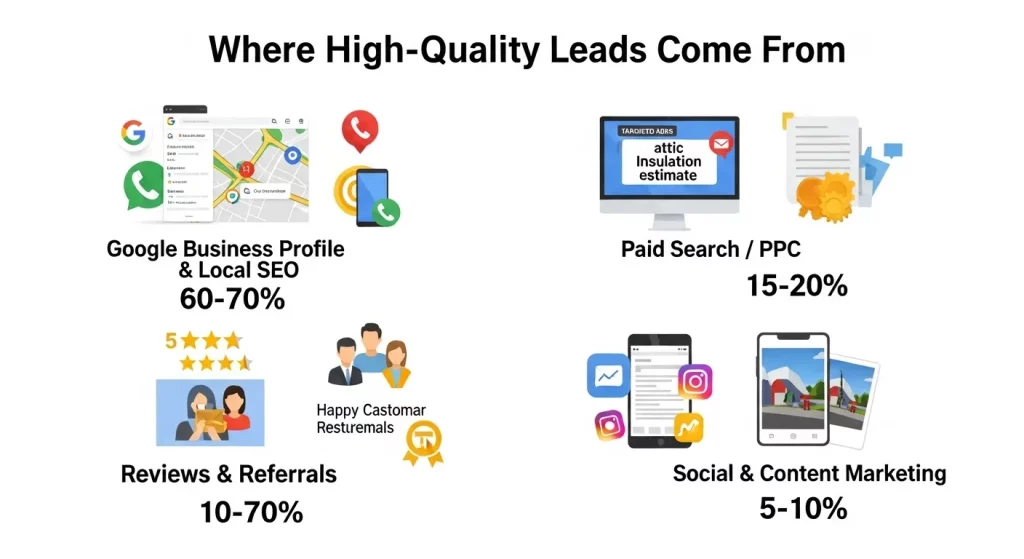
1. Google Business Profile & Local SEO (≈60–70%)
A properly optimized Google Business Profile (GBP) is the #1 source of calls and service inquiries for insulation contractors. According to Google, businesses with complete and accurate profiles are twice as likely to be considered reputable by consumers.
High-intent searches, “spray foam insulation near me”, trigger Google to display local listings. If your profile is weak or unclaimed, competitors get those calls (Think With Google).
2. Paid Search (PPC) (≈15–20%)
Paid ads can work very well for insulation services when they are tightly targeted and tracked. Generic PPC campaigns that cast a wide net attract low-quality traffic and inflate costs. However, campaigns focused on high-intent keywords such as:
- “attic insulation estimate”
- “energy-efficient insulation company”
…can generate real phone calls and booked estimates. According to WordStream, the average conversion rate for Google Ads in home services is around 3–5%, but with well-optimized campaigns targeting intent-rich terms, this can be higher.
3. Reviews & Referrals (≈10–15%)
Contractors traditionally get a lot of business from referrals, and online reviews amplify that trust. According to BrightLocal, 93% of consumers read online reviews before making a local purchasing decision.
Good reviews help your business:
- Rank higher in search results
- Convert lookers into callers
- Differentiate yourself from competitors
Contractors who proactively ask satisfied customers for reviews see a measurable lift in inbound calls and organic visibility.
4. Social & Content Marketing (≈5–10%)
While social platforms like Facebook and Instagram can build brand awareness, they rarely generate high-quality service leads on their own. Organic social content often educates rather than converts, demonstrating insulation benefits, before-and-after photos, or value propositions.
Paid social campaigns can work if they retarget users who have already demonstrated intent (e.g., visited your site or viewed your portfolio).
Top Reasons Insulation Contractors Struggle to Get Quality Leads
1. Focusing on Vanity Metrics Instead of ROI
- Traffic up? Great, but did calls increase?
- Rankings improved? Excellent, but are quotes booked?
- Agencies sometimes sell dashboards filled with impressions and clicks, which sound good but mean little if they don’t produce booked jobs (HubSpot).
2. Poor Local Targeting
National or regional campaigns bring expensive traffic that isn’t relevant to your service area. Insulation contractors succeed when ads and content are localized, down to service cities or zip codes.
3. Ignoring Lead Nurturing
Most homeowners don’t book services on the first contact. Email follow-ups, scheduled call reminders, and SMS follow-ups increase conversions dramatically.
4. Misaligned Messaging
Many campaigns talk about features (“We do insulation!”) instead of solutions (“Lower your energy bills this winter”). Messaging that resonates with homeowner concerns performs far better (Harvard Business Review).
5. Underestimating Reputation Management
Online reviews affect local search ranking signals and trust. Contractors who ignore reviews miss out on both SEO value and customer confidence.
6. Short-Term Mindset
SEO and reputation management compound over time. Contractors expecting instant results often cancel before momentum builds (Search Engine Journal).
7. Miscommunication with Agencies
Contractors assume agencies understand the insulation niche; agencies assume contractors understand digital KPIs. Without alignment, money gets wasted.
What Successful Insulation Contractors Are Doing Differently
Step-by-Step Process
- Visibility (Traffic) – Local SEO + optimized Google Business Profile + targeted PPC.
- Lead Capture – Clear phone numbers, interactive forms, click-to-call buttons.
- Lead Qualification – Pre-screening questions on forms or by phone.
- Lead Nurturing – Automated SMS, emails, and timely callbacks (HubSpot).
- Conversion to Job – Streamlined estimate process and professional follow-through.
- Retention & Referrals – After-service follow-up, review requests, referral incentives.
Short-Term vs Long-Term Marketing Strategies
Short-Term (PPC & Paid Social)
Pros – Quick visibility, immediate traffic, and easier attribution.Cons – Can be expensive; traffic often low-intent without proper targeting.
Long-Term (SEO, Reviews, Content)
Pros – Sustainable leads, builds trust and credibility, lower cost per qualified lead over time.Cons – Takes longer to produce results; requires ongoing effort (Search Engine Journal).
Who Struggles Most vs Who Wins
Who Struggles Most
- Rely on a single channel
- Expect instant results
- Track the wrong KPIs
- Don’t follow up leads
Who Wins
- Track real revenue outcomes
- Localize targeting and messaging
- Invest in reputation & follow-up
- Diversify channels
Biggest Misconception
Misconception: “More clicks mean more customers.”Reality: Not all clicks are equal. In insulation services, relevance and intent matter more than volume. Contractors must prioritize high-intent touchpoints where customers are ready to spend, like local search, targeted PPC, and reputation systems (BrightLocal).
Real Question Contractors Should Ask
“Which marketing actions generate predictable, measurable jobs in my service area?”Focusing on this question, rather than surface-level metrics, forces accountability and performance from your strategy or agency.
Ready to Transform Your Marketing?
Maximize Leads, Minimize Waste with Spray Foam Genius Marketing
Stop losing money to generic campaigns. Partner with experts who understand the insulation industry and local demand. We turn clicks into calls, calls into booked jobs, and booked jobs into repeat business and referrals.
Contact Us: Call us at 877‑840‑FOAM (USA) or 844‑741‑FOAM (Canada), or email info@sprayfoamgeniusmarketing.com to get a marketing audit, schedule a strategy call, and start generating qualified insulation leads today.
Trusted by contractors nationwide for measurable results in spray foam and insulation marketing.
FAQs
What is the most effective way for insulation contractors to get leads?
Optimizing for local search visibility, especially Google Business Profile and relevant local keywords, generates the highest-intent inquiries.
How much should contractors budget for digital marketing?
Typical local home services campaigns range from $2,000 to $5,000 per month, depending on competition, goals, and paid search spend.
How long does it take to see results from SEO?
Local SEO typically begins showing improvements around 3–6 months, with stronger compounding gains over 9–12 months.
Are social media ads worth investing in?
Social ads help with brand awareness but are most effective when paired with retargeting and conversion-optimized landing pages.
How important are online reviews for insulation contractors?
Very important, over 90% of consumers check reviews before hiring local services.
Sources
- BrightLocal Local Consumer Review Survey
- Google Business Profile Overview
- Think With Google – Consumer Insights
- WordStream PPC Benchmarks
- HubSpot Lead Nurturing Stats
- Search Engine Journal SEO Stats
- Harvard Business Review – Customer Trust