
Introduction
Most spray foam contractors do not struggle because of poor service. They struggle because they lack a steady system for attracting, capturing and converting customers. If your phone is not ringing consistently, the problem is often visibility and follow-up, not your rig, your crew or your workmanship. Homeowners and commercial property managers are searching for the work you do, and those searches may be landing on a competitor's website instead of yours.
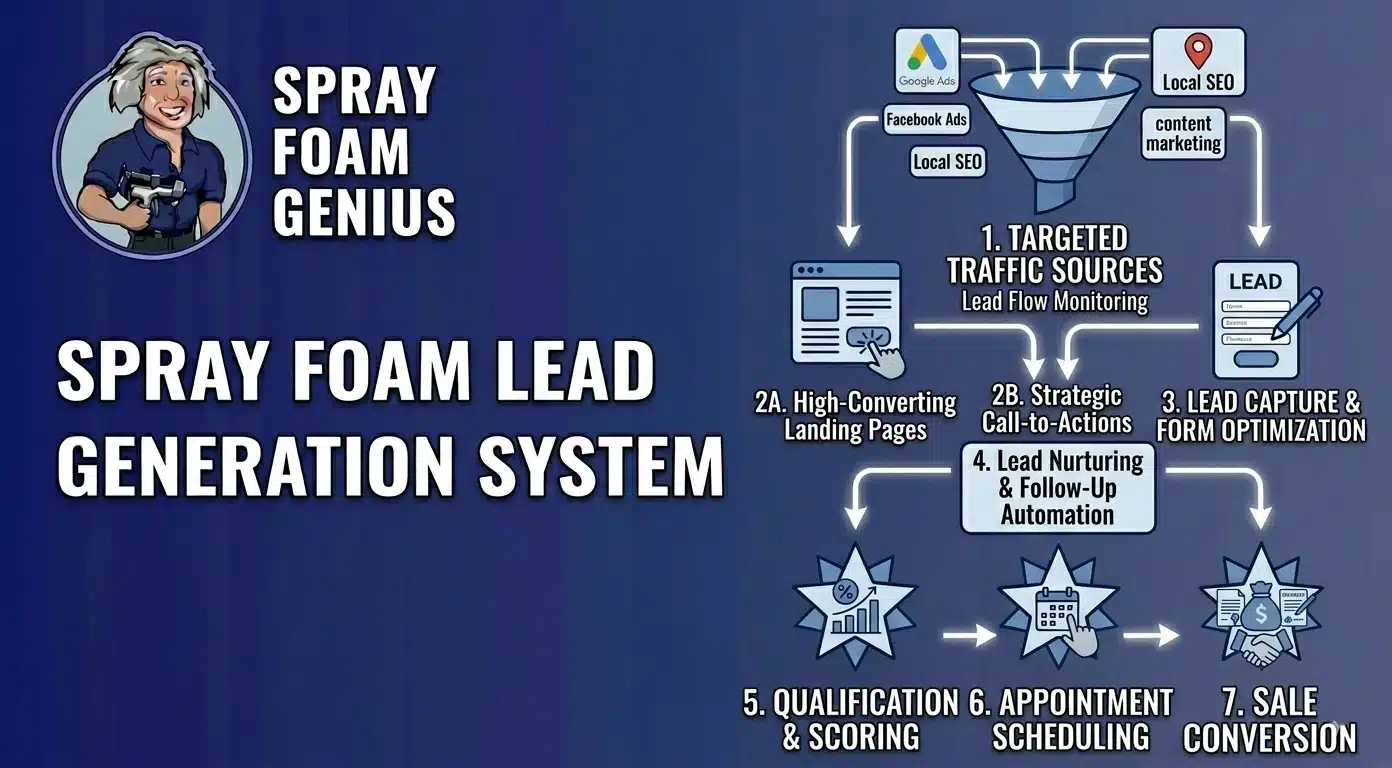
Spray foam lead generation is the structured process of attracting, capturing and converting potential customers into booked jobs. It is not one tactic like running Google Ads or posting on Facebook. It is a set of connected parts, each feeding the next. This guide walks through every part, in the order we would build them.
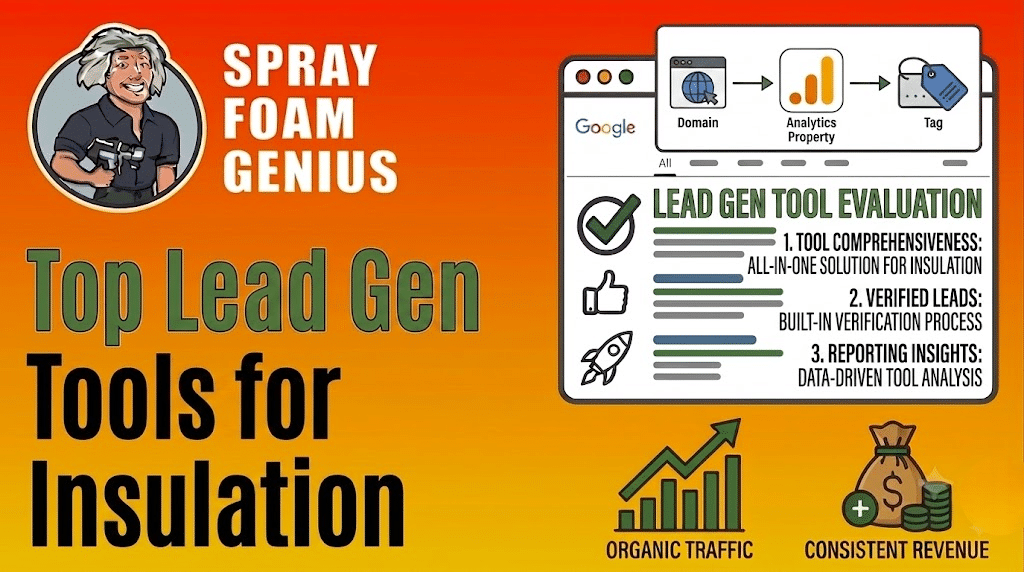
Related reading: Top Lead Generation Tools for Insulation Contractors (2026 Guide)
Why a System Beats Referrals Alone
Referrals and word of mouth are valuable, but they are hard to turn up when work slows and hard to scale when you add capacity. A system gives you more control. Done well, it can:
- Smooth out feast-or-famine cycles
- Give you more say over job volume and mix, residential or commercial
- Make revenue easier to forecast, because you can see your leads, close rate and cost per job
- Give you more confidence when hiring crews or buying equipment
- Reduce pressure to compete only on price
No system guarantees a number of leads, and results depend on your market and how well you execute. But businesses that measure their marketing can make better decisions than businesses that guess. For how this compares with referrals, see SEO vs referral marketing for insulation contractors.

The Six Parts of a Lead Generation System
- A website built to convert visitors into calls and quote requests
- Local SEO and a strong Google Business Profile
- Paid advertising, such as Google Ads or Google Local Services Ads (California and Florida only for insulation installers), for faster volume
- Social proof: reviews, project photos and testimonials
- Helpful content that answers customer questions
- Fast follow-up and tracking, supported by a CRM and automation
A gap in any one of these can leak leads you never notice until you audit your numbers.
1. A Website That Converts
Your website is not a digital business card. It should work like a sales representative that is always on. It should:
- Say what you do and where you do it, clearly and quickly
- Build trust with reviews, certifications and real project photos
- Make calling or requesting a quote easy, especially on a phone
- Load fast on mobile (Google highly recommends good Core Web Vitals)
- Offer pricing guidance: you do not need exact numbers, but explaining what drives cost builds trust
Pages most spray foam contractor sites need:
- Home page with your main service, area and a clear call to action
- Separate pages for open-cell spray foam, closed-cell spray foam, attic insulation, basement and crawl space insulation, commercial spray foam, agricultural buildings and metal buildings
- Service area pages for the cities you actually serve
- About page with your team, story and certifications
- Blog or resources for helpful content
- Contact page with a tappable phone number and a working form
Small conversion gains add up. Example only, with made-up numbers: if 100 visitors come to a page each month, a page that turns 5 percent of them into leads produces 5 leads, while one that turns 15 percent produces 15. Your actual rates will differ, which is why tracking matters. For more, see our website design blueprint for spray foam contractors.
2. Local SEO and Google Business Profile
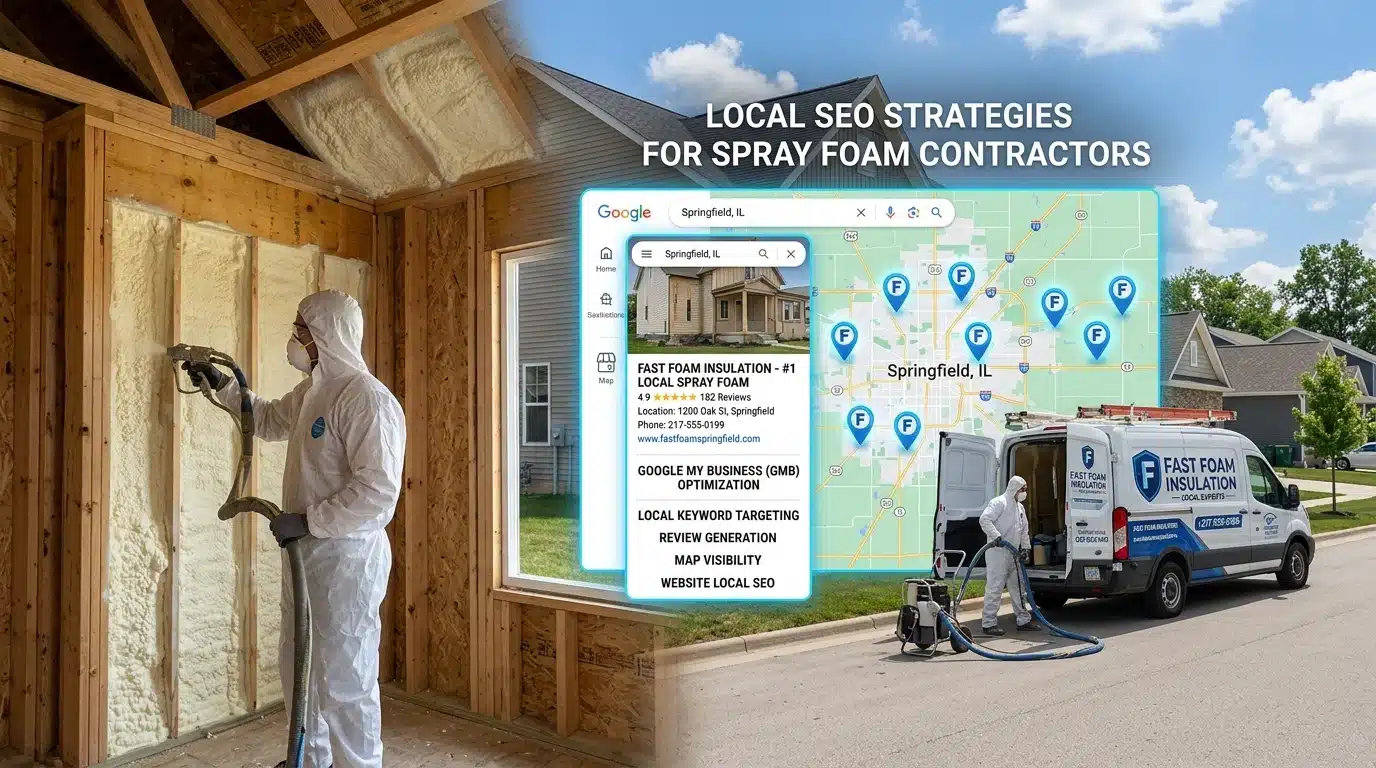
Local SEO determines whether you appear when nearby customers search for spray foam services. Google says local results are mainly based on relevance, distance and prominence (source). Your Google Business Profile (GBP) is often what people see first, so treat it as seriously as your website:
- Complete every section: services, hours, service areas and description
- Choose the most accurate primary category (such as insulation contractor) and add relevant secondary ones
- Upload real before-and-after photos and keep adding new ones
- Reply to every review, positive or negative
- Post updates and project highlights now and then
- Keep your name, address and phone number identical across your site and directories
This is one of the faster and cheaper improvements available to most contractors, but no one can promise a map ranking. For the full playbook, see our local SEO guide for spray foam contractors and our spray foam SEO strategy guide.
3. Paid Ads for Faster Volume
Organic work takes time to build, while paid search can start sending calls much sooner. It still needs careful setup and tuning, and the leads stop when the budget stops.
Google Ads
- Target high-intent phrases: "spray foam insulation contractor [city]," "closed cell spray foam installers," "attic spray foam cost." Avoid loose matching that attracts unqualified clicks.
- Add negative keywords such as DIY, kit, training, salary and jobs to cut wasted spend.
- Send each ad group to a landing page that matches the search, not to your homepage.
- Set up conversion tracking before you spend, and consider call-only ads for mobile.
- Move to automated bidding strategies only after you have enough conversion data to work with.
Local Services Ads
Google Local Services Ads appear above regular search ads for eligible categories and areas and are charged per lead rather than per click. Right now, Local Services Ads are available to insulation installation contractors only in California and Florida, so contractors in other states cannot run them. Google can change this, so check its Local Services Ads page for your area. For more detail, see our guides on Google Ads for insulation businesses, the Google Ads framework for spray foam contractors and Angi vs Google Local Services Ads.
Retargeting
Many visitors leave without calling, and homeowners researching insulation can take days or weeks to decide. Retargeting shows your brand again to people who already visited your site, on platforms such as Facebook, Instagram, YouTube and Google Display. Show finished projects, testimonials and a clear call to action.

4. Social Media
Social media is rarely where the purchase journey starts, but it builds familiarity and trust. A homeowner who has already seen your project photos and a short video of your process may feel more comfortable calling.
- Post before-and-after project photos and short clips of the application process
- Share customer stories you have permission to share
- Show your crew and community involvement
- Run Facebook or Instagram lead-form ads aimed at your service area, and retarget website visitors
Keep ads honest and specific: seasonal energy-cost messaging is more convincing than vague promises. For a fuller plan, see our social media playbook for spray foam contractors.
5. Helpful Content
Blog posts and resource pages attract people who are researching spray foam and show that you know the trade. Good topics include:
- Open-cell vs closed-cell spray foam: which is right for which job
- How much spray foam insulation costs, and what moves the price
- Spray foam vs fiberglass
- Spray foam for crawl spaces, attics, metal buildings and pole barns
- Insulation rebates and building code requirements in your state or province (confirm details before publishing)
- How long spray foam lasts and why air sealing matters
Answer one question per page, write in plain language, and end with a clear next step. Add your own photos and experience.
Contractors also ask about AI search. Google says there are no special requirements to appear in AI Overviews or AI Mode, no special structured data and no special files; the same helpful, accurate, indexed content applies (source).
6. Landing Pages That Convert
A landing page has one job: turn a visitor into a lead. Unlike a homepage, it focuses on a single offer and action. Include:
- A headline matching the search, such as "Get a Free Spray Foam Quote in [City]"
- A short subheadline reinforcing the main benefit
- Trust signals: years in business, certifications and real projects
- A few bullet points covering the service benefits
- A short form (name, phone, email, zip code)
- Reviews with real customer names, with permission
- A tappable phone number and a single, high-contrast call-to-action button
Remove navigation menus and anything that does not build trust or move the visitor toward contacting you. See how to design a high-converting spray foam landing page.

7. Reviews and Reputation
Reviews help people choose you and, per Google, more reviews and positive ratings can help your local ranking. Treat them as part of your lead system, not an afterthought.
- Ask every happy customer, ideally in person at job completion, then send a text with a direct review link
- Make reviewing part of your standard closeout process
- Reply to every review, especially negative ones, calmly and professionally
- Watch your reputation on Google, Facebook, Yelp, Houzz and the Better Business Bureau
- Never offer a discount or gift for reviews. Google prohibits incentivized reviews.
More in how important Google reviews are for a spray foam business.
8. Referrals and Partnerships
Referrals tend to come with built-in trust, but they work best when you build a process rather than waiting for luck.
- Follow up after each job with a thank-you and a simple request for referrals
- Build relationships with HVAC companies, builders, roofers, plumbers, property managers, real estate agents, general contractors and energy auditors
- Make it easy for partners to send work: fast scheduling, clear communication and reliable quality
- For commercial work, consider trade events and local business groups, where you can meet decision-makers in person
9. Follow-Up, CRM and Automation

Generating the lead is only half of the job. Many leads are lost to slow or inconsistent follow-up.
- Answer calls live when you can, and reply to forms and messages quickly. Speed matters because homeowners often contact more than one contractor.
- Use a CRM to log every lead, set reminders and track each lead from first contact to booked job. See our guide to choosing the best CRM for insulation contractors.
- Set up an automatic text or email reply to new inquiries, so people hear back even while you are on a roof or in an attic.
- Follow up on unsold quotes at set intervals.
- Use email to nurture leads who are not ready yet: educational messages, seasonal reminders, and re-engagement for past customers. See our email marketing tips for spray foam contractors.
- Offering financing, where it is available to you, can reduce price objections for some buyers.
Residential and Commercial Customers Need Different Messages
Residential customers are usually motivated by energy bills, comfort and home value. They search, compare and often need more than one touchpoint before booking. Commercial customers, such as property managers, general contractors and building owners, care about code compliance, schedule, energy performance and return. They respond to case studies, specifications and direct relationships more than to broad advertising.
- Residential: local SEO, Google search ads, reviews, helpful content and social retargeting
- Commercial: referral and builder relationships, direct outreach, LinkedIn, targeted ads for commercial terms, and project case studies you have permission to share
Separate pages and messages for each audience usually work better than one mixed message.
Track What Works
You cannot improve what you do not measure. Connect three kinds of data: marketing data (clicks, impressions, spend), lead data (calls, forms, source, quality) and sales data (quotes, booked jobs, revenue). Track monthly:
- Cost per lead, by channel
- Lead-to-quote and quote-to-job rates
- Cost per booked job
- Average job value
- Return on ad spend
- Lead source for every closed job
Use call tracking, Google Analytics 4, Google Ads conversion tracking and your CRM. Math example only, with made-up numbers: if your average job is $4,000 and you close 30 percent of leads, you need about 17 leads a month to book roughly $20,000 of work (5 jobs). Plug in your own job value and close rate to set a target. See how to track and analyze your marketing ROI and how much to spend on insulation marketing.
A Sensible Order to Build It
- Foundation: fix website basics, complete your Google Business Profile, start asking for reviews and set up tracking and a CRM.
- Volume: add Google Ads (or Local Services Ads, in California and Florida) if you need leads sooner, with dedicated landing pages.
- Authority: publish helpful content, add service area pages and build referral relationships.
- Nurture and scale: add email follow-up, retargeting and automation, then expand to new areas as results justify.
Do not depend on one channel. Spread your sources so a change in one does not stall the whole business.
Common Mistakes
- A slow, outdated or hard-to-use website
- Ignoring local SEO and the Google Business Profile
- Sending ad traffic to the homepage
- Slow or inconsistent follow-up
- No tracking, so you cannot tell which channel books jobs
- Buying low-quality shared leads as a long-term plan (see high-quality leads vs cheap leads)
- Treating marketing as a one-time project
If calls are already slow, start with why your insulation company is not getting leads. If leads come in but jobs do not, read why leads are not converting into jobs.
Get Help Building Your System
Spray Foam Genius Marketing works with spray foam and insulation contractors. If you would like a plain-language review of your website, Google Business Profile, reviews and lead flow, ask for a free marketing audit. Call 877-840-3626 or email info@sprayfoamgeniusmarketing.com.
Frequently Asked Questions
How long does it take to see results from lead generation?
It depends on the channel. Paid ads can start sending calls soon after launch once tracking and landing pages are set up. SEO and content take longer, and nobody can promise a date. Google says changes can take hours to months to show up. Judge progress by calls, forms and booked jobs.
How much should a spray foam contractor spend on marketing?
It depends on your goals, market and margins, so rely on your own numbers rather than a rule of thumb. Start from what a booked job is worth and what you want to grow, test channels, and adjust. Our guide on how much to spend on insulation marketing walks through how to set a budget.
What is the best lead generation channel for spray foam contractors?
There is no single best channel. Search-based channels such as local SEO, Google Ads and, in California and Florida, Local Services Ads reach people who are actively looking, while referrals, reviews and content build trust and support everything else. A mix tends to be more stable than any one source.
How do you get more Google reviews?
Ask every satisfied customer directly after the job, then send a text with a direct review link. Make it part of your closeout routine, reply to every review, and never offer incentives for reviews.
Do you need a specialized spray foam marketing agency?
Not necessarily, but trade knowledge helps. Someone who understands open-cell and closed-cell foam, seasonality, how homeowners and commercial buyers search, and local codes can often avoid generic mistakes. Whoever you choose, ask what they will report and who owns your accounts. See our agency checklist.
What is the fastest way to get spray foam leads?
Paid search, such as Google Ads or, in California and Florida, Local Services Ads, is usually the quickest to start, and a complete, accurate Google Business Profile is one of the cheapest improvements. Neither is guaranteed to produce results, so track what you get.
Why are leads coming in but not turning into jobs?
Usually it is response time, follow-up, estimate presentation or the quality of the leads. Track the lead-to-quote and quote-to-job rates, and fix the weakest step first.