Direct Answer
Many insulation contractors struggle to measure the effectiveness of their marketing because they rely on assumptions rather than data. The common belief is that a flashy website, Google Ads, or social media posts will automatically generate leads. However, the reality is that customer behavior is far more complex; buyers may search multiple channels, compare contractors offline, or call directly without interacting online. According to Google’s Customer Journey research, 76% of people use multiple channels before making a purchase decision, highlighting how fragmented attribution truly is.
This article will explore why marketing results are often misinterpreted, reveal where real leads come from, highlight common mistakes contractors make, and outline a step-by-step framework for tracking and improving results.
TLDR
- 70% of leads come from repeat exposure: Multiple touchpoints are typically required before conversion.
- Website traffic ≠ leads: High traffic without clear calls to action often results in zero inquiries.
- Offline sources still dominate: Referrals, word-of-mouth, and repeat clients often account for 40–50% of jobs, consistent with Harvard Business Review on customer acquisition.
- Call tracking is essential: Without it, up to 50% of leads can be invisible to analytics systems.
- Content marketing compounds over time: HubSpot research shows that companies consistently publishing educational content see 3× more qualified leads.
- Paid ads require proper attribution: First-touch or last-touch models alone miss most influence paths.
- Seasonal fluctuations matter: Don’t judge campaigns based on short intervals, track quarterly or yearly cycles.
The Real Problem Most Insulation Contractors Don’t See
Contractors often assume that marketing metrics such as website clicks, social media likes, or ad impressions directly translate to revenue. In reality:
- Customer search behavior is fragmented: Potential clients may search “home insulation contractors near me,” read reviews on Google Business Profile, visit multiple contractor websites, but ultimately call after seeing a truck wrap offline.
- Purchasing decisions are rarely immediate: Think with Google notes that high-involvement services often require research across several sessions before a purchase.
- Attribution is murky: Most analytics tools default to last-click attribution, which rarely represents the full influence chain.
Example Customer Journey
A homeowner searches:
- “Best spray foam insulation for attic” → Reads articles via Forbes Home.
- “Insulation contractors near me” → Visits 2–3 websites.
- Call a contractor after seeing results on Yelp.
The sale may appear to come from the last click, but the actual decision was influenced by multiple interactions.
For a broader understanding of how insulation businesses can build multi-channel visibility and generate consistent leads, review these spray foam contractor marketing insights.
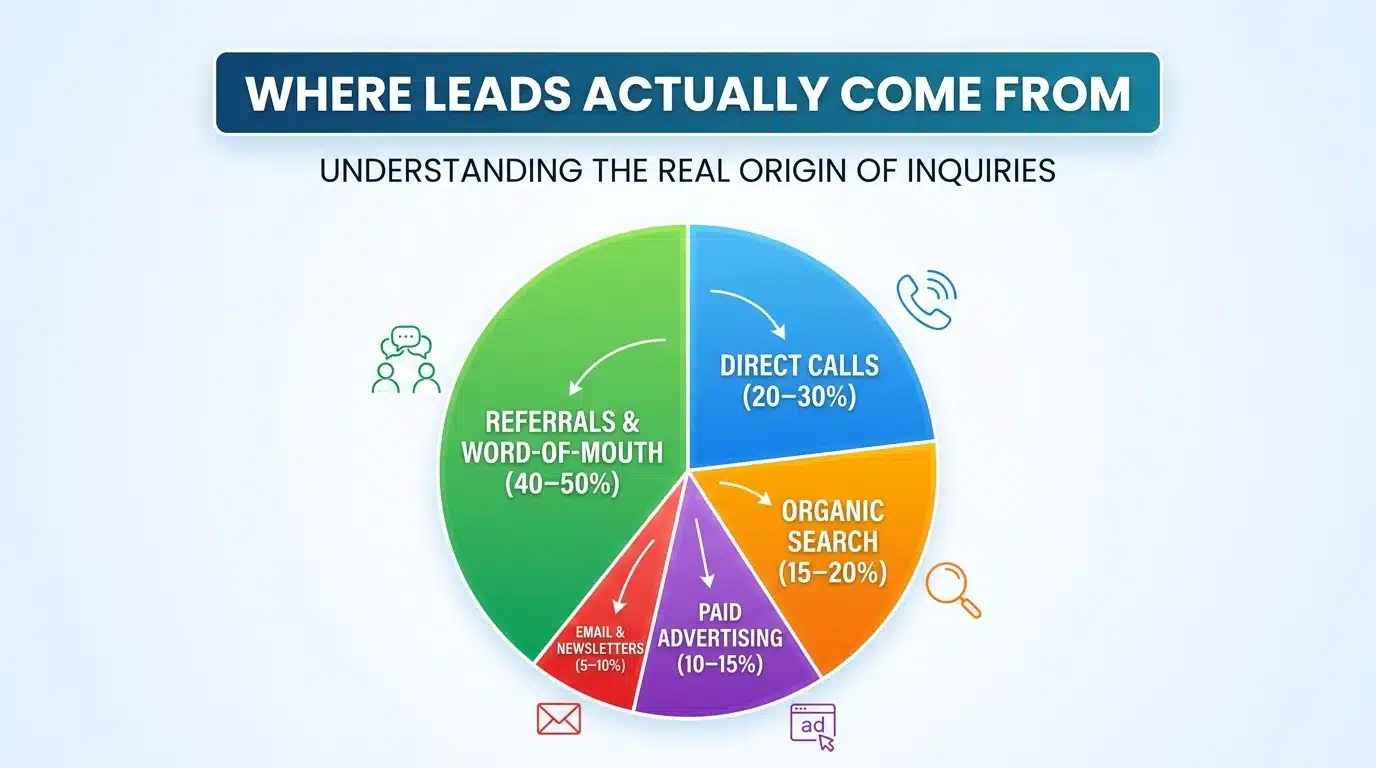
Where Leads Actually Come From
Understanding the real origin of inquiries is essential:
- Referrals & Word-of-Mouth (40–50%) – Past clients, friends, or builders recommending your services.
- Direct calls (20–30%) – Clients dialling from local listings or repeat familiarity.
- Organic search (15–20%) – Google Search results (SEO). Moz notes that the top organic position receives more than 30% of all clicks.
- Paid advertising (10–15%) – Ad campaigns on Google Ads or Meta platforms.
- Email & newsletters (5–10%) – Nurturing existing contacts.
Top Reasons Insulation Contractors Struggle to Get Accurate Marketing Insights
1. Relying solely on website analytics
- Analytics like Google Analytics track visits but not phone calls by default.
- Missed offline touchpoints distort reporting.
2. Ignoring multi-touch attribution
- Leads often require several exposures across platforms before converting.
3. Lack of call tracking
- Unique numbers per campaign are needed to know what drives calls.
4. Seasonal misinterpretation
- Peak demand months skew performance if not normalized across annual data.
5. Overemphasis on paid ads
- Paid is idealistically measured as “direct leads” without recognizing its imprint on organic and referral channels.
6. Inconsistent follow-up systems
- Leads fall through the cracks without CRM or pipeline processes.
7. Misaligned messaging
- Ads and site content that do not match customer intent produce engagement without conversions.
What Successful Insulation Contractors Are Doing Differently
| Struggling Contractors | Successful Contractors | Key Difference |
| Post ads without tracking | Use call tracking & CRM | Visibility on real conversions |
| Treat clicks as results | Focus on qualified leads | Revenue-oriented attribution |
| Track only last-click | Track multi-touch journeys | More accurate ROI |
| Random social posts | Content schedules | Builds trust and authority |
| Ignore referrals | Systematic referral incentives | Maximizes highest-ROI source |
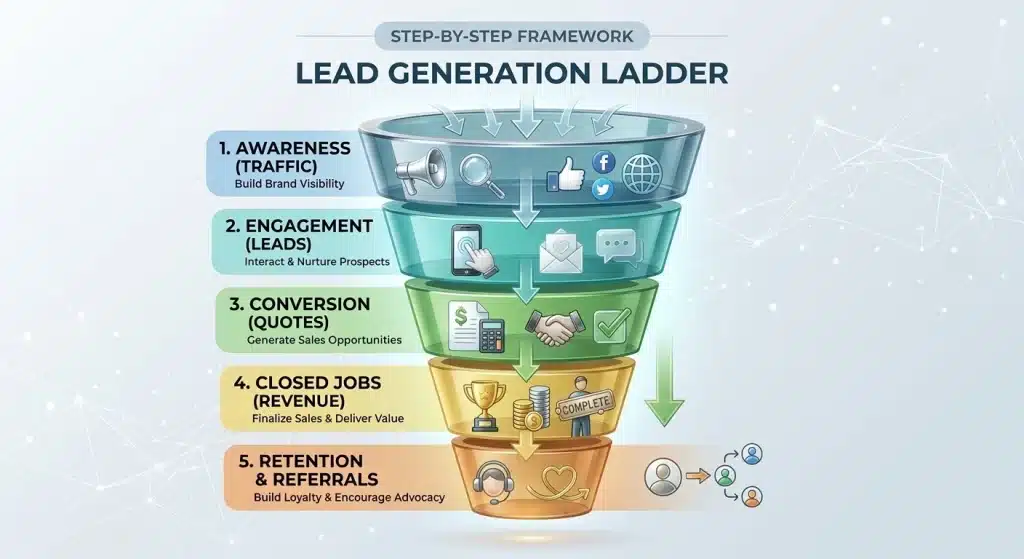
Step-by-Step Framework
Lead Generation Ladder:
- Awareness (Traffic) – Organic search, social, directories.
- Engagement (Leads) – Forms, calls, chats.
- Conversion (Quotes) – Consultations and estimates.
- Closed Jobs (Revenue) – Signed contracts.
- Retention & Referrals – Repeat business and mentions.
Comparison: Short-Term vs Long-Term Strategies
| Strategy | Pros | Cons | Compounding Effect |
| Paid Ads | Immediate visibility | Can be costly | Low without tracking |
| SEO / Content | Sustainable traffic | Slow start | High over time |
| Referral Programs | Highest conversion | Limited scale | Very high when systemized |
| Social Engagement | Builds community | Ongoing effort | Medium growth curve |
Who Struggles Most vs Who Wins
Underperformers:
- Track vanity metrics instead of real leads.
- Ignore offline influence.
- Lacks strategic consistency.
High Performers:
- Track calls + forms + multi-touch paths.
- Nurture leads across channels.
- Systematize referrals and reviews.
Biggest Misconception
Misconception: “If my ads are getting clicks, my marketing is working.”
Reality: MarketingProfs research shows clicks are not conversions, only leads and closed jobs drive ROI.
Real Question Contractors Should Ask
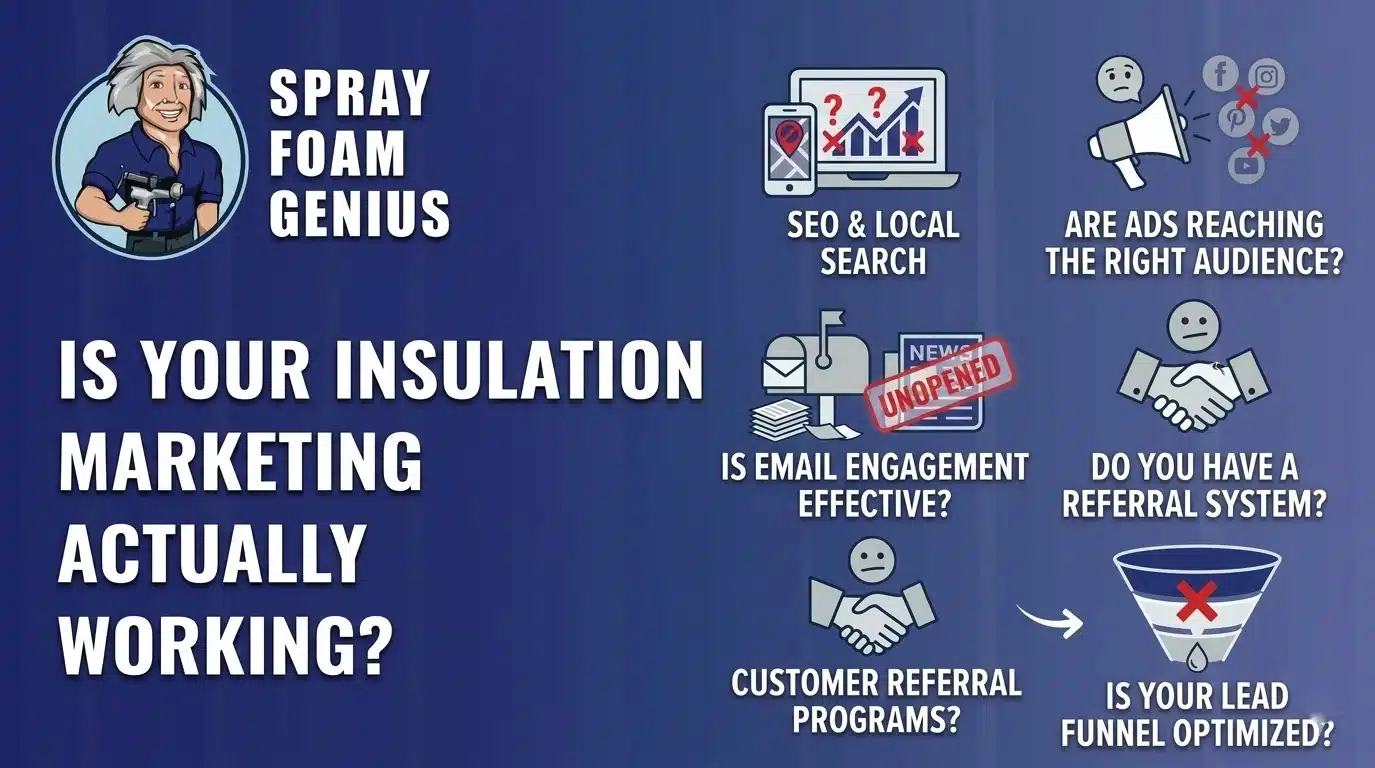
Instead of “Is my marketing working?” ask:
“Which specific actions and channels consistently produce qualified leads, and how can they be optimized for revenue?”
Maximize Your Marketing ROI
Discover How to Turn Every Lead Into Revenue
Spray Foam Genius Marketing helps insulation contractors track, measure, and optimize marketing for consistent results. Stop guessing and start growing your business with actionable insights.
Contact Us:
USA: 877‑840‑FOAM
CA: 844‑741‑FOAM
Email: [email protected]
Take control of your marketing today, make every campaign count and watch your business grow.
FAQs
What is the most effective way to track insulation leads?
Using call tracking numbers, CRM systems, and multi-touch attribution ensures every lead is properly accounted for, whether it starts online or offline.
How long does it take to see results from content marketing?
Typically, 3–6 months for noticeable organic traffic growth, with compounding benefits over 12 months.
Do paid ads guarantee leads for insulation contractors?
Paid ads can generate leads quickly, but without proper targeting and tracking, ROI can be misleading.
How important are referrals compared to online marketing?
Referrals often account for nearly half of all leads, making them equally or more important than digital channels.
Should insulation contractors invest in multiple marketing channels simultaneously?
Yes. Multi-channel strategies increase visibility and improve conversion by reaching potential clients at multiple touchpoints.
Sources
- Google — Consumer Path to Purchase Research
- Harvard Business Review — Customer Acquisition Cost Overview
- HubSpot Marketing Statistics
- Moz — Organic Click-Through Rates
- Forbes Home — Insulation Guides
- Yelp Business Directory
- MarketingProfs — Attribution Basics

Spencer is a Google ranking expert and SEO consultant who has helped businesses in the spray foam marketing industry achieve their online marketing goals. Spray Foam Genius Marketing has a proven track record of success, having achieved some impressive results for his clients.
- You’re Ranking on Google, So Why Aren’t You Making More Sales? - September 7, 2026
- How Spray Foam Companies Get Recommended in ChatGPT, Claude, Gemini, and Perplexity - September 3, 2026
- Why Your Insulation Company Needs a Digital Marketing Strategy - August 31, 2026