

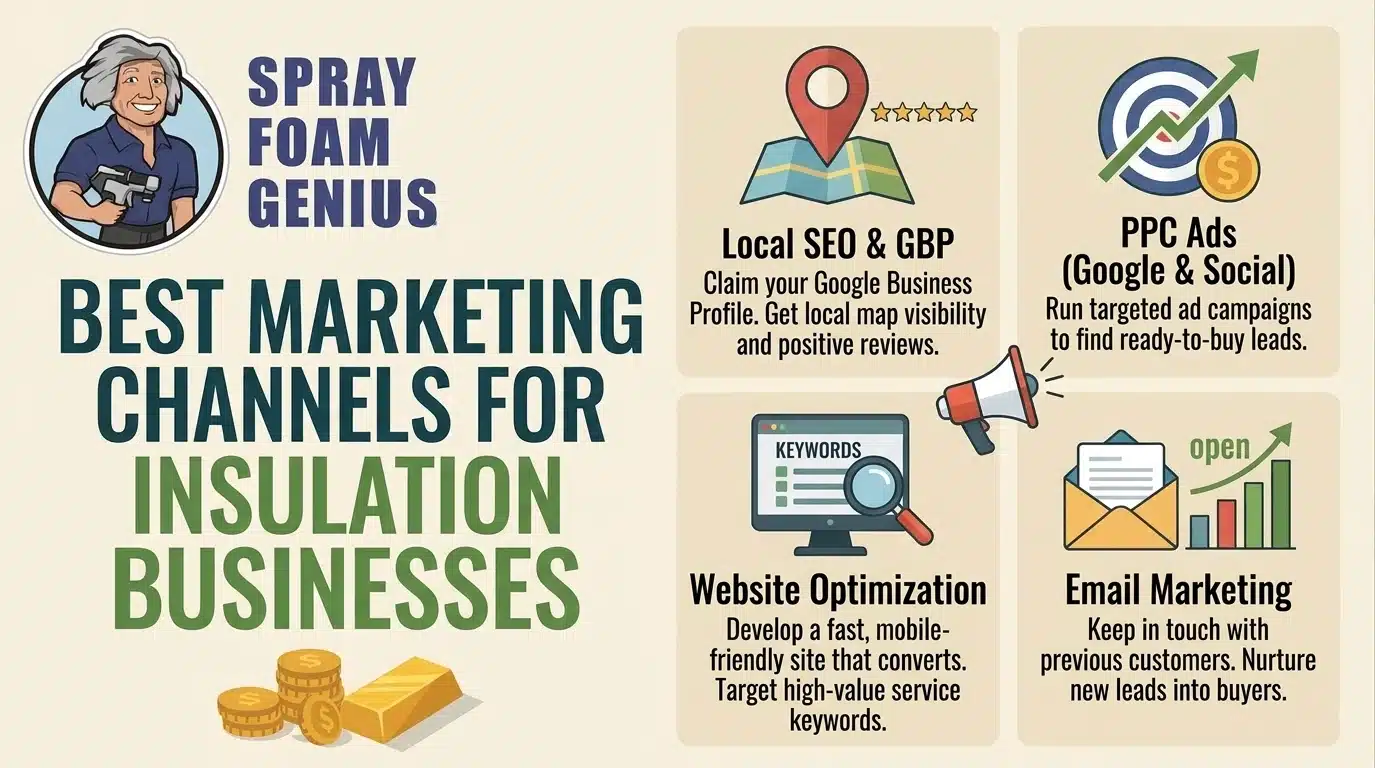
In 2026, the spray foam contractors who win the most work are not always the best at their craft. They are often the easiest to find and the easiest to trust. Homeowners, builders and commercial project managers research contractors online before making a single call, and if you are not where they look, a competitor gets that job.
The challenge is not a lack of marketing options. It is choosing a combination that fits your budget, service area, capacity and goals. This guide covers the main channels for spray foam and insulation contractors, what each is good for, and how to put them together. It is written by Spray Foam Genius Marketing, an agency that works with spray foam and insulation contractors, and we do not promise specific results from any channel.
How to Choose Channels
There is no single best channel. Compare each option on:
- Buyer intent: are people actively looking for what you sell?
- Local targeting: can you limit it to your service area?
- Speed: how soon can it produce inquiries?
- Cost per booked job, not just cost per lead
- Whether it builds an asset you own or stops when you stop paying
- Whether your crews can handle the extra work
Most contractors do better combining a few channels well than spreading a small budget across many. For budgeting help, see How Much to Spend on Insulation Marketing.
Related reading: Best Review Generation Tools for Insulation Contractors in 2026
Channel 1: Local Search and Your Google Business Profile
When someone searches “spray foam insulation contractor near me,” they are often close to ready to hire. Local search puts your business in front of them at that moment.
Start with your Google Business Profile. Google’s local ranking guidance says local results are based on relevance, distance and prominence, that businesses with complete and accurate information are more likely to show up, and that you cannot pay for a better local ranking. Keep categories and service areas accurate, add photos of finished jobs, and keep hours and contact information current.
On your website, create a dedicated page for each service, including open-cell spray foam, closed-cell spray foam and commercial applications, and location pages that say something real about each area you serve. Make sure the site loads quickly and works well on a phone. You can test it with Google PageSpeed Insights.
Channel 2: Reviews and Reputation
Reviews are a trust signal for buyers, and Google lists prominence, which can include review count and ratings, among the factors behind local results. A steady flow of genuine reviews helps both.
- Ask every satisfied customer soon after the job, with a direct link by text or email.
- Respond to every review, positive or negative.
- Show reviews on your service pages and in your ads.
There is no magic number of reviews. Recency, detail and an honest pattern matter more than a single count. See our reputation management guide for spray foam contractors.
Channel 3: Google Ads and Local Services Ads
SEO builds momentum over time. Google Ads can produce inquiries sooner, which helps in slow seasons, in new service areas or when launching a new service.
Where available for your trade and area, Google’s Local Services Ads are pay-per-lead rather than pay-per-click, and businesses go through Google’s screening and verification. Right now, Local Services Ads are available to insulation installation contractors only in California and Florida, so contractors in other states cannot run them. Google can change this, so check its Local Services Ads page for your area.
For standard search campaigns, focus on high-intent keywords like “spray foam insulation cost,” “spray foam contractor [city]” and “attic spray foam insulation.” Use tight geographic targeting, negative keyword lists and dedicated landing pages, and track phone calls as conversions. Google Keyword Planner is a free tool for researching terms. See Google Ads for insulation businesses.
Channel 4: Referrals and Strategic Partnerships
Some of the highest-quality leads come from trusted referrals. General contractors, custom home builders, roofers, HVAC companies, energy auditors and real estate agents all meet homeowners who may need spray foam, so structured referral relationships can create a steady stream of pre-qualified jobs.
To do this well:
- Set clear goals for the partnership, such as the kind of jobs, response times and service areas.
- Decide how it will be rewarded: reciprocal referrals, a referral fee on completed work, or shared marketing costs.
- Define how leads are handed off and how quickly you will respond.
- Put the agreement in writing, and consider having it reviewed by legal counsel, especially on liability and licensing.
- Track referrals sent and received, jobs closed and revenue, and review the partnership regularly.
Common mistakes include informal handshake deals, one-sided value, poor communication, slow follow-up on partner referrals and not tracking results. Our post on SEO versus referral marketing compares the two approaches.
Channel 5: Facebook and Instagram
Not every prospect is actively searching. Many homeowners do not realize they need spray foam until something prompts them: high energy bills, drafty rooms or a damp crawl space. Social ads can reach them before they search, and let you target by location and retarget people who visited your website but did not call.
Before-and-after photos, short videos of real jobs and clear seasonal messages usually work better than generic claims. Social media is typically stronger for awareness and trust than as a primary lead source, so treat it as support.
Channel 6: Video
Video shows your work and answers common questions. Titles like “How Much Does Spray Foam Insulation Cost?” or “Open Cell vs Closed Cell Spray Foam Explained” attract people in the research phase. Short clips of a spray foam application work on YouTube Shorts and Instagram Reels, and the same videos can be embedded on your website.
Cost-conscious homeowners may respond to savings details. ENERGY STAR notes that EPA estimates homeowners can save an average of 15% on heating and cooling costs by air sealing and adding insulation, which makes a useful hook when you explain what you do.
Channel 7: Email, Text and Past-Customer Follow-Up
Email and text are underused in the trade. Past customers are the most likely source of referrals and repeat work, and unbooked estimates are a pool of warm leads. A short seasonal email with energy-saving tips, project highlights or a referral request keeps your business memorable without being intrusive, and tools such as Mailchimp or your CRM make automation inexpensive.
Channel 8: Your Website and Tracking
Your website is the hub that every other channel sends people to. If it is slow, unclear or untrustworthy, you pay for traffic that goes nowhere. Put your phone number in the header, add a form and call to action to every service page, show real reviews and photos, and set up call and form tracking so each lead has a source.
Why a Multi-Channel Mix Beats a Single Source
Relying on one source hands over control of your revenue. If a search algorithm changes, an ad account is flagged or a lead service raises its prices, a single-source business can see leads fall quickly. A mix gives you stability.
It also matches how people buy. Homeowners rarely hire the first insulation company they see. A typical path might be searching “spray foam near me,” clicking a result, seeing your project photos on social media later, reading your reviews, and then calling. Each touchpoint builds familiarity and trust.
Channels also feed one another:
- Search ads can show which keywords lead to calls, which can then guide your SEO content.
- Retargeting can bring back website visitors who did not convert.
- Reviews improve the performance of every other channel.
- A CRM and call tracking tie it all together, so you can see which sources produce booked jobs.
Consistent messaging, logos and offers across all channels reinforce this effect. A cohesive plan is easier to manage when each channel has a clear job: for example, Google Business Profile and reviews for trust, SEO for lasting visibility, ads for speed, referrals for high-trust leads, and email for follow-up.
Choosing a Mix for Your Stage
- New or small contractor: start with your Google Business Profile, a simple website with service pages, a review routine and referral relationships. Add a small, well-tracked ad campaign if you need inquiries sooner.
- Growing company: add search ads, content, retargeting and a CRM so lead flow is more predictable.
- Established or competitive market: build a fuller mix across local SEO, ads, partnerships and follow-up automation, with reporting by channel.
Common Mistakes
- Spreading a small budget across too many channels
- Running ads without call tracking or a decent landing page
- Ignoring reviews
- Expecting SEO results immediately
- Treating social media as your only lead source
- Running disconnected channels with different messages and no shared tracking
- Generating leads without a fast response and follow-up system
Measure Each Channel
For every channel, track calls and form leads, cost per lead and cost per booked job, close rate and revenue. Review the numbers monthly and shift budget toward what produces jobs. See KPIs insulation contractors should track monthly, and our complete digital marketing guide for spray foam contractors for how everything fits together.
Get a Second Opinion on Your Mix
If you are not sure which channels deserve your budget, Spray Foam Genius Marketing offers a free marketing audit that reviews your website, local search visibility and lead generation setup. Call USA: 877-840-3626 or email info@sprayfoamgeniusmarketing.com.
Frequently Asked Questions
What is the most cost-effective channel for a new spray foam contractor?
A complete Google Business Profile with a steady review routine and a clear website is usually the lowest-cost place to start, since it mostly takes time. Referral relationships with builders and other trades are another low-cost option.
Should you run Google Ads and SEO at the same time?
Often yes. Ads can produce inquiries sooner while SEO builds lasting visibility, and running both reduces dependence on a single source. Make sure your website and tracking are ready first.
How long does SEO take to generate spray foam leads?
It typically takes months, and the pace depends on your competition and your website. No one can promise a specific timeline, so look for early signs such as better Business Profile activity and more calls from search.
How many Google reviews does a spray foam contractor need?
There is no fixed number. A steady stream of recent, detailed reviews tends to look more trustworthy than a large but stale total. Keep asking after each job.
Can social media produce real spray foam jobs?
It can, especially when paired with targeted ads, video and retargeting, but it usually supports search and referrals rather than replacing them.
What is cross-channel marketing?
It means connecting your channels so they share messages, data and goals, rather than running each in isolation. For example, search, ads, social, email and your CRM all reinforce the same offer and report into the same tracking.
Can small contractors compete with larger ones?
Yes, by being specific. A small company can win by focusing on a service area and service line, showing proof of work and reviews, and responding faster than bigger competitors.