
There is no single correct marketing budget for an insulation or spray foam company. The right amount depends on how many jobs you want, how well you convert leads into those jobs, how competitive your market is, how big your service area is and how much room your crews have to take on work. What works better than a generic number is a method: start with the jobs you want, work backward to the leads you need, and let your own tracking tell you what a lead and a job really cost.
This guide explains that method, what typically goes into a budget, how needs differ for a startup, an established shop and a larger company, and the mistakes that make good budgets fail.
The Short Version
- Budget from the jobs you want, not from a copied percentage.
- Know your close rate, average job value and margin before you set a number.
- Put money first into the basics: tracking, your Google Business Profile, a website that converts and a way to answer every lead fast.
- Balance fast channels such as search ads with slower, compounding ones such as local SEO and reviews.
- Review results monthly and move money toward what produces profitable jobs.
- Do not scale spend until your tracking and follow-up are working.
Work Backward from the Jobs You Want
Start with a target, then do the arithmetic in reverse. As an example only, with assumed numbers, say you want six more jobs a month. If you close 40% of estimates, you need 15 estimates. If half of your leads book an estimate, you need about 30 leads. If your assumed cost per lead is $100, the budget for that goal is around $3,000 a month in ad and lead costs. Change any of those assumptions and the answer changes, which is the point.
Then sanity-check the result against profit. Divide that spend by the six jobs to get cost per booked job, and compare it to your average job value and gross margin. If the margin on a job cannot comfortably cover its marketing cost and the cost of doing the work, the plan needs to change. Our guide to calculating your true cost per job shows how to do this properly.
Some owners prefer to set the budget as a share of revenue. That can work as a rough check, but the right share depends on your growth goals, margins and market, and a percentage copied from another business may not suit you. Start from the jobs, then compare to your revenue.
What Drives the Budget Up or Down
Market size and competition
Busy metro areas usually mean more competitors bidding on the same searches, which tends to raise cost per click and make organic visibility harder to win. Smaller markets can often be reached for less.
Service type
Spray foam can be more competitive and carry a higher ticket than some other insulation work, which affects both what you can afford to pay for a lead and what the market charges for the click. Attic, crawl space and commercial work also behave differently, so budget by service line when you can.
Service area size
Covering several towns, counties or states takes more content, more ad targeting and more listings than serving one city well.
Growth goals and capacity
Steady maintenance costs less than aggressive growth. But more leads help only if your crews and office can handle them. If your schedule is already full, spend on filling better jobs and higher margins, not volume.
Brand strength and reputation
A strong set of reviews and an established name make every dollar work harder. A new company often has to pay more for visibility while it builds trust.
Website and sales process quality
A weak website or slow follow-up raises your effective cost per job. Fixing those first is often cheaper than buying more traffic.
Where the Money Actually Goes
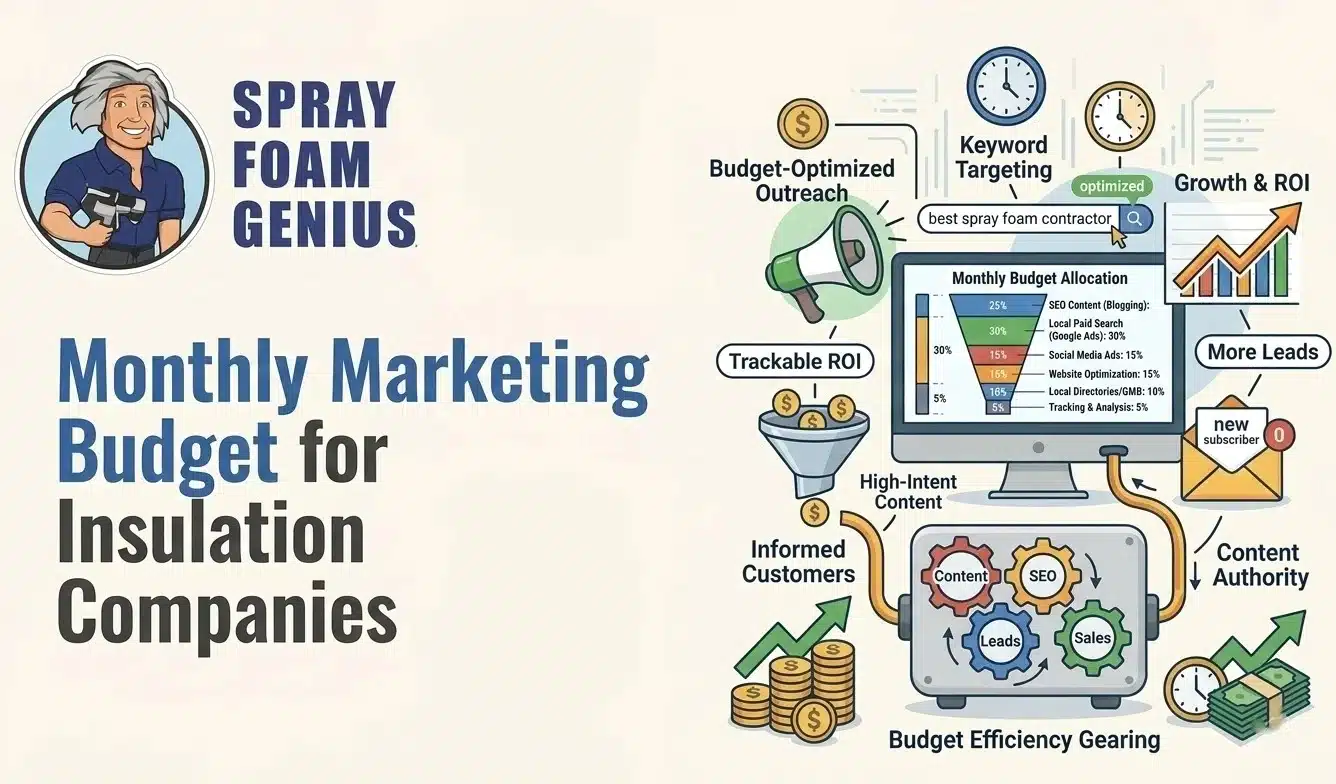
Marketing is more than running ads. A balanced budget usually mixes a few of these:
- Paid search (and Local Services Ads, in California and Florida) for fast, high-intent leads. See Google Ads for insulation businesses.
- Local SEO and your Google Business Profile for visibility that compounds over time. See SEO cost for insulation contractors.
- Your website and landing pages, which convert the visitors you pay for. See website cost for insulation contractors.
- Content marketing, such as service pages, project write-ups and educational posts. See the value of SEO-driven content.
- Reviews and reputation work, which lift conversion across every channel.
- Retargeting and email to follow up with people who did not act the first time.
- Tracking and software: call tracking, a CRM and reporting.
- Offline items such as direct mail, home shows and local sponsorships, if you can measure them.
Paid ads can produce leads quickly but stop when you stop paying. SEO and content take longer and no one can promise how long, but they can reduce reliance on ads over time. Most contractors benefit from some of both.
Budgeting by Stage
Startups and very small companies
A new or small company usually has limited money, so focus on the few things most likely to produce calls: a complete, active Google Business Profile, a clear website with a visible phone number, a small and tightly targeted search ad campaign, call tracking and a plan to collect reviews. Avoid spreading thin across many channels. Run a short test, measure it, then add more.
Be honest about capacity. If you can only take on a few extra jobs a month, a huge lead budget is wasted.
Companies in the middle
Once a company has steady work, the question is scaling. Add budget in steps tied to evidence: if a channel returns profitable jobs at a stable cost, put more into it and watch whether the cost per job holds. Add content and SEO alongside paid, and work on conversion, since a better close rate lets you pay more for leads than a competitor can.
Larger and multi-crew companies
Bigger companies often have the budget for a full mix of channels, a CRM and deeper tracking. The risk is spending without discipline. Review every channel on cost per booked job and customer lifetime value, and fund foundations such as branding, the website and CRM setup before layering on more spend.
Should You Pay a Monthly Retainer?
A retainer can be worth it when it buys measurable lead generation, tracking and conversion work and when the provider understands home services. It is a poor fit when you cannot handle more leads, have no process for follow-up or expect instant results. Ask what exactly the monthly fee includes, how leads and jobs are tracked, and how you will know it is working. Check our guides on when not to hire a marketing agency and in-house marketing versus an agency.
Remember that ad spend is often separate from agency fees, so a budget has to cover both.
What Scaling Costs Beyond Marketing
Marketing is only one piece of growth. Scaling a spray foam business can also mean equipment and rig upgrades, more crew members, sales staff, vehicles, insurance, training and software. Leads that you cannot service quickly turn into lost money and bad reviews. Plan marketing spend and capacity together, and step up in stages instead of all at once.
How to Judge Whether the Budget Is Working
- Track leads, appointments, jobs and revenue by channel.
- Calculate cost per lead, cost per booked job and return by channel. See how to track your marketing ROI and the monthly KPIs to review.
- Give campaigns enough time to gather data before judging them, and give slower channels longer than ads.
- Move money toward profitable channels and trim the rest. Change one thing at a time.
Common Budget Mistakes
- Relying only on referrals. They are valuable but unpredictable, and growth stalls when they slow.
- Running ads to a weak website. Traffic without conversion work wastes money.
- No lead tracking. Without it you cannot tell which dollars made money.
- Buying shared leads without checking real cost per job. See high-quality leads versus cheap leads.
- Spreading a small budget over too many channels.
- Stopping SEO early. Organic visibility builds slowly, and cutting it before it has had time can waste what you already put in.
- Scaling spend before follow-up and capacity are ready.
- Cutting marketing entirely, which leaves the field to competitors who stay visible.
Want Help Setting a Realistic Budget?
If you would like a second opinion on what your market and goals call for, ask for a free marketing audit. Email info@sprayfoamgeniusmarketing.com or call 877-840-3626 (USA). See also our lead generation system guide.
Frequently Asked Questions
How much should an insulation company spend on marketing each month?
It depends on your goals, close rate, average job value, margin, market and capacity. Work backward from the number of jobs you want, using your own tracking data, instead of copying a general figure.
Should a budget be a percentage of revenue?
A percentage can be a rough check, but the right share varies by growth goals, margins and market. Use it as a comparison after you have built the budget from your target jobs.
How much should a new insulation company spend on marketing?
Enough to cover the basics well: Google Business Profile, a clear website, call tracking, review collection and a small, focused search campaign. Start small, measure and add budget when you see profitable jobs.
What marketing channel generates the most insulation leads?
For many contractors, Google search (local SEO, the map listings and search ads) is a core source because homeowners search when they need work done. The best mix still depends on your market, so let your own tracking decide.
Should insulation companies invest more in SEO or in ads?
Most benefit from both. Ads can produce leads quickly but stop when spending stops. SEO builds more slowly and can lower reliance on ads over time. Nobody can guarantee how fast SEO will work.
What is a good cost per lead for insulation?
There is no universal figure. It varies by market, service and channel, and cost per lead matters less than cost per booked job. Measure yours and compare it to your job value and margin.
How do you know if you are overspending or underspending?
If cost per booked job is higher than your margin can comfortably cover, you may be overspending or leaking leads. If you cannot get enough qualified calls to keep crews busy and have good conversion, you may be underspending. Your tracking should show which.