
Your spray foam work might be flawless, but if your online reputation tells a different story, you can lose jobs to competitors who are less skilled. Homeowners and commercial clients are about to spend serious money, and they will almost always look you up before they call.
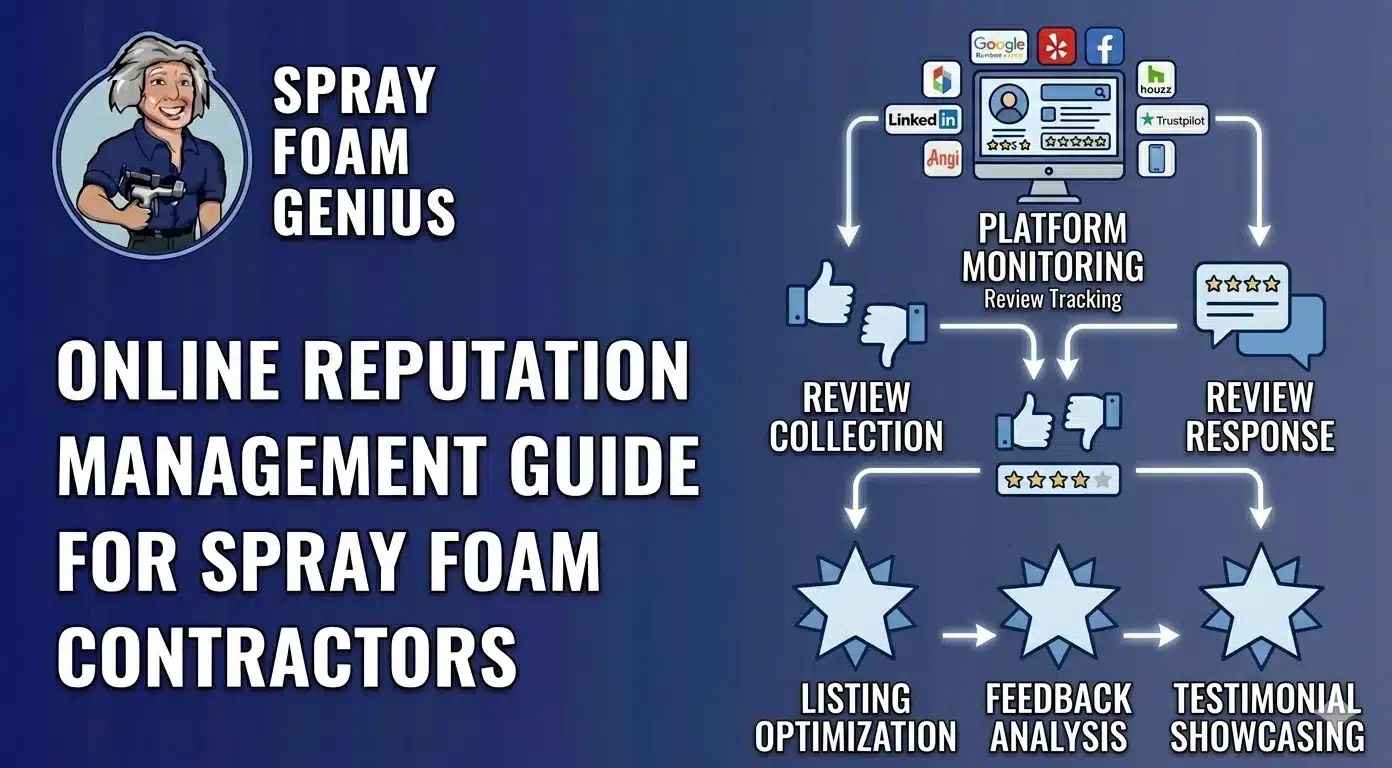
Reputation management for spray foam contractors is more than responding to bad reviews. It is a system that covers how your business appears on Google, what past customers say about you, how your brand shows up on social media, and whether a new prospect trusts you enough to pick up the phone. This guide breaks that system into steps built for spray foam and insulation businesses in a competitive local market.
Why Online Reputation Management Matters for Spray Foam Contractors
Spray foam is a high-trust purchase. You are asking to work inside someone's home, crawl space or building, using a product that will stay in their walls for decades. That makes the research phase thorough, and the research usually starts with a search.
When a homeowner searches for a spray foam contractor near them, Google can show star ratings, review counts, photos and snippets of what customers said. Picture two contractors side by side, one with a large number of recent reviews and one with a handful. Even if your crews are equally good, the first company looks safer.
Homeowners rarely stop at one source. Before calling, many will check your Google profile, your Facebook page, a directory such as the Better Business Bureau or Houzz, and your website. They may even search your company name along with the word "reviews." That is why what can look like a lost job on price is sometimes a trust problem that started before the first call.
Related reading: What Does Reputation Management Cost for Insulation Contractors?
How Customer Reviews Affect Your Spray Foam Business

Reviews are your digital word of mouth. They help people find you, help them compare you with other contractors and give them the final reassurance before they call.
On local rankings, here is what Google actually says. Its local ranking help page explains that local results are based mainly on relevance, distance and prominence, and that more reviews and positive ratings can help your business's local ranking. That is useful guidance, but it is not a formula. No one outside Google knows exactly how much each piece counts, so treat reviews as one important part of a complete profile rather than a switch you can flip.
What customers look for in spray foam reviews:
- Professionalism during the estimate and walkthrough
- Whether the crew showed up on time and cleaned up after the job
- How the contractor handled problems or surprises
- Whether the foam performed as promised
- How easy the contractor was to communicate with
A generic "great job" tells a reader little. A detailed review that mentions the service, the space and the crew is more convincing, and it is more useful to you. You cannot script what a customer writes (and you should not try), but you can mention the specific job when you ask, which nudges people toward detail.
Review platform priority: Google first, because it feeds your map results and profile. Then add the platforms your customers use in your area, such as Facebook, Houzz, Angi or the Better Business Bureau.
A Reputation System You Can Run Every Week
The three-phase approach
Phase 1, set expectations before the job. Send a confirmation by text or email that explains what will happen, when the crew arrives and what the customer should do to prepare. Misunderstandings are a common source of unhappy reviews, and informed customers feel respected.
Phase 2, deliver a good on-site experience. The foam itself is the baseline. What gets mentioned in reviews is the surrounding experience: arriving when you said, protecting floors, telling the owner about changes as they happen and doing a walkthrough before you leave.
Phase 3, follow up. A short text or email after the job shows you care about the result and opens the door to a review request.
The reputation stack
Think of your reputation as layers of trust. At the base is an accurate, complete Google Business Profile. On top of that sit your reviews, then your website and its testimonials, then your social presence and then your content, such as project photos and videos. Each layer supports the others, and a weak layer makes the whole stack look shaky.
How to Get More Google Reviews
Most happy customers will leave a review if you ask at the right moment and make it easy. The biggest mistake is assuming they will do it on their own. Satisfied customers are busy, and without a prompt most simply move on.
- Ask soon after the job, while the result is fresh. Skipping the ask or waiting weeks usually means lost reviews.
- Send a direct link. Google's tips for getting reviews point to using a link or QR code so customers do not have to hunt for your listing. Avoid "find us on Google."
- Keep the message short and personal: use their name, mention the job and make the link the only thing they need to click.
- Build the request into your routine: your job or invoicing software, a follow-up text or email, a QR code on the completion sheet and a review link in your email signature.
- Train your crew to mention that a link is coming at the final walkthrough, when rapport is highest.
An example message: "Hi [Name], thank you for choosing us for your spray foam project. We hope everything looks and feels great. If you have a moment, we would really appreciate it if you shared your experience on Google. Here is a direct link: [link]. It helps other homeowners find a contractor they can trust."
Stay inside the rules
Do not offer discounts, gifts or payment for reviews. Google's contributed content policy does not allow paid or incentivized reviews, and it also does not allow selectively soliciting only positive reviews. That means no review-gating, where you send happy customers to Google and unhappy ones to a private form. Ask everyone. The FTC's rule on consumer reviews, which took effect on October 21, 2024, also covers buying fake reviews and incentives tied to a particular sentiment.
You can motivate your own team without breaking anything. Recognize the crew leads who ask every customer and follow the process. Reward consistency, not five-star results.
Managing Negative Reviews
Every contractor eventually gets a bad review: a difficult client, a miscommunication or a job that went sideways. A negative review is not a reputation killer. How you respond is what future readers will remember.
A four-part reply that works:
- Acknowledge the experience without getting defensive.
- Apologize for the frustration, whether or not you believe you were at fault.
- Say what you are doing about it.
- Invite the reviewer to contact you directly to resolve it.
Google's own advice on replying is similar: be honest, apologize when appropriate, personalize the reply and respond promptly.
What not to do:
- Argue with the reviewer in public.
- Brush off the complaint as exaggerated.
- Leave it unanswered.
- Ask friends or family to post fake praise to bury it.
- Reply while you are angry.
If a review is clearly fake or breaks Google's policies, flag it through your Google Business Profile and document why. Removal is not guaranteed, but clear violations are often addressed. In the meantime, a calm public reply, such as saying you cannot find a record of the customer and inviting them to call, helps readers see the full picture.
When you resolve a complaint offline, you can politely ask the customer whether they would be willing to update their review. Do not offer anything in return, and do not pressure them. Customers who had a problem fixed often write the most persuasive reviews.
Local SEO and Your Google Business Profile

Local SEO and reputation management work from the same foundation. Your Google Business Profile, your reviews and your listings elsewhere on the web all tell the same story about who you are and where you work.
Google Business Profile checklist:
- Choose the right primary category (insulation contractor) and any fitting secondary categories.
- Write a clear business description that lists your services and the areas you serve.
- Upload real photos of completed jobs, your crew and your equipment.
- Post updates on a regular schedule.
- Reply to every review, positive or negative.
Keep your business name, address and phone number the same everywhere you are listed, including directories, social profiles and your website. Mismatches make it harder to tell your listings are the same business. If you work in several cities or counties, build service area pages on your site that describe the work you really do in each place, with local details and real reviews. For a deeper walk-through of the profile itself, see our Google Business Profile services.
Use Your Proof Everywhere
A good reputation only helps if people see it. Put your best reviews on your homepage, service pages and contact page. Include your star rating in estimates and proposals. Consider a testimonials page that gathers written reviews, short video testimonials and photos. Link to it when you follow up with prospects who have not decided yet.
In a visual trade, before, during and after photos are some of the strongest proof you have. Take them on every job (with the owner's permission), and tell the story of the problem, what you did and the products you used. Share them on your website, your Google profile and your social channels. Do not publish numbers, savings or results that you cannot back up from your own jobs.
Educational content builds trust before the first call. Answer the questions customers ask, such as how open-cell and closed-cell spray foam differ, what to expect during installation, how to spot poor workmanship and what to ask a contractor. Prospects who find your answers during research arrive already trusting your expertise.
Social Media Reputation Basics

You do not need to post every day to protect your reputation. You need to be consistent and professional on the platforms your customers use.
- Facebook: before-and-after photos, customer stories and helpful answers for homeowners.
- Instagram: short videos and photos of your work in progress.
- YouTube: longer videos explaining the process, which can also support your search visibility.
- LinkedIn: useful if you want commercial work, since property managers and facilities teams are there.
Respond to comments and questions promptly and professionally. They are public, and silence can look like indifference. For a full plan, see our social media playbook for spray foam contractors.
Credibility Signals Worth Showing
Spray foam customers sometimes arrive with concerns about poor installations, off-ratio mixing or odor, so your reputation work should answer those worries directly.
- Certification: contractor credentials such as those offered through the Spray Polyurethane Foam Alliance (SPFA) tell customers you meet industry standards. Show them on your website, your Google profile, your trucks and your proposals, if you hold them.
- Transparency: say which foam products you use and why, show your crew's training and licenses, offer a written estimate and warranty and explain exactly what they cover.
- Consistency: use the same company name, logo and phone number on your website, Google profile and social pages. Mismatches make a business look less established.
Common Reputation Mistakes
- Ignoring your Google Business Profile. An unclaimed or incomplete profile looks inactive.
- Responding defensively to criticism.
- Buying or faking reviews. This violates Google's policies and can get reviews removed or a profile penalized.
- Letting listings drift apart, with different names, addresses or phone numbers.
- Letting reviews go quiet. A profile with many reviews but none for a long time can look stale to readers. A steady flow after each job looks healthier.
In-House or With Help?
You can run all of this yourself if someone on your team has the time to do it every week. Most contractors are on the job all day and struggle to keep up with review requests, replies, profile updates and posting. The right choice depends on your volume and your bandwidth. What matters is consistency: a burst of activity followed by months of silence will not build anything lasting. For a breakdown of what each option involves, read our post on reputation management cost for insulation contractors.
If you would like help, we offer a free marketing audit that looks at your reviews, profile and visibility compared with nearby competitors. Call 877-840-3626 (USA) or email info@sprayfoamgeniusmarketing.com, or read about our reputation management services.
Frequently Asked Questions
How many Google reviews does a spray foam contractor need?
There is no fixed number. What counts depends on your market, so look at the contractors who show up for the searches you want and see how many reviews they have. Review quality, recency and whether you reply matter alongside the raw count. Aim for steady growth rather than one big push.
Can you remove a fake negative review from Google?
You can report reviews that break Google's policies, such as spam, fake reviews from non-customers or inappropriate content. Open your Business Profile, find the review and use the report option. Removal is not guaranteed, but a clear and well-documented violation is more likely to be acted on.
How long does it take to improve a damaged reputation?
It depends on how many complaints you have, how many are unresolved and how many jobs you complete. Reviews accumulate one customer at a time, and nobody can promise a timeline. The things in your control are fixing real problems, replying to every review and asking every customer.
What is the best way to ask for reviews without sounding pushy?
Ask soon after the job, keep it short and make the link easy. Frame it as helping other homeowners find a trustworthy contractor. A genuine message from the crew lead or owner usually works better than a stiff, formal one.
Can you give a discount or gift for a review?
No. Google's policy does not allow incentivized reviews, and the FTC's rules also restrict incentives tied to positive sentiment. Ask every customer, and let the work earn the review.
Is social media important, or is Google enough?
Google should be your first priority because it is where many local searches start. Social media adds reach and a record of your work, and it keeps you visible to past customers who might refer you. Pick one or two platforms and do them well rather than spreading yourself thin.
How often should you check your reviews?
Often enough that nothing sits unanswered. Turn on notifications for new reviews, and check your profile on a regular schedule so you can reply promptly.