
Direct Answer
Spray foam companies earn bad reviews primarily due to unmet customer expectations, poor communication, inconsistent quality, pricing disputes, and lack of follow‑through on service guarantees. These issues stem from gaps in training, oversight, and customer experience systems, not from the insulation product itself. By standardizing processes, setting clear expectations, enhancing communication, leveraging professional training, and proactively managing reviews, spray foam contractors can dramatically reduce negative feedback and build stronger reputations.
TLDR
- Set Clear Expectations Upfront: Accurately scope jobs, explain processes, and document commitments before work begins.
- Communicate Proactively: Regular updates during projects reduce anxiety and build trust.
- Invest in Training & Quality Control: Skilled applicators and rigorous QC eliminate rework and callbacks.
- Transparent Pricing & Documentation: Avoid surprise charges with clear contracts and line‑item pricing.
- Follow‑Up & Warranty Support: Quick responses to issues turn unhappy customers into advocates.
- Leverage Review Management Tools: Monitor and respond to feedback across platforms (Google, Yelp, Facebook).
- Use Data & Metrics: Track satisfaction scores and root causes to improve continuously.
- Build a Strong Brand Promise: A consistent guarantee differentiates quality contractors.
Why Spray Foam Companies Get Bad Reviews
Before we fix the problem, let’s understand the root causes behind negative customer feedback.
1. Misaligned Expectations
Customers often don’t understand what spray foam insulation entails:
- Installation noise, smell, and disruption during the spray process.
- Curing time can take up to 24–48 hours, depending on temperature/humidity.
- Coverage limitations based on structural constraints.
Result: When expectations aren’t set, customers feel misled.
To better understand how insulation contractors can prevent negative reviews and manage customer expectations, see this reputation management guide for spray foam contractors.
2. Poor Communication
A survey by BrightLocal found that 89% of consumers read businesses’ responses to reviews before deciding to work with them. Lack of updates during the project can feel like radio silence, leading to frustration.
3. Inconsistent Quality Control
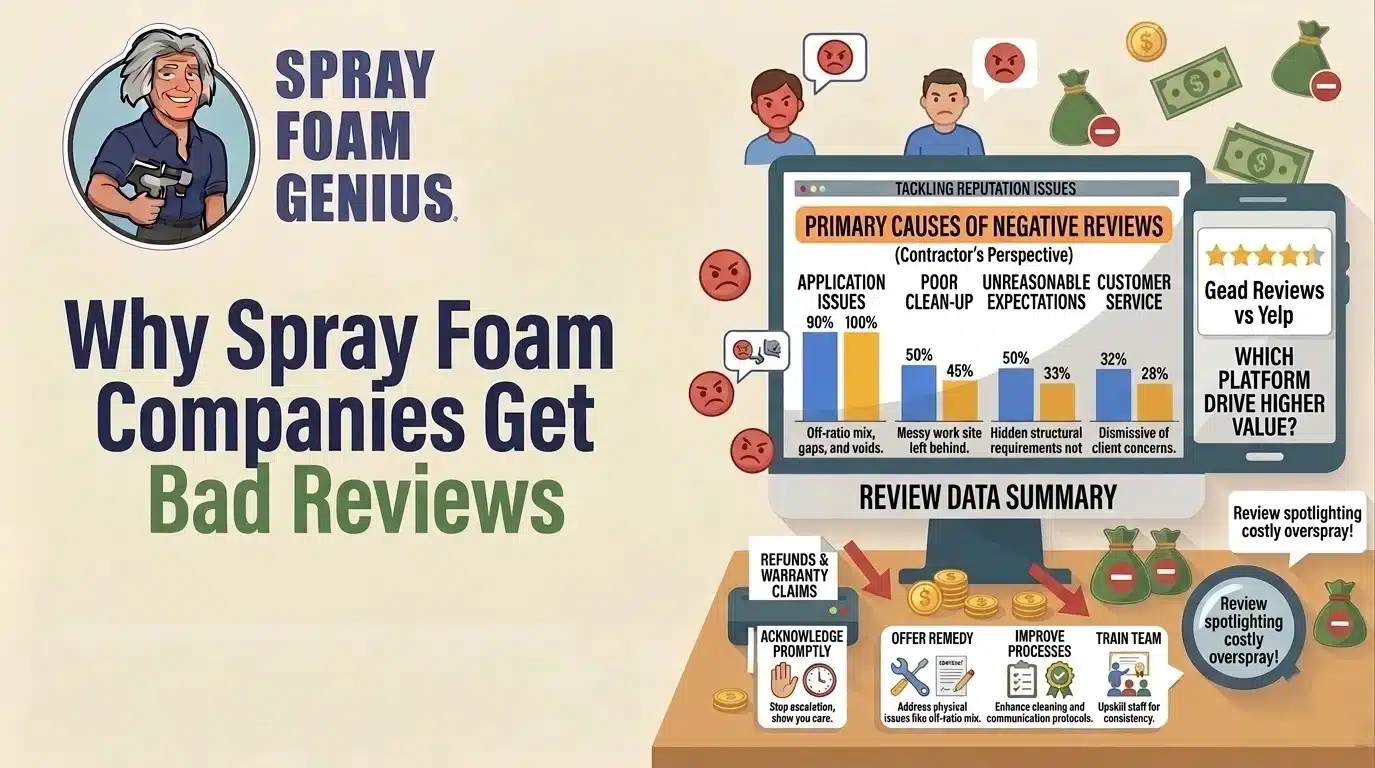
Spray foam application requires precision. Inadequate training, inexperienced crews, and lack of oversight create issues such as:
- Uneven coverage
- Overspray inside conditioned spaces
- Gaps and voids leading to thermal bridging
4. Hidden Costs & Billing Disputes
Contracts that lack detail on pricing or change orders that aren’t explained in advance make customers feel nickel‑and‑dimed.
5. Slow or No Follow‑Up
Not responding to callbacks or warranty claims quickly compounds negative sentiment.
Common Complaints & Real‑World Examples
Example: A homeowner reported spending $7,000 on attic spray foam, only to discover cold drafts afterwards. The contractor did not return calls, prompting multiple negative reviews.
Actionable Strategies to Prevent Bad Reviews
1. Standardize Pre‑Sale Education
Customers who understand the process are happier overall.
Actions:
- Develop a Pre‑Installation Guide that covers: What spray foam is (Wikipedia) Expected timeline Smells, sounds, and curing details Job site preparation requirements
- What spray foam is (Wikipedia)
- Expected timeline
- Smells, sounds, and curing details
- Job site preparation requirements
- Require a signed scope of work with clear deliverables
2. Communicate at Every Stage
No news = bad news in customers’ minds.
Communication Plan Example:
- Day Before: Reminder call/text about start time and prep
- Day of: Arrival window and confirmation upon arrival
- Mid‑Job Update: Quick 10–15 second photo or message
- Completion: Sign‑off walkthrough and explanation
Tools:
- CRM systems with automated texts (JobNimbus, ServiceTitan)
- SMS reminders for appointments
3. Implement Rigorous Training & Quality Control
Spray foam is a specialized skill, not just “spray and go.”
Training Components:
- Manufacturer certification programs (BASF, Demilec)
- Internal field training checklists
- Weekly field audits by senior technicians
Quality Control Checklist:
- Verify substrate preparation
- Ensure proper ambient conditions before spraying
- Adhere to the recommended board foot application rates
Companies with internal quality standards see fewer callbacks and fewer complaints (Harvard Business Review – The Discipline of Quality).
4. Transparent Contracts & Pricing
Customers hate surprises.
Contract Must‑Haves:
- Detailed line items for materials, labor, and optional services
- Change order process documented and signed before execution
- Payment milestones tied to completion checkpoints
5. Proactive Warranty & Follow‑Up
Great aftercare prevents negative review spirals.
Follow‑Up Sequence:
- 48 hours after job completion: Check‑in call
- 7 days: Customer satisfaction survey
- Immediate response to any issues within 24 hours
Provide customers with a dedicated support line for warranty claims.
6. Monitor & Respond to Reviews
Responding to reviews builds credibility, even when negative.
Response Framework:
- Acknowledge quickly: within 24–48 hours
- Empathize genuinely (“We understand your concern…”)
- Take it offline (“Call us to resolve…”)
- Offer a solution or next step
Review platforms include: Google Business Profile, Yelp, Facebook, Angi / Houzz.
Preventing Bad Reviews vs. Fixing Bad Reviews

Real‑World Case Study: Before & After
Company A (Before):
- No pre‑installation packets
- Crews were sent out with minimal oversight
- Communication via phone only
- Repeated 2–3 star reviews about missed calls and hidden fees
Company A (After: Implemented Changes):
- Pre‑installation packet emailed and mailed
- Daily field check-ins required via CRM
- Transparent contracts with line-item pricing
- Follow-up calls at 48 hours and 7 days
Result:
- 4.7★ average review on Google within 6 months
- 35% reduction in customer callbacks
- Fewer disputes and refund requests
Tools & Templates to Adopt Today
Take Control of Your Online Reputation & Grow with Confidence
Take control of your online reputation and grow your business with confidence. Your company’s reputation directly impacts your growth, and ignoring negative reviews can hold you back. We help you improve your customer experience, strengthen communication, and build systems that consistently generate 5-star feedback.
Spray Foam Genius Marketing helps insulation contractors improve customer experience, strengthen communication, and implement systems that consistently generate 5-star reviews.
Call us in the USA at 877-840-FOAM or in Canada at 844-741-FOAM. You can also email us at info@sprayfoamgeniusmarketing.com to get started.
If you’re ready to improve your processes and reduce negative feedback, request a Genius Audit today. Our team will review your customer journey and identify opportunities to increase satisfaction and referrals.
FAQs
1. What is the #1 cause of bad reviews for spray foam companies?
Most bad reviews stem from poor communication and unmet expectations rather than the insulation quality itself.
2. How important are online reviews for spray foam contractors?
Online reviews are extremely important because search engines and customers use them as trust signals. According to BrightLocal, 77% of consumers always read reviews before hiring a local business.
3. Should contractors respond to every negative review?
Yes, contractors should respond to every negative review. Prompt and empathetic responses can reduce damage and sometimes even turn unhappy clients into loyal customers.
4. Can training reduce negative reviews?
Yes, proper training can significantly reduce negative reviews by helping crews avoid mistakes and minimizing callbacks or customer complaints.