
Spray Foam Genius Marketing helps spray foam and insulation contractors in Orlando, Florida win more jobs from homeowners and builders searching in that market. Spray foam marketing in Orlando, Florida should follow the climate and the housing stock you can actually cite. The climate zone on this page is 2A. The population line reads 333,888. The cards under the reading are the citations.
333,888 is the population figure for Orlando. The note on that line says: Estimate for July 1, 2025. The county line reads Orange County. Rankings on Google Maps are local to the searcher, so a strong pin near the shop can still leave the rest of a city this size uncovered.
The local reading for Orlando is ordinary, and it is specific. Cooling is the larger degree-day number and the zone is humid, so attic heat, moisture, and air sealing belong at the front of a Orlando site. With owner-occupancy at 37%, a Orlando campaign that speaks only to resident homeowners is aimed at the smaller tenure group. Check it against the grid. A message can be right for the climate and still be invisible three miles from the shop.
Tenure is part of the marketing picture in Orlando: 37% of occupied homes are owner-occupied. That is lower than the national figure of 65% in the same note. The city figure is under half, so renters are a large part of occupied homes. Renters are less often the person who hires insulation, which makes owners and landlords the tighter audience. Landlords and builders remain a separate audience when the owner share is modest.
The median value line reads $430,200 for Orlando. That is higher than the national figure of $360,600 in the same note. Treat it as a reference from the cited survey, not today's asking price. Market prices move after the survey date printed on the card.
Zone 2A is the climate designation published for Orlando. The moisture letter on this zone is humid (2A). The accompanying note is "humid climate, zone 2 of 8". Source on this page: U.S. DOE and PNNL, Guide to Determining Climate Zone by County: Building America and IECC 2021 Updates (PNNL-33270), as of October 21, 2022. Homeowners do not search for a zone number. They search for the comfort problem that zone tends to produce, which is why the degree-day lines matter when this page has them.
Before-1980 construction is 29% in Orlando. That share is lower than the national figure of 48% in the same note. The note on that line says: National: 48% (survey estimate). Combine this with the median year rather than quoting only one of them in an ad.
Heating fuel in Orlando, as published here, is electricity (92%). The note on that line says: Share of occupied homes (survey estimate). Ads can name that fuel. They should not promise a bill outcome the source does not state.
Cooling (3,452) is larger than heating (525). The heating degree-day value is 525 and the cooling value is 3,452. Both figures use base 65 F. The heating note says the reading was measured at ORLANDO INTL AP. Pages and ads can lead with hot attics, summer bills, and rooms that will not cool. Put the larger load first on the Google Business Profile services and on the main service pages.
Orlando's median build year on this page is 1995. That year is later than the national median of 1981 printed in the same note. The note on that line says: National median: 1981 (survey estimate, with a margin of error). Pair it with the share of homes built before 1980 when that line exists, because a median hides the older tail.
If you want the map before a conversation, run the Market Visibility Audit for your Orlando service area. If you want to talk first, book a strategy call. The work is month to month with 30 days notice. It is not pay-per-lead, and it is not an exclusive territory.
Local area
What Census files list for Orlando. If a line is missing, that file had nothing that met the overlap rule. Nothing here is estimated.
ZIP codes. 32827, 32832, 32824, 32811, 32822, 32803, 32829, 32804, 32805, 32808, 32819, 32812, 32806, 32835, 32807, 32801, 32839, 32814.
These are 2020 Census ZIP Code Tabulation Areas that overlap Orlando. A ZCTA is the Census stand-in for a ZIP code. It is not a USPS delivery list. Source: U.S. Census Bureau, 2020 ZCTA to Place Relationship File. Retrieved 2026-10-31.
Primary roads. I-4, State Highway 400, State Highway 408, East-West Expressway, Central Florida Greeneway, State Highway 417, State Highway 528, Florida's Turnpike.
Limited-access highways from the 2020 Census TIGER primary roads file that cross the city boundary. Interstate labels drop the space Census stores after the hyphen. Short Census forms in the road names are written as full words. Interstate, US, state, and Puerto Rico route numbers stay as route designators. A road stored with both & and and is listed once. Source: U.S. Census Bureau, TIGER/Line 2020 Primary Roads (MTFCC S1100). Retrieved 2026-10-31.
Landmarks. Orlando International, Orlando International Airport, Orlando Executive Airport (Oea).
Named Census area landmarks that overlap Orlando: airports, national park land, national forest or other federal land, state parks, and larger parks. Largest overlap first, up to five. Abbreviations in those names are written out, and a Park- prefix is shown as the place name followed by Park. Source: U.S. Census Bureau, TIGER/Line 2020 Area Landmarks. Retrieved 2026-10-31.
Market facts for spray foam contractors in Orlando
Population
333,888
Estimate for July 1, 2025
Source: U.S. Census Bureau, Vintage 2025 population estimates for cities and towns. As of July 1, 2025.
County
Orange County
County that contains the city's central point
Source: U.S. Census Bureau Geocoder (2020 county boundaries). As of 2020.
IECC climate zone
2A
humid climate, zone 2 of 8
Source: U.S. DOE and PNNL, Guide to Determining Climate Zone by County: Building America and IECC 2021 Updates (PNNL-33270). As of October 21, 2022.
Heating degree days per year
525
Normal, base 65 F, measured at ORLANDO INTL AP
Source: NOAA NCEI 1991-2020 U.S. Climate Normals. As of 1991-2020.
Cooling degree days per year
3,452
Normal, base 65 F, measured at ORLANDO INTL AP
Source: NOAA NCEI 1991-2020 U.S. Climate Normals. As of 1991-2020.
Median year homes were built
1995
National median: 1981 (survey estimate, with a margin of error)
Source: U.S. Census Bureau, 2024 American Community Survey 1-year estimates, table B25035. As of 2024.
Homes built before 1980
29%
National: 48% (survey estimate)
Source: U.S. Census Bureau, 2024 American Community Survey 1-year estimates, table B25034. As of 2024.
Owner-occupied homes
37%
National: 65% (survey estimate)
Source: U.S. Census Bureau, 2024 American Community Survey 1-year estimates, table B25003. As of 2024.
Median home value
$430,200
Owner-occupied homes. National: $360,600 (survey estimate)
Source: U.S. Census Bureau, 2024 American Community Survey 1-year estimates, table B25077. As of 2024.
Main heating fuel
electricity (92%)
Share of occupied homes (survey estimate)
Source: U.S. Census Bureau, 2024 American Community Survey 1-year estimates, table B25040. As of 2024.
Each figure links to its public source and shows the date it applies to.
Drawn from the sourced figures above. No new numbers.
Homes built before 1980
Owner-occupied homes
Median home value
Heating and cooling load in a typical year
Degree days per year, a standard measure of how much heating or cooling a climate needs.
What this means for your marketing in Orlando
37% of occupied homes in Orlando are owner-occupied (nationally: 65%), and the median home value is $430,200 (nationally: $360,600). Renters make up a large part of the city, and renters are less often the ones who commission insulation work, so the buyers you want are a smaller group of owners and landlords. It is worth checking in your Google Maps grid whether the strongest demand sits in the suburbs and towns around the city.
Orlando is in Orange County, which falls in IECC climate zone 2A. NOAA's 1991-2020 normals for ORLANDO INTL AP (about 5 miles away) show 525 heating degree days and 3,452 cooling degree days in a typical year, so cooling is the larger load. For a spray foam or insulation contractor, that tends to move what homeowners search for toward hot attics, high summer energy bills and rooms that will not cool. The "A" in 2A marks a humid climate, so moisture control and air sealing deserve space in your content.
The Census Bureau's 2024 American Community Survey puts the median home in Orlando at a build year of 1995 (nationally: 1981), and 29% of its homes were built before 1980 (nationally: 48%). That is a younger housing stock than most of the country. A larger share of the work comes from new construction and recent builds, so builder and developer outreach deserves a place next to homeowner retrofit pages.
Of occupied homes in Orlando, 92% heat mainly with electricity and 5% with utility gas (ACS 2024). Where electricity is the main heating fuel, owners feel a leaky attic in the monthly bill, so energy-bill savings is a natural angle for pages and ads.
Orlando had an estimated 333,888 residents on July 1, 2025 (U.S. Census Bureau). Google Maps rankings change from one part of a market to the next, so being visible near your shop does not mean being visible across the whole service area. The free Market Visibility Audit shows your ranking at a grid of points around your business.
How the Google Maps grid works in a market like Orlando
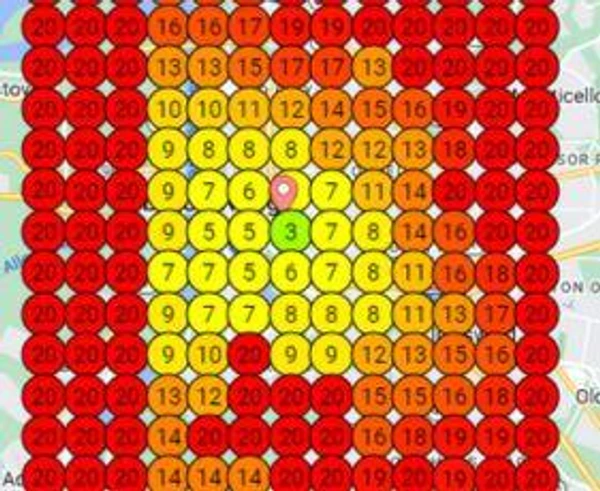
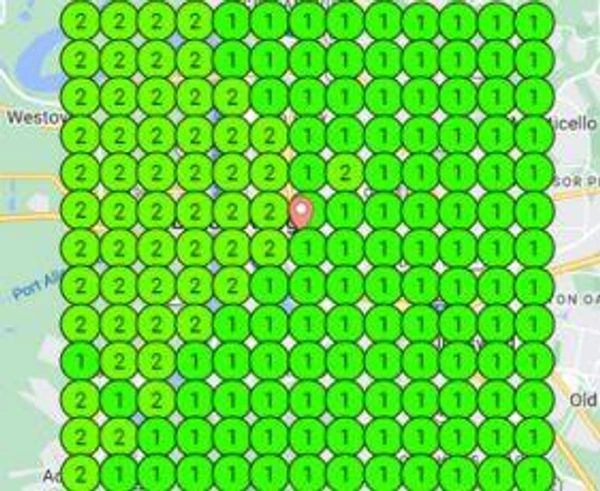
Google Maps does not show one ranking for a whole city. The result changes block by block, depending on where the searcher is standing. Our audit searches from a grid of points around your business and records where you appear at each one. Green means you are in the top 3 at that spot. Red means customers there are not finding you. The Orlando map you want is the one with many points, because that is how customers actually search.
Example from a client in Baton Rouge, Louisiana, not Orlando
How working with us goes
Spray Foam Genius Marketing works with spray foam and insulation contractors. The steps are the same in Orlando as everywhere else. Plans are month to month, and you can end service with 30 days notice.
1. Audit
We look at where your company shows up on Google Maps in the cities you serve. The Market Visibility Audit is free. It shows the current grid. It is not a forecast, and it does not promise a ranking.
2. Plan
If the work is a fit, we write a plan for the website, the Google Business Profile, and the ads for the jobs you take. We do not sell shared leads. We do not promise that only one contractor in Orlando can hire us.
3. Launch
We set up the work in the plan. You buy and own the domain at a registrar you choose, such as Namecheap or GoDaddy. We do not hold the domain, and we do not transfer it. If we build a website, we can move that website to a host you choose after you have been with us at least 90 days and you end service with 30 days notice. Before 90 days the website stays with us.
4. Monthly review
Each month we review what is live: the map listing, the pages, and the ads. We do not bill per lead or per estimate.
Services for Orlando contractors
SEO Services for Insulation Companies
For Orlando, put cooling-season searches on the core pages, because that is the larger degree-day load on this page.
Google Business Profile Optimization
The Google Business Profile for a Orlando company should list the services that match the cooling load shown in the degree days, in the words customers search.
Google Ads Management
Search ads for Orlando can follow the degree days and lead with cooling, the larger of the two published loads.
Facebook & Instagram Ads
Facebook and Instagram ads for a Orlando contractor should target the towns you serve in Florida, with an offer that matches a job you want more of.
Website Development
A Orlando website needs the services, the service area, and a way to call. You buy and own the domain at a registrar you choose. We do not hold it.
Reputation Management
In Orlando, a profile with recent reviews gives a searcher something to check before they call. The work is a steady ask, not a burst of fake feedback.
Results from other markets
These are real client results from the markets named. Client companies are not identified, and results vary by market.
Spray foam marketing in Orlando: FAQ
What climate zone is Orlando in, and why does it matter for my marketing?+
Orange County is in IECC climate zone 2A (U.S. Department of Energy and PNNL, 2022). Climate zone drives what insulation work homeowners ask about, so it shapes which services and keywords to put first on your website and in your ads.
Is heating or cooling the bigger driver in Orlando?+
NOAA's 1991-2020 normals for the nearest weather station show 525 annual heating degree days and 3,452 annual cooling degree days. Cooling is the larger number, which is a useful starting point for choosing what to promote.
How old are the homes in Orlando, and does it change what I should sell?+
The Census Bureau's 2024 American Community Survey estimates a median build year of 1995 and 29% of homes built before 1980 in Orlando. A younger stock means new-construction work matters more, so reach builders as well as homeowners.
Do most people in Orlando own their homes?+
The 2024 American Community Survey estimates that 37% of occupied homes in Orlando are owner-occupied, compared with 65% nationally. Owners are usually the ones who buy insulation work, so this is the size of the group your marketing is aimed at.
How big is the Orlando market?+
The U.S. Census Bureau estimated 333,888 residents in Orlando on July 1, 2025. Population is only one input. The audit shows how many positions you actually hold on Google Maps across the area.
Do you have an office in Orlando?+
No. Our office is in Vancouver, Washington. We work with spray foam and insulation contractors across the United States and Canada.
How do I see where my company ranks in Orlando?+
Run the free Market Visibility Audit. It checks your Google Maps ranking at a grid of points around your business and shows the map in a few minutes.
Other areas in Florida
See where your company ranks in Orlando.
Get a free market visibility audit and see where you show up, and where you do not, across your service area.
Get My Free Market Visibility AuditPrefer to talk first? Book a strategy call.