
Direct Answer
Many insulation contractors believe a website alone will generate leads and booked jobs. They often spend thousands on design or expensive SEO packages without considering how customers actually think and behave online. The real problem is having a website that fails to attract, engage, and convert the right local customers. Contractors commonly assume visitors will immediately call, fill out a complex form, or understand their value without guidance, but that rarely happens.
This article explains the real issues behind underperforming insulation contractor websites, why they fail, and how to fix them with practical strategies aligned with user behaviour, search patterns, and industry realities.
TLDR
- Local search dominates lead generation. Up to 60% of qualified website traffic comes from Google Maps and local queries, yet many contractors overlook local SEO best practices.
- Poor user experience cuts conversions. Confusing navigation and unclear calls to action reduce lead submissions by 40 to 60 percent.
- Trust signals are essential. Websites with visible reviews and case studies see more inbound calls and longer user engagement.
- Mobile optimization is non-negotiable. A majority of users search from smartphones, and mobile-friendly sites significantly improve lead capture.
- Fast site speed boosts engagement. Pages that load under 3 seconds convert better than slow ones according to Google Core Web Vitals.
- Content without intent loses users. Visitors want practical answers, pricing clarity, and benefit-driven information not technical jargon.
- Conversion-focused pages outperform generic ones. Dedicated landing pages targeted at specific services increase conversions by two times or more.
The Real Problem Most Insulation Contractors Don’t See
Contractors often assume that once the website is built, leads will automatically follow. However, user behavior on the web tells a different story. Research from the Pew Research Center shows that most consumers begin with broad searches like “insulation contractors near me” or “attic insulation cost [city]” before ever visiting a site’s homepage.
Visitors typically
- Search with intent. Queries like “best spray foam insulation installer [city]” signal high purchase intent.
- Compare options. Users open multiple tabs to compare pricing, reviews, and service quality before contacting anyone.
- Look for trust. Websites with clear social proof, examples of past work, and certifications reduce hesitation.
Many contractor sites fail to capture this behavior because they
- Bury important information deep in the navigation
- Use overly technical language instead of explaining customer outcomes
- Don’t align content with what users are searching for
This gap between perception and reality is the root cause of low lead generation.
This spray foam contractor website conversion guide explains how insulation contractor websites can be optimized to turn traffic into leads.
Where Leads Actually Come From
Understanding where leads originate is crucial for improving website performance.
Local search and listings account for 50 to 60 percent of qualified leads. Optimizing a complete Google Business Profile with photos, services, hours, and categories and creating location-specific pages with local keywords ensures visibility. According to Google, 76 percent of people who search locally visit a related business within a day of searching.
Organic search and content provide 20 to 25 percent of long-term leads by capturing users at earlier stages of the decision journey. Content such as “How much does spray foam insulation cost,” “Benefits of blown-in vs spray foam insulation,” and “What to expect during insulation installation” helps establish authority and keeps users engaged. Companies that blog generate 3.5 times more leads, according to HubSpot.
Paid search and display ads provide 10 to 15 percent of leads for contractors seeking immediate visibility. Paid campaigns are effective when targeting strong purchase queries, paired with optimized landing pages, and managed with proper bidding and negative keyword segmentation. Paid ads work best as part of a balanced strategy rather than the sole source of leads.
Online reviews and referrals influence trust and contribute up to 10 to 15 percent of inbound leads. Reviews on platforms like Google,Yelp, and HomeAdvisor improve ranking and conversion rates. According to BrightLocal, 87 percent of consumers read online reviews for local businesses.
A pie chart showing lead distribution could illustrate Local Search 60 percent, Content 25 percent, Paid Ads 10 percent, and Reviews 5 percent.
Top Reasons Insulation Contractors Struggle to Get Website Leads
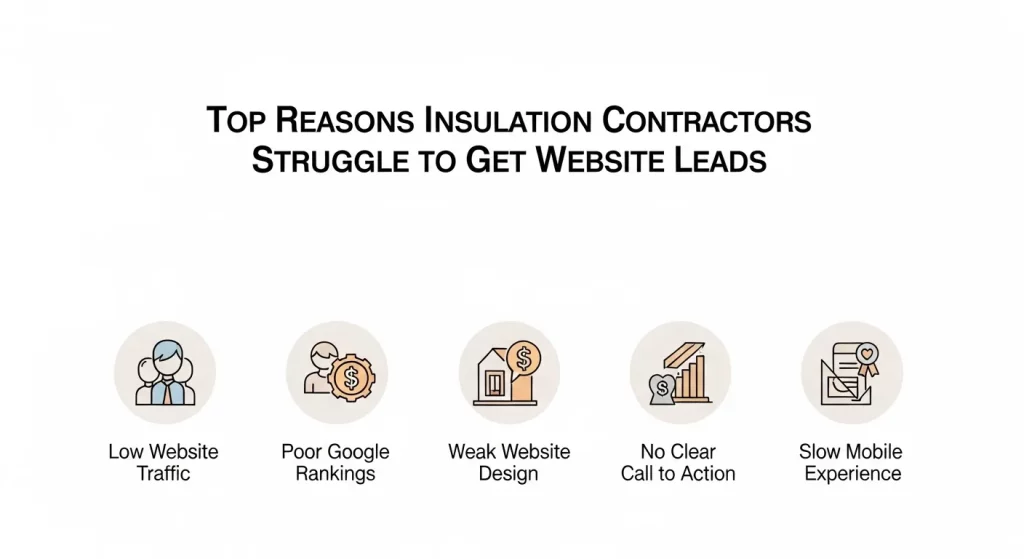
Unclear value proposition. Many websites do not immediately answer the question “Why choose you over competitors?” A strong value proposition should define what the contractor does, highlight the key benefit for the customer, and explain why it is better than alternatives. Without this, visitors often leave for competitors who clearly explain their value.
Confusing navigation and poor UX. Websites with too many menu options, weak page hierarchy, or hard-to-find contact information lose users quickly. According to Nielsen Norman Group, users leave sites that do not quickly provide what they need. Clear navigation directing users to Services, Pricing/Estimators, Reviews, and Contact pages is essential.
Weak calls-to-action. Generic CTAs like “Contact Us” or “Submit” are not motivating. High-performing CTAs are actionable, benefit-focused, and clear about next steps. Examples include “Get Your Free Insulation Estimate,” “See Your Energy Savings Today,” and “Book a Home Assessment Now.” Multiple CTAs placed strategically increase conversions.
Ignoring local SEO optimization. Failing to include meta titles with city keywords, schema markup for local businesses, and consistent NAP (Name, Address, Phone) data reduces search visibility. Local SEO is essential for showing up in relevant queries.
Minimal trust signals. Users are more likely to convert when websites display verified reviews, case studies with before and after photos, and certifications. Displaying these prominently builds credibility and reduces hesitation.
Slow load times. Web performance impacts user experience and rankings. Faster pages retain visitors and improve engagement according to Google Core Web Vitals.
What Successful Insulation Contractors Are Doing Differently
| Struggling Websites | Successful Websites |
| Generic homepage content | Clear, targeted homepages that answer intent |
| Poor visibility in maps | Optimized Google Business Profile |
| Minimal educational content | Blogs and resources that answer search intent (HubSpot) |
| Sparse trust signals | Reviews, certifications, and project photos (BrightLocal) |
| Vague CTAs | Conversion-focused CTAs |
| Slow mobile pages | Fast, mobile-first design |
High-performing websites act as sales funnels, guiding users from search to decision.
Step-by-Step Process / Framework
Traffic acquisition using local SEO (Moz), content, and paid ads
Engagement using a compelling value proposition and easy navigation (Nielsen Norman Group)
Conversion using clear calls-to-action and trust signals
Follow up with lead nurturing emails and retargeting campaigns
Revenue growth from repeat customers and referrals
A funnel chart could visually illustrate Traffic to Engagement to Conversion to Revenue.
Comparison Section — Short-Term vs Long-Term Strategies
| Strategy | Pros | Cons | Best Use |
| Paid Ads | Immediate visibility | Costly without optimization | Quick lead influx |
| SEO and Content | Sustainable growth | Slow build | Long-term authority |
| Reviews and Reputation | Builds trust | Takes time to scale | Improves all channels |
Balancing short-term and long-term strategies provides the most reliable pipeline of leads.
Who Struggles Most vs Who Wins
Struggling contractors focus only on aesthetics, ignore SEO fundamentals, and rarely update content. Top performers generate content based on search intent (HubSpot), actively collect and display reviews (BrightLocal), and continuously optimize website performance.
Biggest Misconception
The misconception is that a nice website automatically generates leads. The reality is that a convertible website optimized for local search, user experience, and clear actions drives results.
Real Question Contractors Should Ask
Instead of asking how to make a website look good, the question is “How can my website consistently rank, engage, and convert local customers into paying jobs?”
Take Action and Grow Now
Supercharge your website into a lead-generating machine. Spray Foam Genius Marketing specializes in helping insulation contractors turn browsers into booked projects using proven strategies.
Spray Foam Genius Marketing
USA: 877-840-FOAM
CA: 844-741-FOAM
Email: [email protected]
Your website can become your most powerful salesperson when built the right way.
FAQs
What is the first step to improving an insulation contractor’s website?
Optimizing the Google Business Profile and local SEO is the most important first step. It increases visibility in local search results and drives qualified traffic.
How much do online reviews impact contractor websites?
Online reviews are critical for building credibility. According to BrightLocal, 87 percent of consumers read reviews before choosing a local business.
Should insulation websites focus on content?
High-quality, targeted content attracts potential customers and educates them about services. Resources like HubSpot show that blogging increases leads and engagement.
Are paid ads worth investing in?
Paid ads like Google Ads generate immediate traffic and leads. They work best when combined with optimized landing pages and ongoing SEO efforts.
How important is mobile performance?
Mobile-friendly websites improve user experience and lead conversions. Google Web.dev research confirms that faster, mobile-optimized pages retain more visitors.
Sources
Pew Research Center –https://www.pewresearch.org
Google –https://www.google.com/
HubSpot –https://www.hubspot.com/
BrightLocal –https://www.brightlocal.com/
Nielsen Norman Group –https://www.nngroup.com/
Moz – https://moz.com/learn/seo/what-is-seo
Google Web.dev – https://web.dev/vitals/
Google Ads –https://ads.google.com/

Spencer is a Google ranking expert and SEO consultant who has helped businesses in the spray foam marketing industry achieve their online marketing goals. Spray Foam Genius Marketing has a proven track record of success, having achieved some impressive results for his clients.
- 5 GA4 Reports Every Spray Foam Contractor Should Check Every Month - August 21, 2026
- Google Tag Manager for Contractors: How to Track Calls, Form Fills, and Leads - August 18, 2026
- What Is GEO? A Guide for Spray Foam Contractors - August 18, 2026