
If a competitor is outranking an insulation business on Google, the instinct is to blame budget or bad luck. The real answer is almost always rooted in technical SEO gaps, incomplete local optimization, and weak content authority problems that are completely fixable. Most insulation contractors believe having a website is enough. Others think Google Ads covers the organic battle. Neither is true. This article breaks down exactly why competitors rank higher, where leads come from, and the step-by-step framework to dominate local search.
TLDR: Key Takeaways
- 46% of all Google searches have local intent contractors ignoring local SEO are invisible to nearly half their potential audience. (Think with Google)
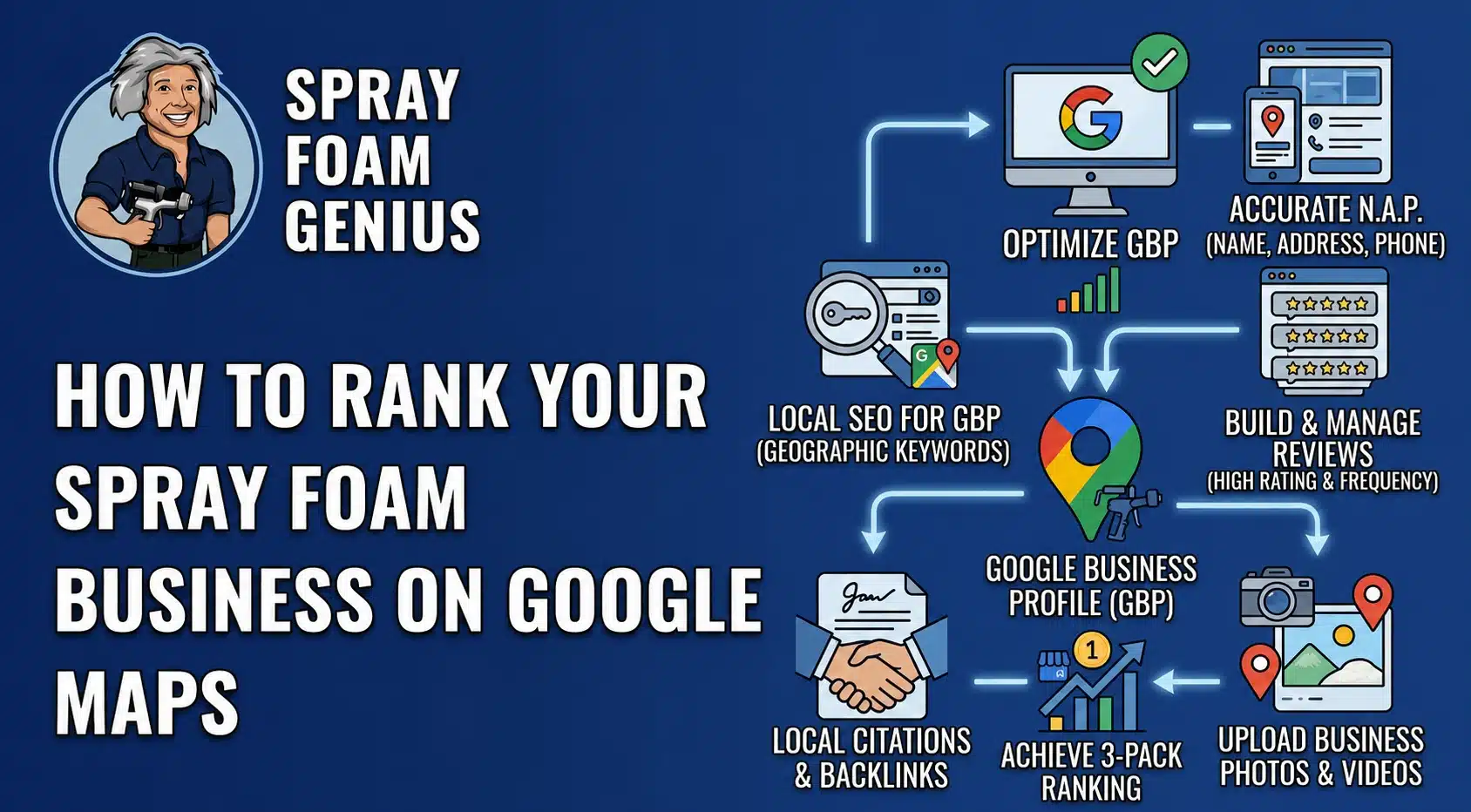
- Google Business Profile optimization is the single highest-leverage SEO action, yet most profiles are incomplete
- Competitors publishing dedicated city service pages consistently outrank those with a single generic page
- Page one contractors receive ~92% of all search traffic; page two receives less than 6% (Backlinko)
- Reviews and backlinks are two of Google’s top 3 ranking signals; most insulation sites are weak on both
- Sites not updated in 6+ months are deprioritized in Google’s crawl frequency and rankings
The Real Problem Most Insulation Contractors Don’t See
Most contractors assume Google ranks websites based on how professional they look. In reality, Google evaluates hundreds of technical and behavioral signals invisible to the untrained eye.
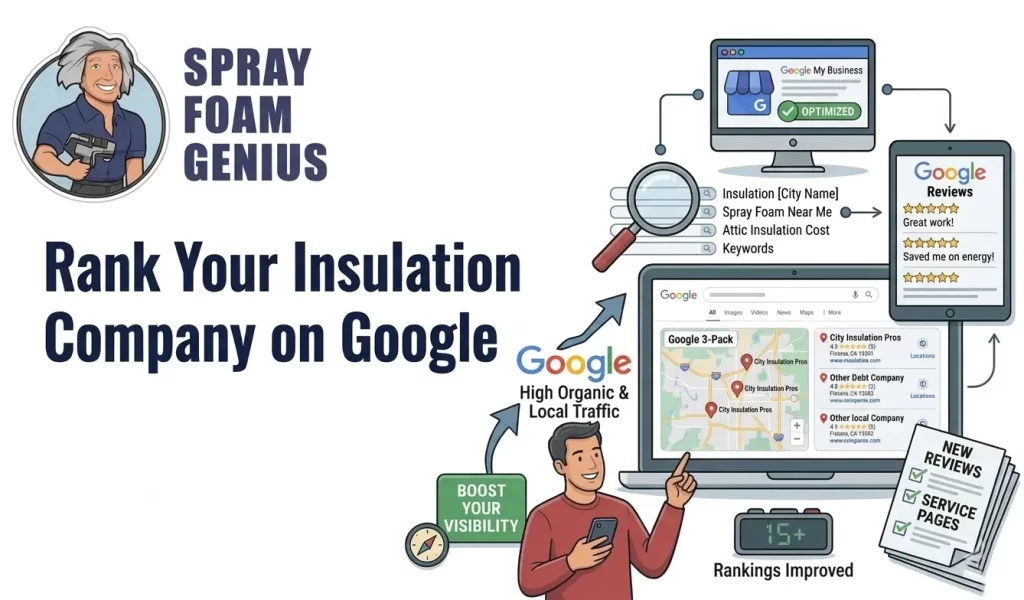
Here is how customers actually search: “spray foam insulation contractors near me,” “blown-in insulation [city],” “attic insulation cost,” and “best insulation company [zip code].” According to Think with Google, near-me searches have grown over 900% in the last two years. Contractors optimize for broad terms like “insulation services” while customers search hyper-locally with specific intent. Without matching that intent, rankings stall regardless of how much the website costs.
Key Insight: Google does not rank websites; it ranks relevance. A simpler site with stronger local signals will outrank a polished but unoptimized site every time.
Understanding how Google evaluates relevance, authority, and local intent is critical for improving rankings. Learn more in this SEO guide for spray foam contractors.
Where Insulation Leads Actually Come From
The combined organic and local pack share, roughly 65% of all leads, comes entirely from free Google visibility. SEO is not optional; it is the dominant lead channel for insulation businesses.
Top Reasons Insulation Contractors Struggle to Rank
1. Incomplete Google Business Profile. Missing service categories, no photos, no posts, and no defined service area all suppress Local Pack visibility.
2. No Location-Specific Pages. A single “Service Areas” page listing 20 cities does almost nothing. Google needs dedicated pages targeting “Spray Foam Insulation in [City]” with unique content for each location.
3. Slow Mobile Experience. Google uses Core Web Vitals as ranking signals.
4. Zero Backlink Strategy. Competitors on page one often have 30–100+ relevant referring domains from suppliers, associations, and local press. Most insulation sites have fewer than 10.
5. No Review System. Review velocity matters, 5 new reviews per week beats a business that collected 100 reviews two years ago and stopped entirely.
6. Thin Content. A 5-page website cannot compete with a site that has 40 pages of keyword-targeted content. Service pages under 500 words rarely rank competitively.
What Successful Contractors Do Differently
The SEO Results Framework
SEO vs. Paid Ads: What Most Contractors Get Wrong
The ideal strategy combines both PPC fills the pipeline while SEO builds a permanent asset. Contractors who rely on ads alone are renting visibility. SEO means owning it.
The Biggest Misconception
A beautiful website that cannot be found is a billboard in a forest. SEO drives traffic. Design drives conversion. Both matter, but in that order. Investing in a costly redesign without fixing SEO is like renovating a store nobody can find.
Mindset Shift: Stop asking “Does my website look professional?” Start asking: “Am I showing up on page one for what my customers are searching right now?”
Ready to Outrank Your Competition? Start With a Genius Audit.
Spray Foam Genius Marketing specializes exclusively in helping spray foam and insulation contractors dominate local Google rankings. A Genius Audit covers GBP health, citation consistency, keyword gaps, page speed, content strategy, and backlink opportunities with a clear, prioritized action plan.
The insulation contractors ranking on page one didn’t get there by accident and neither will you.
Frequently Asked Questions
How long does SEO take for an insulation contractor?
Google Business Profile improvements show within 4–8 weeks. Significant organic ranking gains for competitive city and service keywords typically take 3–6 months of consistent effort. SEO compounds, a 12-month investment produces far better ROI than a short campaign that stops.
What is the most important first SEO step?
Start with the Google Business Profile, it is free and directly impacts Local Pack visibility. Follow with a technical audit to fix speed and crawlability issues before investing in content or link building.
Why does a worse-looking competitor website rank higher?
Google cannot see how a website looks, it reads code, measures speed, and evaluates backlinks, content relevance, and local citations. A plain site loading in 1.5 seconds with 80 backlinks will outrank a visually impressive site loading in 6 seconds with three generic pages.
Do Google Ads improve organic rankings?
No. Google maintains a strict separation between paid advertising and organic search rankings. Ad spend has zero direct influence on organic position.
How many reviews are needed to rank in the Local 3-Pack?
It depends on local competition. Smaller markets may require 25–40 reviews; larger metro areas often see top businesses with 100–300+. Review recency and velocity matter more than total volume, consistent new reviews signal ongoing customer activity to Google.