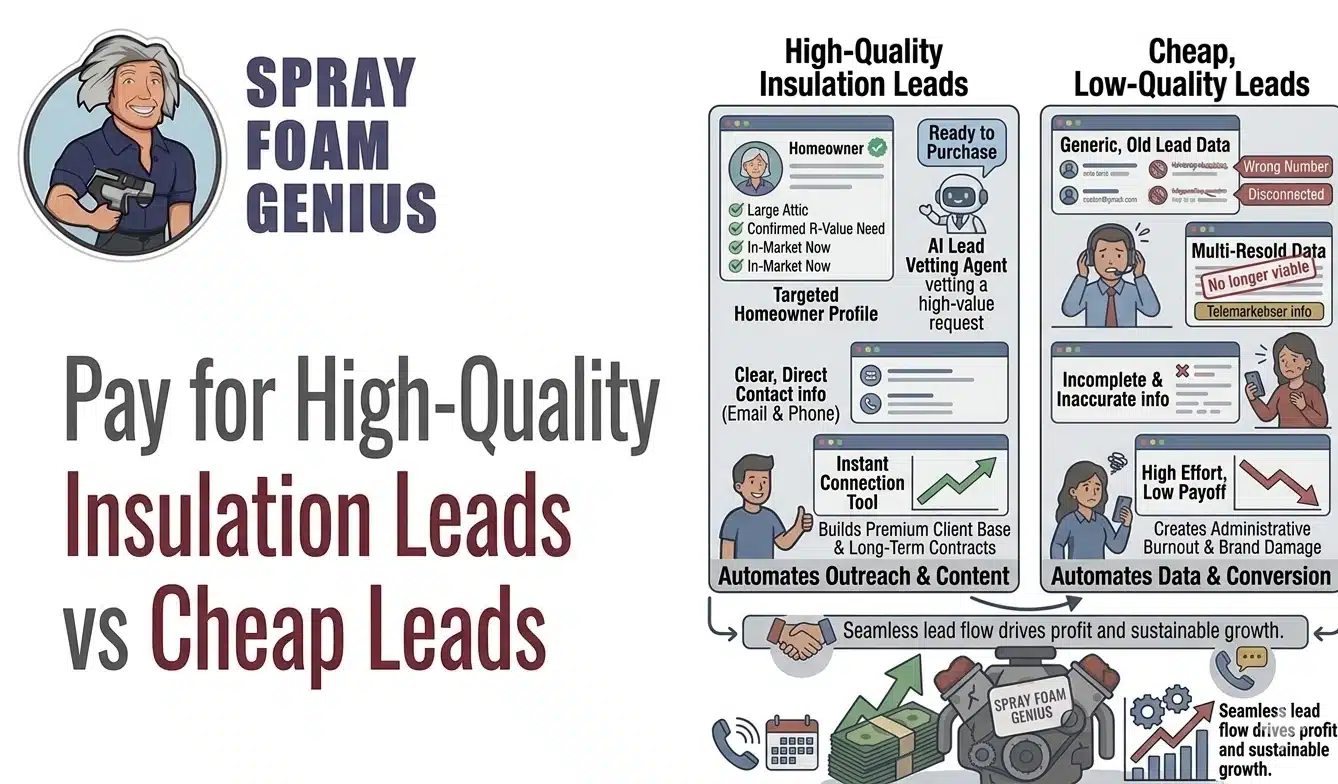

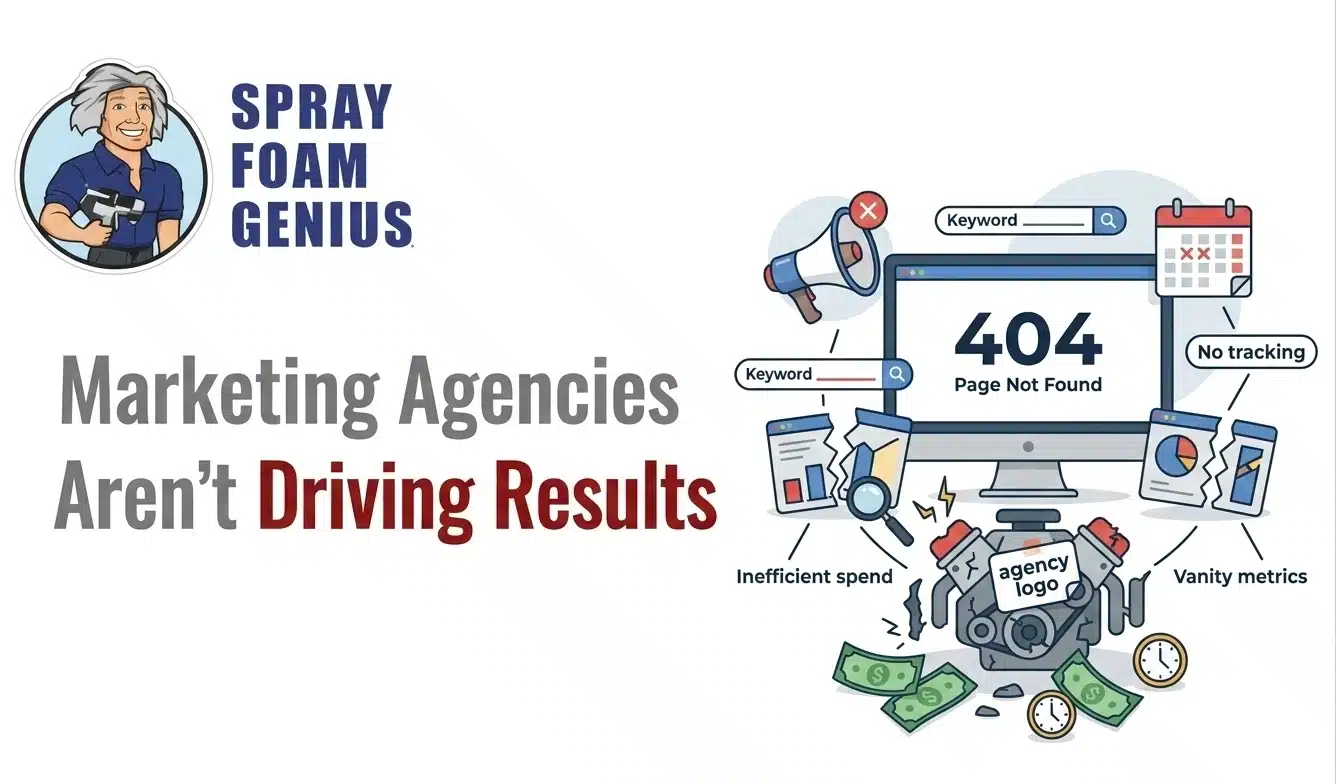
Many insulation contractors assume that hiring a marketing agency automatically means more quality leads, steady calls and more revenue. When it does not happen, the cause is usually one of two things: the agency is applying generic “home services” tactics that do not fit how insulation buyers search and decide, or the contractor’s business is not set up to catch and close the leads. Often it is both.
This article covers why agencies often fall short for insulation contractors, how insulation customers actually search, which channels tend to produce better leads, and what to ask your agency. As an agency ourselves, we know these problems from the inside, and we would rather you see them clearly than learn them the expensive way.
The Short Version
- Generic keywords and messaging attract browsers, not buyers.
- Local search and a strong Google Business Profile are central to how many local service businesses get found.
- Clicks, impressions and followers are not leads. Calls, booked jobs and revenue are.
- Leads that are not followed up quickly are often lost, no matter how well the ads perform.
- Content that answers cost, savings and material questions builds trust before the first call.
How Insulation Buyers Actually Search and Decide
Homeowners and business owners looking for insulation are rarely just browsing. They weigh cost, energy savings, materials, credibility and sometimes rebates before choosing a contractor. Their searches often sound like:
- “spray foam insulation cost near me”
- “fiberglass vs spray foam insulation benefits”
- “insulation contractors with financing options”
- “attic insulation energy savings calculator”
These are very different from a broad term like “insulation service.” Agencies that optimize only for general keywords can bring in traffic that has little purchase intent. Buyers also move through stages, and good marketing speaks to each one:
- Awareness: “What type of insulation saves the most money?”
- Consideration: “How much does insulation cost?”
- Decision: “Insulation contractors near me with financing and warranties.”
Where Good Insulation Leads Come From
Insulation leads rarely come from a single channel. Contractors who do well tend to combine local search, ads, content and reputation.
Local search and Google Business Profile
For service-area businesses, a complete and accurate Google Business Profile matters. Google says businesses with complete and accurate information are more likely to show up in local search results, and its local ranking guidance lists relevance, distance and prominence as the factors behind local results. It also says there is no way to request or pay for a better local ranking.
Paid search (Google Ads)
Paid search can deliver visibility quickly, but only if keywords match buyer intent and landing pages are built to convert. Generic campaigns spend budget on low-intent searches. See our guide to Google Ads for insulation businesses for what a well-run account looks like.
Reviews and reputation
Insulation is a trust-driven purchase. People want to know whether others were satisfied, whether the crew showed up on time, and whether the cost was justified by the results. Reviews answer all three.
Educational content and tools
Buyers do research. Content such as a spray foam versus fiberglass comparison, a guide to energy-efficiency incentives from sources like the IRS and Energy.gov, or a cost explainer builds authority and shortens the time between search and call.
Top Reasons Agencies Fail to Deliver Insulation Leads
1. Generic keywords and messaging
Targeting terms like “insulation contractor” draws browsers, not buyers. Messaging that lists services (“We do insulation!”) instead of solving problems (“lower your energy bills this winter”) also underperforms. Messaging that addresses cost, savings and financing tends to resonate more.
2. Poor local SEO execution
- An incomplete or inaccurate Google Business Profile
- Missing service-area targeting
- No optimization for “near me” and city-level searches
- One generic services page instead of pages for each service and location
3. No follow-up or lead nurturing
Most homeowners do not book on the first contact. Agencies often deliver leads without helping make sure they turn into calls and booked jobs. Basic systems include SMS autoresponders, email follow-ups and CRM reminders (see HubSpot’s overview of CRM).
4. Inefficient ad targeting
- Geographic targeting that is too broad
- No exclusions for irrelevant audiences and searches
- Ads that are not matched to where the buyer is in the decision
5. Not enough educational content
Without content that answers buyer questions about cost, energy savings and incentives, campaigns struggle to turn traffic into leads.
6. Ignoring reviews and reputation
Failing to ask for and respond to reviews erodes trust. Reviews also give potential customers a reason to choose you over a similar-looking competitor.
7. Focusing on vanity metrics
Impressions, clicks and rankings look good in a report but say nothing about phone calls, booked jobs or revenue. Some agencies sell dashboards full of these numbers (HubSpot covers vanity metrics). Insist on call and lead tracking.
8. A short-term mindset
SEO and reputation work compound over time. Contractors who expect instant results often cancel before momentum builds, and an agency that overpromises makes this more likely.
9. Misaligned expectations
Contractors assume the agency understands insulation. Agencies assume the contractor understands digital metrics. Without shared definitions of success, money gets wasted.
10. Problems inside the business
Sometimes the issue is not the agency at all. Slow response, no estimate follow-up or a full schedule can undermine any campaign. See When Not to Hire a Marketing Agency for Insulation Contractors for the readiness checklist.
Short-Term and Long-Term Marketing
Different tactics pay off on different timelines, and a good plan uses both.
Short-term: paid search and paid social
Pros: quick visibility and easier attribution. Cons: can be expensive, traffic can be low-intent without careful targeting, and leads stop when the budget stops.
Long-term: SEO, reviews and content
Pros: builds trust and sustainable visibility that does not charge per click. Cons: takes longer to show results and needs ongoing effort. Search Engine Journal compares the two approaches.
What Contractors Who Get Results Tend to Do Differently
Successful contractors treat digital marketing as a system, not a one-off campaign. A practical framework looks like this:
- Visibility: optimize your Google Business Profile, target high-intent local keywords and use targeted paid search.
- Engagement: publish educational guides, answer common buyer questions and add cost and savings tools.
- Lead capture: use clear forms, click-to-call and text buttons, and tools such as heat maps and form analytics.
- Follow-up: automate text and email replies, and use CRM reminders.
- Conversion: book on-site consultations and track which channels produce booked jobs.
- Retention and referrals: ask for reviews and encourage referrals after each job.
The ones who struggle tend to hire generic agencies, chase traffic instead of outcomes, ignore reviews, and never measure calls or revenue. The ones who do better target high-intent searches, build local visibility and reviews, track real business outcomes, and invest in content that educates.
Questions to Ask Your Agency
Instead of asking which agency can run your ads, ask which agency can generate qualified insulation leads consistently and track calls through to booked jobs and revenue. Specifically:
- Which keywords are you targeting, and why do they match buyer intent in your service area?
- How are phone calls and forms tracked back to their source?
- What do you report each month, and does it include booked jobs?
- What follow-up system covers leads after they come in?
- Who owns the accounts, website and data?
For a full set of questions and red flags, see our guide to choosing a spray foam marketing agency.
Get a Second Opinion
If your current agency is not producing booked jobs and you are not sure why, Spray Foam Genius Marketing offers a free marketing audit that looks at your website, local search presence and lead tracking. Call USA: 877-840-3626 or email info@sprayfoamgeniusmarketing.com.
Frequently Asked Questions
Which channel generates the most qualified insulation leads?
It depends on your market, but for many local service businesses, local search through Google Business Profile and organic results is a major source of qualified calls. It works best alongside reviews, a good website and some paid search.
How important are customer reviews for insulation contractors?
Very. Reviews help potential customers decide whether to trust you, and Google lists prominence, which can include review count and ratings, as a local ranking factor. Respond to every review professionally.
Which search terms work best for insulation marketing?
Specific, high-intent searches such as “spray foam insulation cost near me” or “insulation contractors with financing” usually signal a buyer closer to a decision than broad terms like “insulation service.”
How often should insulation contractors update their website content?
There is no magic schedule. Review your key pages regularly, keep service, cost and contact information current, and add new content that answers questions your customers actually ask.
Are paid ads worth it for insulation contractors?
They can be, if they target high-intent phrases, use geographic limits, send traffic to landing pages built to convert, and are paired with fast follow-up and call tracking.
How do you know if your agency is the problem?
Check whether calls and forms are tracked to a source, whether reports show booked jobs, whether your team answers and follows up quickly, and whether the plan fits how buyers search. If you cannot answer these, start there.