
Direct Answer:
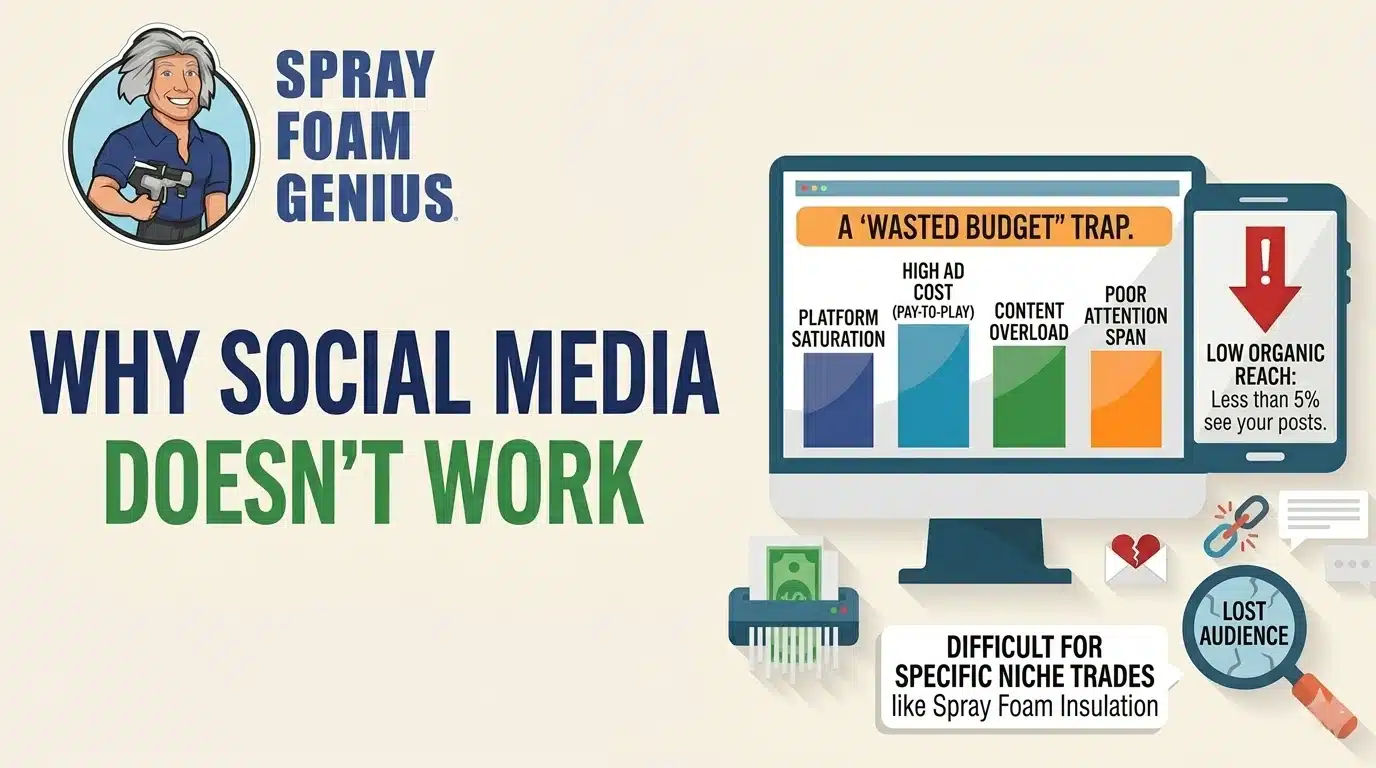
Most insulation companies fail with social media because it attracts the wrong type of engagement, likes and shares from homeowners who aren’t ready to buy, rather than actionable leads. Social media platforms such as Facebook and Instagram are excellent for brand awareness, but for a service-based, high-ticket industry like insulation, a targeted, conversion-driven approach using localized search marketing, referral networks, and direct outreach consistently delivers better results (HubSpot).
TLDR
- Social media is better for branding than lead generation for insulation contractors (Statista).
- Paid shared-lead services often produce low-quality prospects with poor conversion rates (HomeAdvisor).
- Local SEO, Google Business Profile optimization, and targeted Google Ads yield higher ROI (Forbes).
- Referrals and strategic partnerships outperform cold social media engagement (Harvard Business Review).
- Educational content, like case studies or ROI calculators, converts better than generic posts (Energy.gov).
- Tracking conversions with CRM tools ensures marketing dollars are spent efficiently.
- Multi-channel strategies combining SEO, PPC, and email nurture campaigns maximize lead flow.
Why Social Media Falls Short for Insulation Companies
Low-Intent Engagement
Social media users are typically in the research or inspiration phase, not actively seeking insulation services. According to HubSpot, only 16% of social media users engage with posts intending to make a purchase within the next month. This low intent leads to high engagement but few actionable leads.
Because most social media users are still in the research phase, contractors need a strategy focused on trust-building and long-term engagement. Learn more in this social media strategy for spray foam contractors.
Shared Leads Are Expensive and Ineffective
Many insulation companies rely on shared lead services. These leads are sold to multiple contractors, creating fierce competition and lower conversion rates. Data from HomeAdvisor indicates the average conversion rate for shared leads is under 10%.
Poor Targeting and Messaging
Insulation services are often technical and regional. Generic social media posts fail to communicate ROI or energy savings effectively. Posts about “eco-friendly insulation” or “winter savings tips” may generate engagement but rarely prompt inquiries.
What Actually Works for Insulation Contractors
1. Local Search Optimization
Google searches for “insulation contractors near me” convert at a much higher rate than social media interactions. Optimizing your Google Business Profile and local SEO ensures you appear at the top for these high-intent searches.
Actionable Steps:
- Claim and verify your Google Business Profile.
- Add high-quality images, customer reviews, and detailed service descriptions.
- Use local keywords: e.g., “spray foam insulation in Dallas, TX.”
2. Paid Search Campaigns (PPC)
Google Ads targeted to specific service areas ensures your ad dollars reach people ready to buy. Unlike social media, PPC campaigns target users actively searching for insulation services.
Tips for Maximum ROI:
- Focus on high-intent keywords: “attic insulation installation” or “spray foam contractors near me.”
- Use call-only ads for mobile users who can immediately contact your business.
- Track conversions via a CRM or Google Ads integration.
3. Referral Programs and Partnerships
Contractors who invest in referral programs or partner with builders and HVAC companies consistently outperform social media marketing. Referrals carry a trust factor, resulting in conversion rates up to 50% higher than cold leads (Harvard Business Review).
Implementation:
- Offer referral bonuses to past customers.
- Partner with local home builders, HVAC companies, and energy auditors.
- Track and reward referrals using CRM software.
4. Educational and Conversion-Oriented Content
Rather than posting generic social media content, create assets that educate and demonstrate ROI. Case studies, cost calculators, and energy savings comparisons build credibility and attract qualified leads (Energy.gov).
Examples:
- “How Spray Foam Insulation Saves $1,200 Annually on Energy Bills”
- ROI calculators embedded on your website for quick lead capture
- Video testimonials highlighting completed projects
5. Multi-Channel Approach
High-performing insulation contractors combine SEO, Google Ads, email campaigns, and targeted outreach rather than relying on a single social media platform.
6. Track, Measure, and Optimize
Without proper tracking, marketing efforts can’t be optimized. Tools like HubSpot, Salesforce, or Jobber allow contractors to see which channels produce actual paying customers.
Key Metrics to Track:
- Cost per lead
- Lead-to-customer conversion rate
- Average deal size
- Customer acquisition cost (CAC)
Actionable Strategies for Insulation Contractors
- Audit your current lead sources; identify high-cost, low-return channels.
- Prioritize Google Business Profile, SEO, and PPC campaigns over social media.
- Build a referral program with past clients and local partners.
- Develop educational content that demonstrates energy savings and ROI.
- Implement CRM software to track leads and measure conversion.
- Consider social media for branding only; use posts to share case studies, before-and-after project photos, and customer testimonials.
- Reallocate ad spend from generic social media campaigns to targeted PPC and local search ads.
Ready to Turn Leads Into Paying Customers?
Stop wasting time and money on social media campaigns that don’t convert. At Spray Foam Genius Marketing, we specialize in helping insulation contractors generate high-quality, ready-to-buy leads through proven strategies like Google Ads, local SEO, and referral programs.
Take control of your marketing and start seeing measurable results today. Our experts will audit your current campaigns, identify gaps, and provide an actionable plan tailored to your business.
Don’t wait; every day lost is potential revenue missed.
Contact Info:877-840-FOAM | 844-741-FOAMinfo@sprayfoamgeniusmarketing.com
FAQs
Can social media ever work for insulation companies?
Yes, but primarily for brand awareness and credibility. Lead generation through social media is low compared to local search marketing.
How important are online reviews?
Reviews are critical. Studies show 90% of consumers read reviews before hiring a service, and positive reviews directly influence Google search rankings (Google Business Profile).
What content converts best for insulation services?
Case studies, ROI calculators, video testimonials, and project before-and-after photos. These demonstrate tangible value and energy savings (Energy.gov).
Should insulation contractors advertise on Facebook or Instagram?
Only for branding and awareness campaigns. Paid search and referral strategies yield higher-quality leads (HubSpot).
Sources:
- HubSpot. “State of Marketing 2023.” https://www.hubspot.com/state-of-marketing
- Google Business Profile Help. https://support.google.com/business/answer/3038063
- Forbes. “Why Local SEO Matters for Small Business.” https://www.forbes.com/councils/forbesbusinesscouncil/2025/10/01/your-community-is-your-best-local-seo-strategy-the-power-of-hyperlocal-entities/
- Energy.gov. “Insulation Savings Calculator.” https://www.energy.gov/energysaver/insulation
- Harvard Business Review. “The ROI of Customer Referrals.” https://hbr.org/2024/06/research-customer-referrals-are-contagious
- Statista. “Social Media User Intent Data 2023.” https://www.statista.com/statistics/427336/social-media-influence-purchase/