
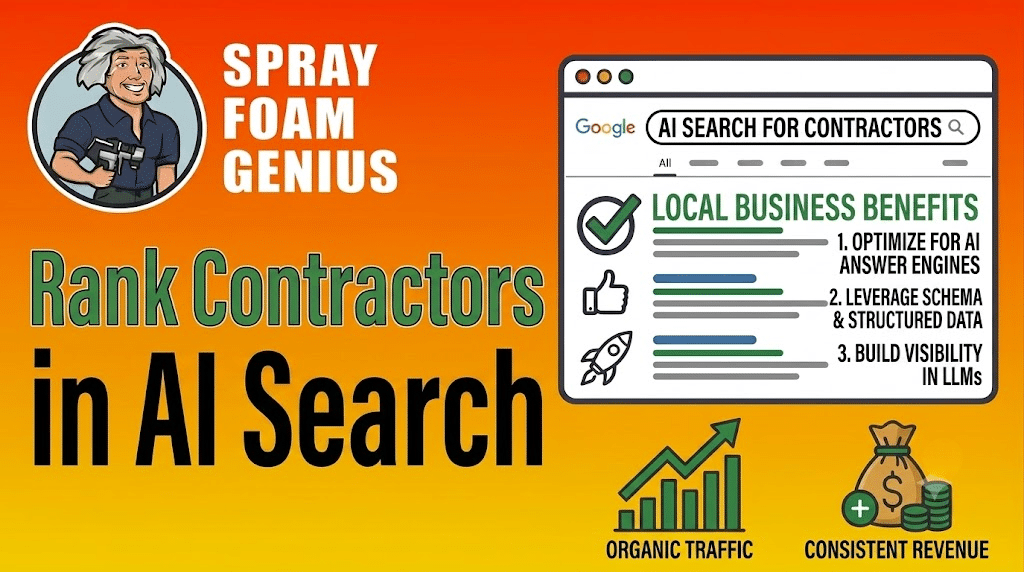
Google Search is changing, and insulation contractors need to pay attention. Homeowners are no longer just typing “spray foam insulation near me” and scrolling through a list of websites. They’re asking detailed questions like:
- Is spray foam insulation worth the money?
- Should I use blown-in insulation or spray foam in my attic?
- What type of insulation is best for an older home?
- Who is the best spray foam insulation contractor near me?
- How much does attic insulation cost in my area?
Google increasingly answers questions like these with AI Overviews and its newer conversational experience, AI Mode. Both appear directly in search results and can link to the websites that support the answer. For insulation companies, that’s another chance to get in front of homeowners before they ever call a contractor.
Because we specialize in marketing for spray foam and insulation contractors, we audit contractor websites and Google Business Profiles regularly. In the four spray foam and insulation contractor audit calls we recorded between early September and mid October 2026, every one turned up a Google Business Profile problem: a profile that was missing from the map results, incomplete, inconsistent with the website, or short on reviews. Three of the four also had location page problems, either no location pages at all or the same page repeated for every town. That is a small sample, but it lines up with what Google’s guide says matters: accurate information and content that is useful and specific to the place you serve.
So how do you get your insulation company included in those answers? Google answered that directly in its official guide, Optimizing your website for generative AI features on Google Search. The biggest takeaway is surprisingly simple:
You don’t need a completely new SEO strategy to appear in Google AI Overviews. You need a better version of the SEO fundamentals that already matter.
Here’s what that means for spray foam contractors, fiberglass installers, blown-in insulation companies, and other insulation businesses.
What Are Google AI Overviews?
Google AI Overviews are AI-generated summaries that appear in certain search results. Instead of only showing a list of websites, Google may generate an answer that pulls together information from multiple sources.
Imagine a homeowner searching: “Is spray foam insulation better than blown-in insulation for my attic?” Google might generate an answer covering:
- The differences between spray foam and blown-in insulation
- Typical installation costs
- Air sealing and energy efficiency
- Moisture considerations
- Which insulation type may suit different attic conditions
Alongside that answer, Google may link to relevant websites: manufacturers, industry publications, educational resources, and insulation contractors. The opportunity is to become one of the sources Google chooses to feature.
Appearing in an AI Overview doesn’t guarantee a click or an estimate request, though. Your content still has to give homeowners a reason to take the next step.
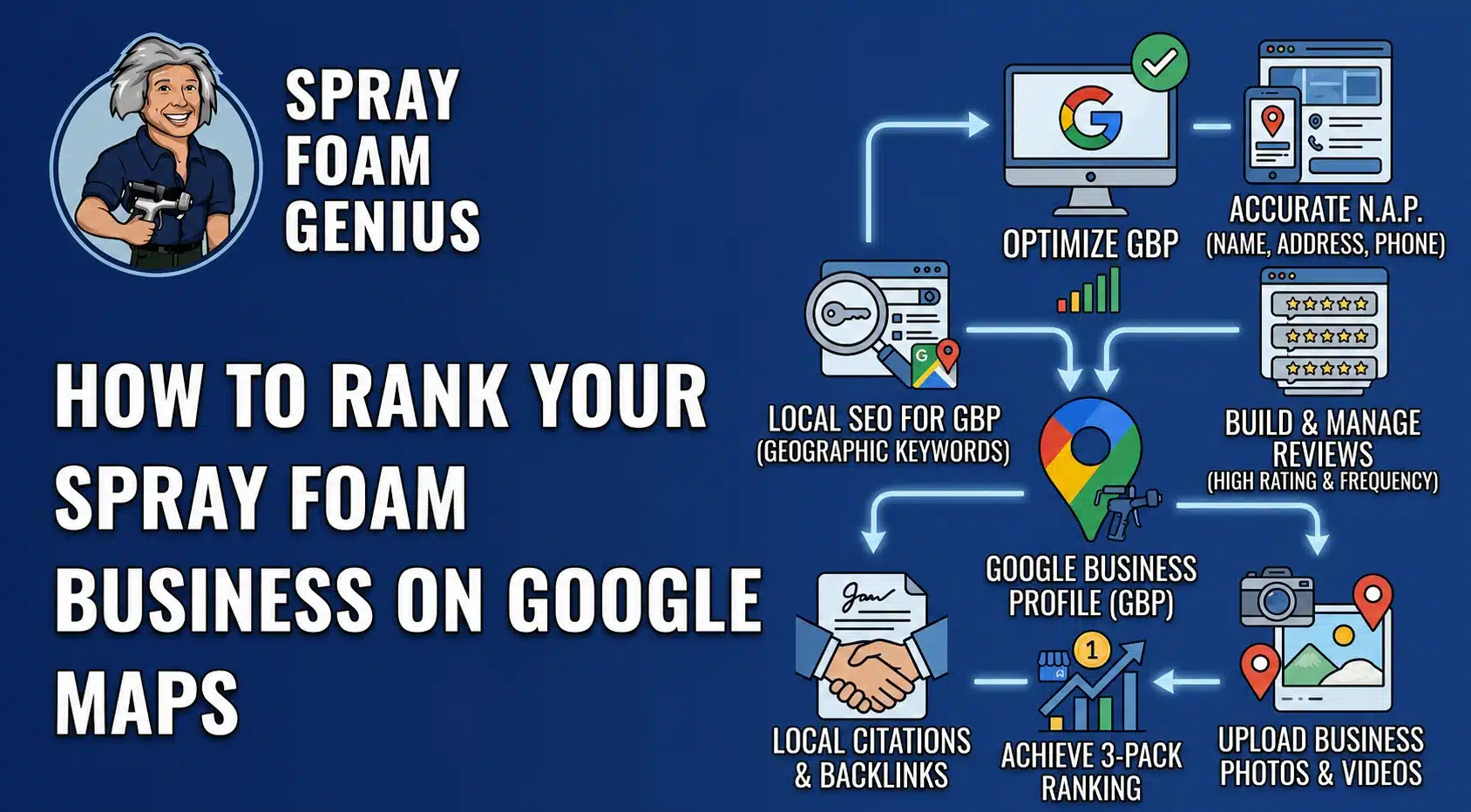
Related reading: How to Rank Your Spray Foam Business on Google Maps
How Does Google Decide Which Insulation Websites Appear in AI Overviews?
Google’s AI search experiences run on the same core ranking and quality systems as traditional Google Search (see Google’s guide). Two concepts from the guide are especially useful to understand.
1. Google’s AI Pulls From Relevant Websites
Google uses a technique it calls grounding (retrieval-augmented generation): before the AI writes an answer, Google’s search systems retrieve relevant, current pages from its index, and the answer links to those pages as sources. That means your website needs to be accessible, understandable, and genuinely useful.
A website with only a homepage, a short services page, and a contact form may not give Google enough to answer detailed homeowner questions. Compare that with a website that explains:
- When spray foam insulation makes sense
- When blown-in insulation may be a better option
- How insulation installation costs are calculated
- What homeowners should know about attic ventilation
- How different insulation materials perform in various applications
The second website has far more opportunities to answer specific questions. That doesn’t mean more pages automatically rank better. It means content that genuinely helps homeowners understand their options.
2. Google Uses Query Fan-Out to Explore Related Questions
Google’s guide describes query fan-out: the AI runs several related searches behind the scenes to answer one complicated question. Take a homeowner who asks, “Should I install spray foam or fiberglass insulation in my attic?” Google might also look into:
- Spray foam insulation costs
- Fiberglass insulation R-values
- Air sealing performance
- Moisture and condensation risks
- Attic insulation installation methods
- Climate-specific insulation recommendations
Each of those related searches is another chance to be cited. A contractor with a detailed attic insulation page, supported by solid articles on cost, R-value, moisture, and real projects, has more ways to show up than one with a single short services page. Your website shouldn’t just list what you offer. It should answer the questions homeowners ask before they decide who to hire.
Is Traditional SEO Still Important for Insulation Contractors?
Yes, and Google’s guidance makes the case for it. Some marketing companies now sell services under new names:
- AEO: Answer Engine Optimization
- GEO: Generative Engine Optimization
- AI SEO: Search optimization focused on AI-powered search experiences
These terms describe efforts to improve visibility in AI-generated answers. Google’s position is that optimizing for its AI search features is still SEO, and it recommends checking any third-party “AEO” or “GEO” advice against its guidance on evaluating third-party SEO advice.
The fundamentals still matter:
- Helpful, original website content
- Crawlable and indexable pages
- Clear website organization
- Accurate business information
- Strong local relevance
- A good user experience
For insulation companies, that means investing in a website that demonstrates real industry knowledge rather than chasing every new AI marketing trend.
What an Insulation Contractor Can Do This Month
None of this requires special files or a new agency. These steps are the ones we would start with, and each one also helps homeowners who never touch an AI tool.
- Write pages that answer the real questions. Open each service page with a plain answer to the homeowner’s question, then add the detail underneath. Pull the questions from your own estimate calls and emails. Google’s guide says you do not need special formatting, chunking, or rewriting for its AI features.
- Show what you know from the job site. Google’s guide puts the most weight on unique, non-commodity content and firsthand experience. Real projects, honest cost factors, and what you see in homes in your area are things a generic article cannot copy.
- Keep your Google Business Profile accurate. Hours, service areas, categories, photos, and replies to reviews all help homeowners decide, and they are part of local search.
- Keep your business name, address, and phone number the same everywhere. Your website, directories, and review sites should match.
- Make sure Google can crawl and index your pages. A page Google cannot index cannot be used as a source.
- Do not mass-produce pages. Google’s guide says creating pages for every query variation primarily to manipulate rankings or AI responses violates its scaled content abuse policy. One strong page beats ten near-copies.
- Check Search Console. Google’s guide points to a Generative AI performance report there, so you can see how your content shows up in Google’s AI features instead of guessing.
What About ChatGPT, Perplexity, Gemini and Claude?
Google’s guide covers Google Search only. The companies behind other AI tools do not publish exact rules for how they choose which businesses to mention, and no one can guarantee a mention in any of them. The same basics help: clear pages, accurate listings, and honest reviews. We cover that side separately in how spray foam companies get recommended by AI search.
Where Should the Money Go?
We do not give a percentage split between SEO and “AI optimization,” because any number would be made up and Google does not treat them as separate. If your site is thin, outdated, or missing core service pages, fix that first. If the basics are solid, invest in content only you can write. If leads are inconsistent right now, paid search can cover the gap while organic work builds. Be wary of anyone who guarantees placement in AI answers, sells a special file or markup as required, or claims inside access to Google’s AI systems.
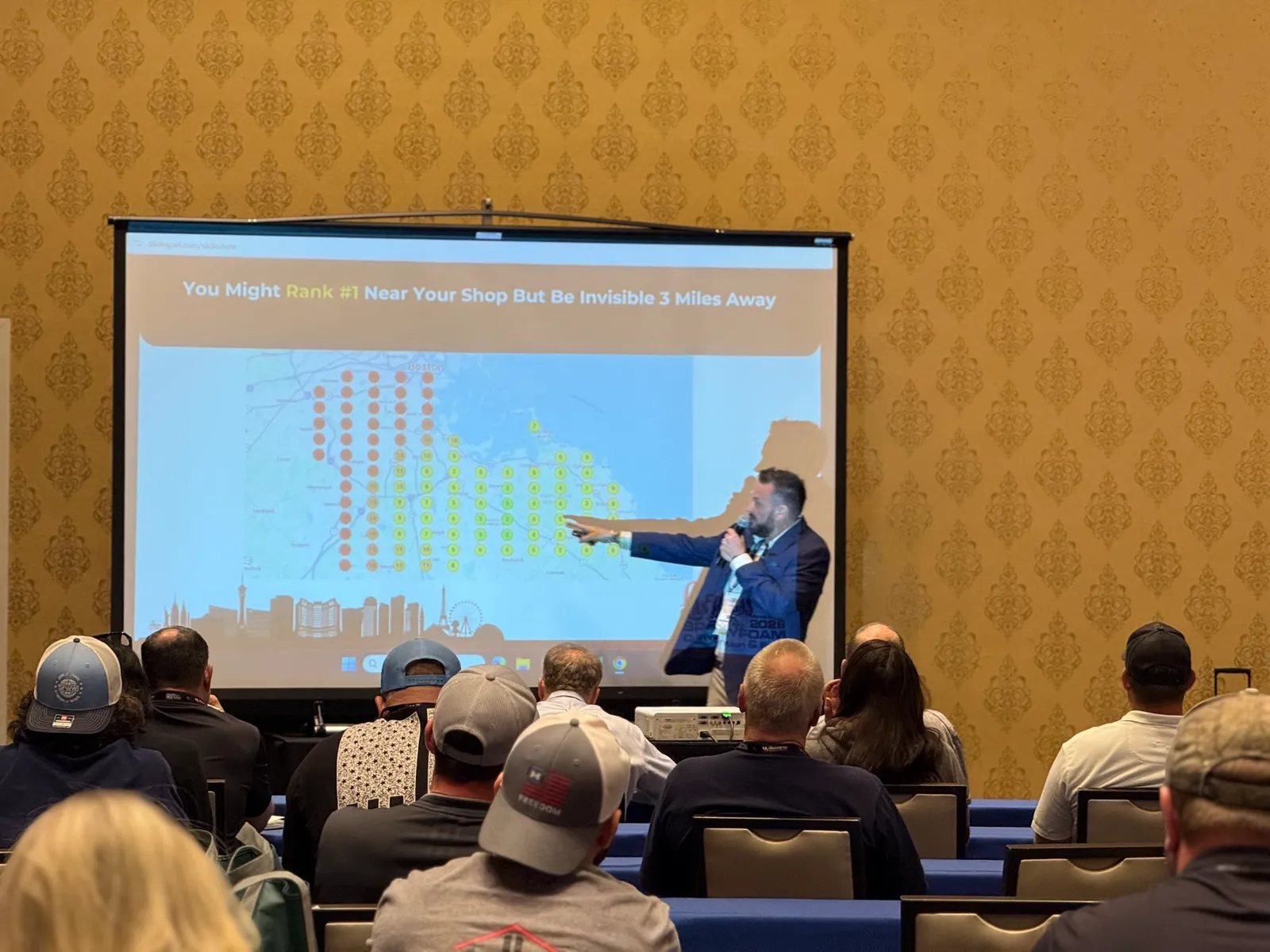
If you want to see where your own company stands, start with our free Market Visibility Audit. It shows how your business appears on Google Maps across your service area, which is where most local insulation searches begin.
Frequently Asked Questions
Do insulation contractors need a different strategy for Google AI Overviews?
No. Google says its AI features are built on core Search ranking and that optimizing for them is still SEO. The same fundamentals apply: helpful, original content, crawlable pages, accurate business information, and a good experience for visitors.
What is the difference between SEO, AEO and GEO?
AEO (answer engine optimization) and GEO (generative engine optimization) are names some people use for trying to appear in AI-generated answers. For Google, Search’s own guide says this is still SEO. It is not a separate discipline.
Do I need schema markup or an llms.txt file to appear in AI Overviews?
No. Google’s guide says structured data is not required for its AI features, and that no special files or markup are needed. Schema can still be useful housekeeping for some rich results in regular search, but it is not the key to AI Overviews.
How long does it take to appear in a Google AI Overview?
No one can say. It depends on your competition, your website, your reviews, and the quality of your content, and no one can guarantee a mention. Be careful with anyone who promises a timeline.
Can a small insulation company compete with larger ones?
Yes. Google’s guide puts the most weight on unique content and firsthand experience, and a local contractor who does the work every day can write from that experience in a way a national site cannot.
How do I see whether my site appears in Google’s AI features?
Use the Generative AI performance report in Google Search Console, described in Google’s guide. For other AI tools, there is no equivalent report, so ask new customers how they found you.
Further reading
Official guidance from Google on the topics in this article: