Direct Answer
To audit your insulation company’s marketing spend effectively, you must break down every lead source, track cost per qualified lead and cost per job, eliminate low-intent channels (especially shared leads), and reallocate budget toward high-converting, trackable channels like local SEO, exclusive PPC campaigns, and referral systems. Most insulation contractors overspend on untracked ads and shared lead platforms, losing 20%–40% of potential profit due to poor attribution and wasted ad spend. A structured audit focused on ROI, conversion rates, and customer lifetime value will immediately reveal where to cut and where to scale.
TLDR
- Track every lead source with cost per booked job, not just cost per lead
- Shared leads often reduce close rates by 30%–60% due to competition
- Focus on conversion rate, not vanity metrics like clicks or impressions
- Cut underperforming PPC campaigns with high cost per acquisition (CPA)
- Invest in SEO and Google Business Profile for compounding returns
- Use marketing attribution models to understand true ROI
- Reallocate budget monthly based on performance data
- A 10% improvement in marketing efficiency can increase profit by 20%–30% in home services businesses
Why Auditing Marketing Spend Matters for Insulation Contractors
Many insulation companies operate with fragmented marketing systems. Money is spread across Google Ads, Facebook campaigns, lead brokers, and directory listings without clear visibility into what actually produces revenue.
According to the Harvard Business Review, companies that use data-driven marketing decisions are 5–6% more profitable than competitors that do not prioritize analytics. Yet in home services industries, including insulation, marketing budgets are still commonly managed by “gut feel” instead of structured tracking.
In insulation services, where average jobs range from $1,500 to $8,000 depending on scope, even small inefficiencies in marketing spend can cost tens of thousands annually.
For insulation companies aiming to connect marketing spend directly to revenue and improve ROI tracking, see this spray foam contractor digital marketing guide.
The Biggest Areas Where Marketing Spend Is Wasted
Before fixing anything, you need to identify leakage points. Most insulation companies lose money in predictable areas:
1. Shared Lead Platforms
Platforms like HomeAdvisor or Angi often sell the same lead to multiple contractors. This creates bidding wars and reduces close rates dramatically.
2. Poorly Optimized PPC Campaigns
Google Ads without proper negative keywords, location targeting, and conversion tracking often waste 20%–50% of budget.
3. Lack of SEO Investment
Businesses relying only on paid ads miss out on organic traffic that compounds over time. According to Moz, organic search drives over 50% of trackable website traffic in many industries.
4. Social Media Vanity Spending
Boosted posts without conversion tracking rarely produce insulation leads with purchase intent.
5. Untracked Referrals
Referrals are often the highest-converting leads, but many companies fail to track or incentivize them properly.
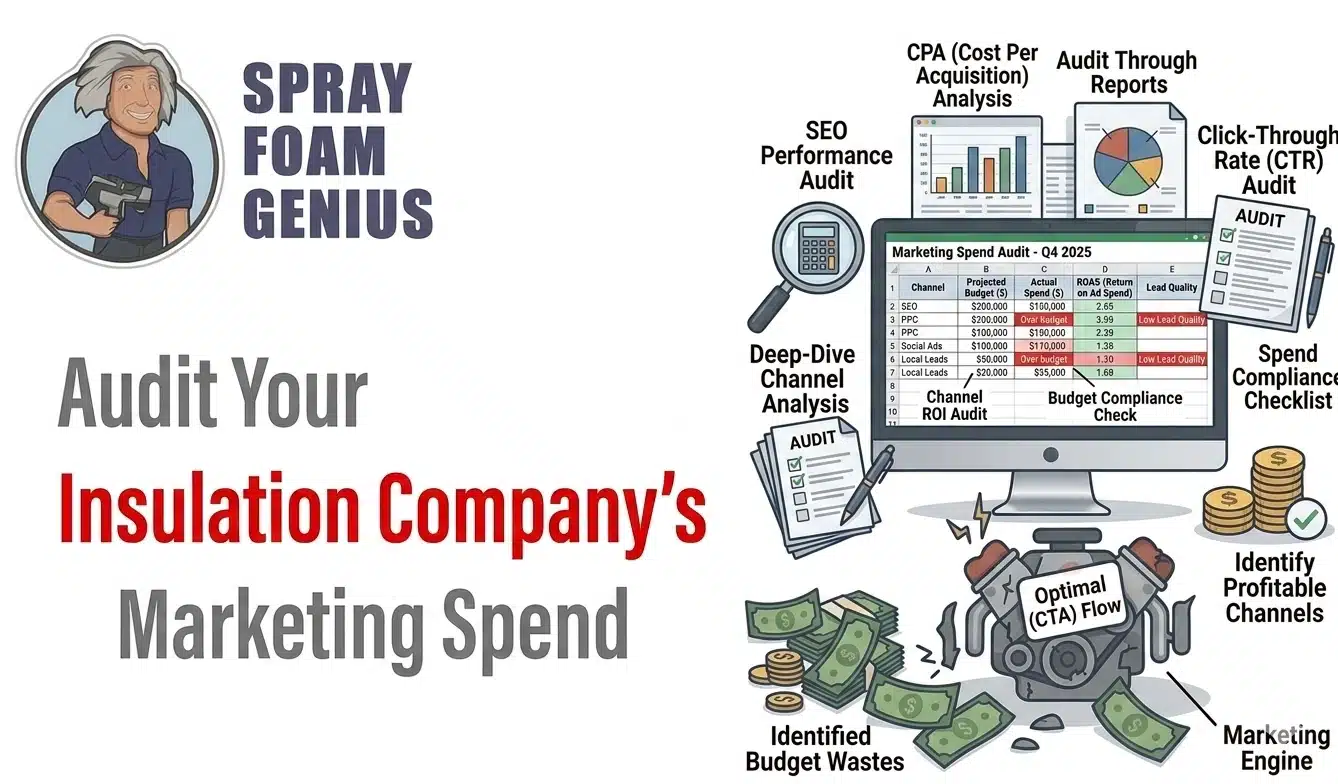
Step-by-Step Marketing Spend Audit Framework
To properly audit your insulation marketing, follow this structured approach:
Step 1: Map All Lead Sources
List every source:
- Google Ads
- Facebook Ads
- SEO / Organic search
- Referral network
- Shared lead platforms
- Direct calls
- Offline advertising
Step 2: Assign Real Costs
Include:
- Ad spend
- Agency fees
- Platform fees
- Staff time (estimated hourly cost)
Step 3: Measure Outcomes, Not Activity
Track:
- Cost per lead (CPL)
- Cost per appointment
- Cost per closed job
- Revenue per channel
Step 4: Calculate ROI
ROI formula:
ROI = (Revenue – Marketing Cost) / Marketing Cost × 100
According to Wikipedia’s marketing ROI overview, businesses that consistently measure ROI outperform those that do not by significant margins.
Step 5: Identify Underperformers
Any channel with:
- High CPL but low close rate
- Low-quality leads
- Poor follow-up conversion
Should be reduced or eliminated.
Marketing Channel Audit Table
| Channel | Typical Issue | Performance Indicator | Action |
| Google Ads | High CPC without conversion tracking | CPA above $150–$300 | Optimize keywords and landing pages |
| Shared Leads | High competition, low close rate | <10% close rate | Reduce or eliminate |
| SEO | Underfunded but high ROI potential | Slow early growth | Increase investment |
| Facebook Ads | Low intent traffic | Low appointment rate | Retarget only |
| Referrals | Undervalued channel | High close rate (30%–70%) | Incentivize aggressively |
Why Shared Leads Are Killing Your Profit Margins
Shared leads are one of the most damaging cost structures in insulation marketing.
Here is why:
1. Price Inflation
Multiple contractors bidding on the same lead increases acquisition cost artificially.
2. Low Intent Buyers
Many customers requesting shared quotes are price shopping, not quality-focused.
3. Reduced Conversion Rates
Industry benchmarks show shared lead close rates often fall below 10%, compared to 25%–45% for exclusive leads.
4. Brand Dilution
You are never building long-term customer relationships, only competing on price.
A report by Nielsen on advertising effectiveness shows that consistent brand exposure improves conversion likelihood by up to 60% over time.
Key Metrics Every Insulation Company Must Track
If you cannot measure it, you cannot improve it.
Essential KPIs
- Cost per lead (CPL)
- Cost per acquisition (CPA)
- Lead-to-close rate
- Average job value
- Marketing ROI per channel
- Customer lifetime value (CLV)
Example Benchmark Table
| Metric | Good Range | Warning Sign |
| CPL | $30–$120 | Above $150 |
| CPA | $200–$600 | Above $800 |
| Close Rate | 20%–40% | Below 15% |
| ROI | 300%+ | Below 150% |
Google Ads home services benchmarks typically show conversion rates between 2%–5% depending on targeting quality.
Optimization Strategies to Cut Waste and Increase ROI
1. Shift Budget to High-Intent Channels
Prioritize:
- Local SEO (Google Business Profile optimization)
- Branded search campaigns
- Referral programs
2. Fix Landing Pages First
Even strong ads fail if landing pages are weak.
Best practices:
- Fast loading (<3 seconds)
- Clear CTA above the fold
- Trust signals (reviews, certifications)
3. Implement Call Tracking
Tools like call tracking ensure you know which ad produced each call.
4. Use Negative Keywords Aggressively
Eliminate irrelevant searches such as:
- “DIY insulation”
- “free insulation kits”
- “jobs hiring insulation”
5. Improve Follow-Up Speed
Studies from HubSpot show that responding to leads within 5 minutes increases conversion likelihood by up to 21x.
Reallocating Budget for Maximum Growth
Once you identify waste, reallocate funds strategically:
Recommended Budget Split
| Channel | Allocation |
| Google Ads (optimized) | 30% |
| SEO | 25% |
| Referrals | 15% |
| Retargeting | 10% |
| Testing (new channels) | 10% |
| Shared Leads | 0%–5% max |
Over time, SEO and referrals should dominate your lead flow due to compounding returns.
Stop Guessing, Start Scaling
If your insulation company is spending money on marketing without clear ROI tracking, you are likely losing thousands each month in inefficiencies and low-quality leads. A structured audit can uncover hidden waste, improve close rates, and shift your business toward predictable growth.
At Spray Foam Genius Marketing, we specialize in helping insulation contractors eliminate wasted ad spend, optimize lead flow, and build high-converting marketing systems designed specifically for the insulation industry.
Contact us:
Phone: 877-840-FOAM | 844-741-FOAM
Email: [email protected]
Request a professional audit today to see exactly where your marketing dollars are going and how much profit you are losing each month.
FAQs
1. How often should insulation companies audit their marketing spend?
At minimum, quarterly. High-spend companies should review performance monthly to adjust budgets quickly and avoid wasted spend accumulation.
2. Are shared leads ever worth it?
Only in rare cases when volume is the priority over quality. However, most insulation companies see significantly lower ROI compared to exclusive leads or SEO-generated leads.
3. What is the most profitable marketing channel for insulation companies?
Local SEO combined with Google Business Profile optimization typically delivers the highest long-term ROI due to low acquisition cost and high trust.
4. How do I know if my PPC ads are wasting money?
If your cost per booked job exceeds your average profit margin or your conversion rate is below 3%, your campaigns likely need optimization.
5. How long does SEO take to generate insulation leads?
Typically 3–6 months for initial traction and 6–12 months for strong, consistent lead flow depending on competition and content quality.
Sources
- https://hbr.org/
- https://en.wikipedia.org/wiki/Return_on_investment
- https://moz.com/learn/seo/what-is-seo
- https://ads.google.com/home/resources/
- https://www.nielsen.com/insights/
- https://blog.hubspot.com/service/response-time
- https://www.google.com/analytics/learn/what-is-google-analytics/

Spencer is a Google ranking expert and SEO consultant who has helped businesses in the spray foam marketing industry achieve their online marketing goals. Spray Foam Genius Marketing has a proven track record of success, having achieved some impressive results for his clients.
- The Future of Search for Insulation Contractors Goes Beyond Google Rankings - September 30, 2026
- AI Search Is Changing How Homeowners Find Insulation Contractors - September 30, 2026
- Finding Affordable SEO Services for Your Insulation Business Growth - September 16, 2026