
Your true cost per job is what it costs you, in marketing and sales, to win one paying job. It is often called cost per acquired job, cost per acquisition (CPA) or cost per job (CPJ). It matters more than cost per lead because revenue comes from completed jobs, not inquiries. A channel with a cheap lead can still be expensive per job if few of those leads ever book.
This guide shows the formula, what to include, how it differs from cost per lead, and how to use it to decide where to spend. It is about the cost of winning a job, not the cost of materials and labor to do it, though you need both to know whether a job is profitable.
The Formula
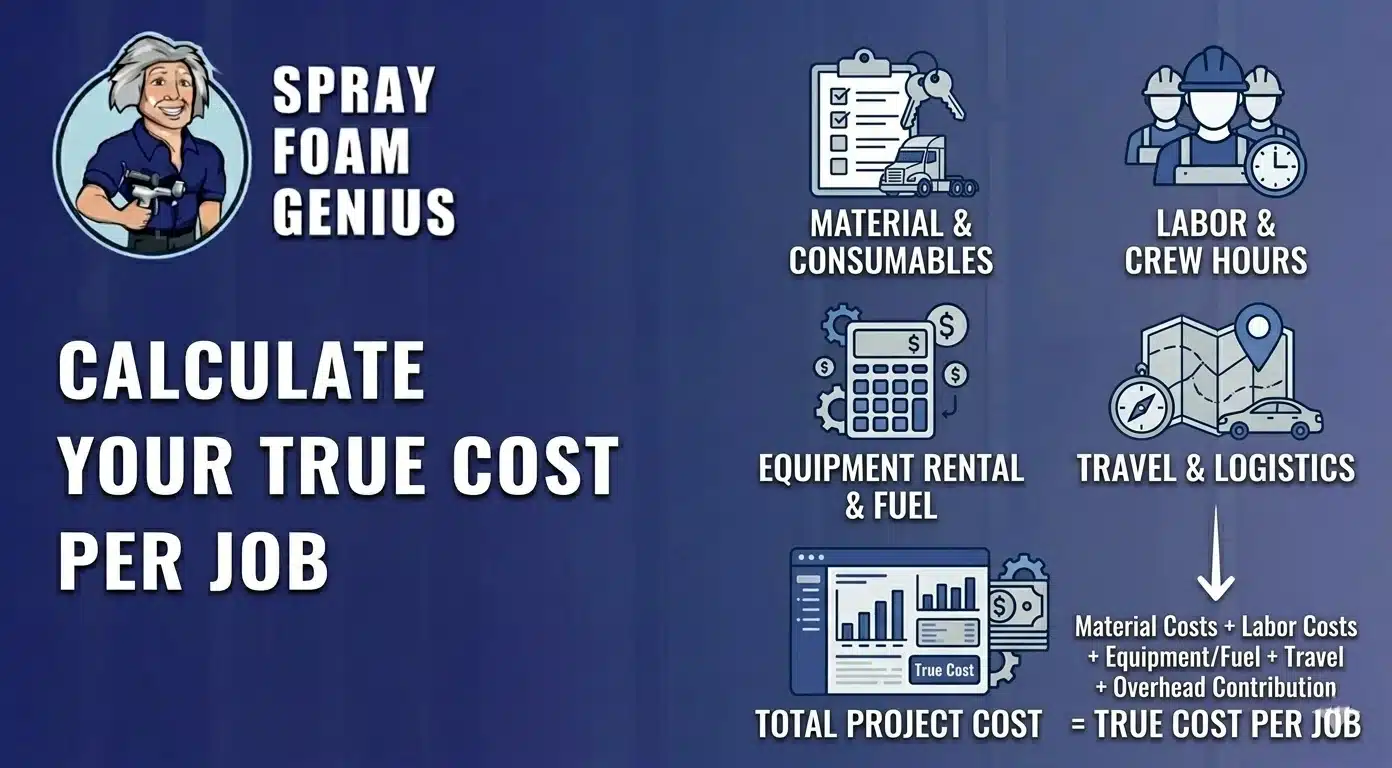
Cost per acquired job = total marketing and sales costs divided by the number of jobs closed in the same period.
Use a period long enough to be meaningful, usually a month or a quarter. If your sales cycle is long, match jobs to the spend that produced them as closely as you can, since a job closed this month may come from last month's lead.
Related reading: What Does Reputation Management Cost for Insulation Contractors?
What to Include
Most contractors undercount by looking only at ad spend. A true calculation includes every cost of getting the job:
- Marketing: Google Ads, Local Services Ads, Facebook ads, SEO or agency fees, lead service fees, website hosting and maintenance, listing fees and offline advertising.
- Tools: call tracking, CRM, reporting software and call answering services.
- Sales: sales rep salary or commissions, the time your estimators spend on estimates that do not close and the cost of travelling to appointments.
- Other acquisition costs: items such as vehicle branding, spread over the months they last.
Include the estimators' time spent on lost estimates too, since a poor close rate hides a real cost there.
A Worked Example
These are made-up figures to show the arithmetic. They are not benchmarks.
- Monthly marketing spend: $8,000
- Monthly sales and tool costs: $4,000
- Jobs closed: 12
True cost per job = $12,000 divided by 12 = $1,000. If the average gross profit on those jobs (after materials and labor) is well above $1,000, the marketing is paying for itself. If it is close to or below $1,000, something has to change, whether that is the close rate, the job mix, pricing or the channels you pay for.
Cost Per Lead vs Cost Per Job
Cost per lead (CPL) is total channel spend divided by leads. It is useful for judging how efficiently a channel produces inquiries. Cost per job (CPJ) divides by closed jobs, so it also reflects lead quality, response speed and how well your team sells. Track both: use CPL to run campaigns and CPJ to decide where the money should go.
Here is the difference in an example. Say you spend $4,000 and get 100 leads, which is $40 per lead. If only five become jobs, your cost per job is $800. Another channel might cost $100 per lead but close 20 out of 100 leads. That is $10,000 spent and a cost per job of $500, even though its cost per lead is higher. A lower cost per lead does not always mean a lower cost per job, and a higher cost per lead can still be profitable if those leads convert. Again, the numbers are invented to illustrate the idea.
Things CPL hides: unqualified or out-of-area leads, slow response, a weak estimate process, poor targeting and low trust. CPJ exposes them because it only counts what turned into work.
What Pushes Cost Per Job Up or Down
- Lead source: paid ads can deliver leads fast but cost more on an ongoing basis. SEO, a strong Google Business Profile and referrals can be cheaper over time, though they take longer to build and are never guaranteed.
- Close rate: if your team closes twice as many estimates, your cost per job roughly halves, with the same spend.
- Speed and follow-up: slow responses and no follow-up waste leads you already paid for.
- Lead quality: higher-intent searches usually convert better than broad or shared leads. See high-quality leads versus cheap leads.
- Service type and market: spray foam can have a higher job value but also more competition. Metro areas are typically costlier than small markets.
- Reputation: strong reviews and a trusted brand help leads say yes. Fewer objections mean fewer lost estimates.
- Average job value: upsells and bundled services spread acquisition cost across more revenue.
From Cost Per Job to Profit
Compare cost per job to gross profit per job, which is revenue minus materials, labor and direct job costs. A rough check: gross profit per job minus cost per job leaves what is left to cover overhead and owner pay. If that margin is thin or negative on a channel, you are buying jobs that do not pay.
Also think about repeat and referral value. A customer who sends friends or comes back for more work is worth more than the first job, but be careful not to assume it. Count it only when your records show it.
How to Track It
- Tag every lead with its source from the first contact. Ask callers how they found you and use call tracking numbers per channel.
- Record the outcome of every lead: booked, quoted, won, lost and why.
- Record job revenue and gross profit when each job closes.
- Each month, total costs by channel, divide by jobs won, and compare.
- Keep the same method every month so trends are fair.
Our guides on tracking marketing ROI and marketing KPIs to review monthly cover the setup in more detail.
Common Mistakes That Hide the Real Number
- Counting only ad spend and leaving out sales time, tools and fees.
- Not tracking missed calls and unqualified leads.
- Averaging all channels together, which hides the ones that lose money.
- Judging by cost per lead alone.
- Over-relying on paid ads with no organic or referral base.
- Treating all leads equally with no source tracking.
- Ignoring the lag between lead and closed job.
What Happens If You Do Not Know Your Number
Without a real cost per job you can overspend on ads that do not convert, think you are profitable when you are not, run into cash flow trouble and struggle to scale. Competitors who track it can bid more confidently, because they know what a job is worth to them.
To plan how much to spend based on your numbers, see how much to spend on insulation marketing.
Want Help Working Out Your Numbers?
If you would like help setting up lead tracking and calculating cost per job by channel, ask for a free marketing audit. Email info@sprayfoamgeniusmarketing.com or call 877-840-3626 (USA).
Frequently Asked Questions
What is a good cost per job for insulation contractors?
There is no universal figure. A good cost per job is one that leaves a healthy profit after the cost of materials, labor and overhead, and that depends on your job value, margins and market.
Should you include employee salaries in cost per job?
Yes. Sales salaries, commissions and the time estimators spend winning work are part of the true cost of acquiring a job.
Is cost per lead or cost per job more important?
Cost per job is the better measure of profitability, because it counts only what turned into revenue. Cost per lead is still useful for managing campaigns.
Does Google Ads raise or lower cost per job?
It depends on how well it is set up. Search ads can bring leads quickly, but they cost money each month, so they raise your cost if the leads do not close. Tracking, negative keywords and a strong landing page help keep cost per job in check.
How often should you calculate it?
Calculate it monthly and look at lead counts and response times weekly so you can spot problems early.
What is the fastest way to lower your cost per job?
Improve what happens after the lead arrives: respond fast, follow up consistently and strengthen your estimate process. Then fix tracking, cut channels that spend without booking, and invest in sources that compound, such as local SEO and reviews.