
Spray foam insulation cost is one of the stronger relative queries in a Google Trends look at spray foam searches in the United States (web search, past 12 months, checked October 31, 2026). That is a relative score, not a search count, and it is not a claim that interest is rising. Homeowners are already asking the price question. A cost page is how you answer it, screen the people who only wanted a number, and give the serious ones a way to ask for a real quote.
This post is for insulation and spray foam contractors. It is about how you talk about price, how you quote, and how you market on cost. It is not a price list for your market.
The only national range worth citing is someone else's, with a link
Angi's spray foam insulation cost guide, updated September 9, 2026, says the national average cost to install spray foam insulation is $2,888, based on 4,048 verified projects from Angi pros. The same page says most homeowners pay between $1,455 and $4,336, or $0.60 to $3.10 per board foot. It puts installed open-cell foam at about $0.60 to $1.60 per board foot and closed-cell foam at about $1.30 to $3.10 per board foot. It also says a typical installed price runs about $1 to $5 per square foot, with new builds around $1 to $4 per square foot and existing homes around $3 to $5 per square foot.
Those figures are Angi's national picture from Angi pros. They are not your price. They are not a number to paste on your site as if you had measured your towns. If you mention them, link that page, name Angi, and say your quote depends on the building. If you do not want a national average on the page at all, skip the dollars and explain the factors below. Do not invent a range to fill the gap.
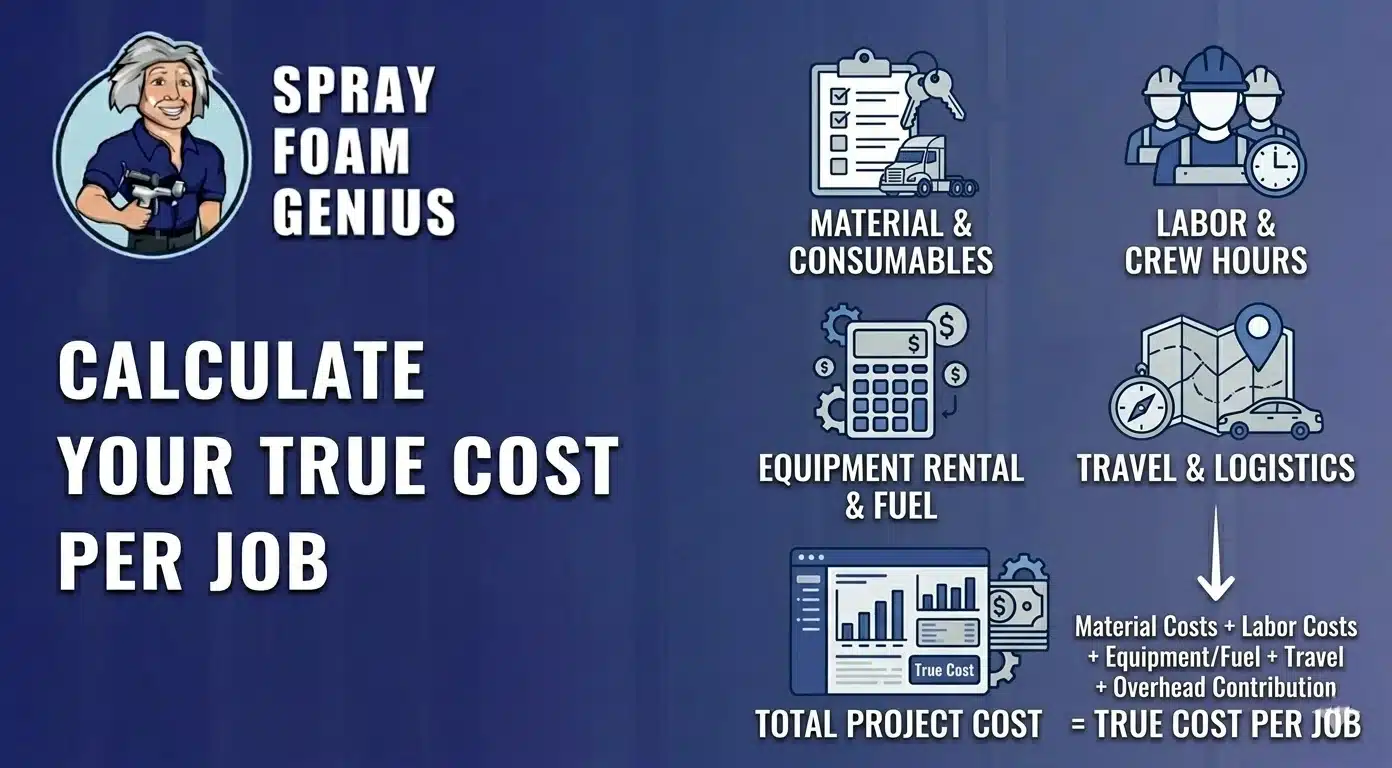
Related reading: How to Calculate Your True Cost Per Acquired Job as an Insulation Contractor
Cost factors to explain before you name a number
Homeowners compare totals. You get a fair comparison only when both quotes describe the same work. On the phone, on the cost page, and on the proposal, walk through what moves the price.
- Open cell or closed cell, and why that product fits that part of the building.
- Thickness and coverage, not a brand name by itself.
- How much area, and whether you are pricing square feet or board feet. Say which unit you use so their other quote is in the same unit.
- New construction or an existing building. Closed walls, old insulation, and drywall repair are a different job from an open frame.
- Where the foam goes: attic, roof deck, walls, crawl space, rim joist, basement, or a metal building.
- Access, prep, masking, and cleanup.
- How far the job is from your shop, and whether the crew can finish it in one trip.
- What the quote includes, and what is extra. Removal, barriers, drywall, and electrical moves should not hide inside a single line.
If you have not seen the building, say the number is not a quote yet. Photos help. A site visit is better when access is unclear.
How to talk about price on the phone
The caller often opens with "what do you charge a square foot?" A square-foot number with no scope is how you get compared to a kit and to a contractor who priced a different assembly.
- Ask what they want insulated, whether the building is new or existing, and which town the job is in.
- Ask whether they have another quote, and what that quote includes. You are checking scope, not badmouthing the other company.
- Explain one or two factors that move your number. Thickness and open cell versus closed cell are usually enough on a first call.
- If you give a range, it should be your range for that kind of job, from work you have actually priced, or a named public source you link. Do not borrow Angi's average and call it your ballpark.
- Offer the next step: photos, a visit, or a written proposal. The proposal guide is the follow-through.
People who only wanted a kit price will often end the call. That is a useful outcome. The call did its job.
What a cost page should include
One page is enough. Title it for the search, in your words: spray foam insulation cost, plus the area you serve. Then write it for a homeowner who is comparing you with a kit and with two other contractors.
- Who the page is for, and the towns you actually work in.
- The factors above, in plain language.
- Open cell and closed cell, as a choice you make for the assembly, not as a slogan.
- Photos from your jobs. Label the town if you can stand behind it.
- A way to ask for a quote: a form, a phone number, or both. Ask for the address or town, the part of the building, and whether it is new or existing.
- If a calculator collects those details, the number it shows has to come from your pricing rules, or the page has to say the result is a starting point and the quote comes after you see the job. Our post on a spray foam quote calculator covers the form. It does not pick your prices.
Do not fill the page with a table of prices you have not priced. A thin page that tells the truth will age better than a specific table you cannot defend.
How to market on cost without becoming the cheap option
The cost page answers the search. It does not have to win a race to the lowest total. When two quotes look like the same product, the cheaper one wins. When the homeowner can see thickness, foam type, and what is included, price is one line among several. That is the same point in why contractors lose jobs to cheaper competitors.
Kit shoppers are part of this, not a separate audience. Send them to how contractors compete with DIY spray foam kits rather than arguing with a can in the middle of your cost page.
Be careful with savings. ENERGY STAR says homeowners can save an average of 15% on heating and cooling costs, or 11% on total energy costs, by air sealing and adding insulation. That is an average estimate for air sealing and insulation, not a promise that your spray foam job will save a set amount on a single house. Do not turn it into a payback period you have not calculated for that building.
In ads, spray foam insulation cost can be a keyword you want, because the person is asking about a professional price. Pair it with the cost page, not with the homepage. Keep kit and DIY terms as negatives on that campaign, the way the Google Ads framework describes.
FAQs
Should I publish my price per square foot?
Only if the number is yours, the unit is labeled, and the page says what it includes. A bare square-foot price gets compared to quotes that are not the same job. Many contractors are better off explaining the factors and quoting after they know the building.
Can I use Angi's average on my website?
You can mention it if you name Angi, link the guide, and say it is a national figure, not your quote. Do not trim the number or present it as the price in your city.
Do I need a quote calculator?
A calculator helps when it collects the details you need and the math is your math. A calculator that prints a national average as if it were a bid will create calls you then have to walk back.
What if the caller says I am higher than the other quote?
Ask what the other quote includes. Thickness, foam type, removal, and drywall are the usual gaps. If the scopes match and you are higher, say so and explain the difference you can actually defend. Do not invent a discount to win the call.
Should the cost page target one city?
If you serve several towns, the cost explanation can live once, with the towns named where you really work. Separate city pages are for local proof, not for pasting the same price article under a new city name. See how to target multiple service areas.
Want a second look at the cost page?
Book a call and we will look at how your site answers the price question today, and whether the next step for a visitor is a real quote. We work month to month, so there is no long-term contract to sign.